Hacker News new | ask | show | jobs
by gbog 3174 days ago
North Korea is a good inverting mirror of our modern societies, and there is always something of inspiration in the diametrically opposite. I, for one, would welcome a brandless packaging of most products, where a pack of coffee would just be a dark brown folded paper with "coffee" written on it. Same with sugar, yogurt, butter, etc. We are brainwashed into believing that sugar X is different from sugar Y but it is the same thing with different packaging, often produced in the same lines in the same factories.

Muji is a successful Japanese brandless shop where I get my clothes. We have generics drugs that are less expensive. I think a brandless Walmart would be successful too, for those who refuse to be brainwashed.

7 comments

> brandless packaging

I stayed in Yanggakdo International Hotel on Yanggak Island in the river Taedong in Pyongyang on a tour, and there were two restaurants, and they were called "Restaurant 1" and "Restaurant 2". I found that quite refreshing.

Where they any different or just overflow?
They looked pretty similar, and we had set meals, so don't know whether their a-la-carte menu was different...
"Muji is a successful Japanese brandless shop where I get my clothes. We have generics drugs that are less expensive. I think a brandless Walmart would be successful too, for those who refuse to be brainwashed."

This is one of the appeals of Marks & Spencer, who are one of the last survivors of the old British department stores. They sell clothes and food, all almost entirely their own-brand products, which are not cheap but are good quality. You can go into an M&S and buy essentials just by collecting the things on your list, without ever having to choose between brands.

Muji is a pretty fun case in irony. No brand markings but super obvious that things come from it due to its unique style.
Maye it is "unique" but then just because it is the simplest design possible. T-shirts are just T-shirts with nothing special, even no "tickets" (the shitty piece of cloth with all the useless warning signs that hurts the skin and serve no purpose).
In the US in the 70s-80s this used to be a thing:

http://gbnfgroceries.blogspot.com/2014/01/from-misc-foods-ai...

There were actually a few no-brand brands from supermarket chains like this that I can recall.

I don't know if it's the case in other countries, but in France, most supermarket chains have their own "budget" brand which are generally quite explicit/generic in term of packaging.

Here is the label of the tin I ate yesterday for example:

https://image.ibb.co/kCxA0b/IMG_20171008_094309.jpg

no product name, just the composition of it.

Even the color are meant to associate to the composition (green -> little peas, pink/red -> bacon, white -> onions, orange -> carrots).

And a realistic photo of what to expect.

Does it change colors for each product? I would never consider that one as a budget brand by looking at it.

In Sweden (etc, I suppose) we have Euroshopper which is as minimal as it gets. It's instantly recognisable in each isle.

Example http://files2.coloribus.com/files/adsarchive/part_1664/16649...

Australia has Black & Gold brand, not specific to a certain store but always low priced and bland packaging that is identical for every product (yellow box, black text).

http://www.lossofprivacy.com/wp-content/uploads/2014/01/abou...

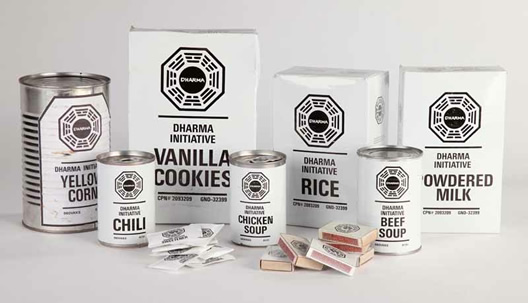
Still not as utilitarian as the Dharma Initiative food packaging in the TV show Lost, though:

https://cdn2.vox-cdn.com/uploads/chorus_asset/file/1313454/l...

Walmart tried this with the 'Price First' brand, I don't watch tv but I pointed it out to my wife and she said it reminds her of 'Lost'
> I don't know if it's the case in other countries, but in France, most supermarket chains have their own "budget" brand which are generally quite explicit/generic in term of packaging.

Very common in the United States as stores don't license the brand names and so have to come up with a non-trademarked name.

In Chile we have the acuenta brand, whose packages are almost as plain as you can get: https://i.imgur.com/DeH1KR4.png
The ironic thing about Muji is everything I come across there costs 50-100% more than branded products I see elsewhere. Single serving packets of curry for 800 yen? Basic shirts for 3000 yen? No thanks.
I live in Beijing and there, for the few I know (because I never shop elsewhere), clothes in Muji are good quality, simple functional design, and relatively cheap.
This is still a thing in U.S. grocery stores, it's just that they have "store brand" generic products. For instance in Costco they sell "Kirkland brand". These generics are usually a good deal in terms of quality for price.
Canada has this, with amazing stark-yellow packaging and big black Helvetica nouns:

https://en.wikipedia.org/wiki/No_Name_(brand)