Hacker News new | ask | show | jobs
by grumpycanuck 5837 days ago
I'm sure I'm going to get flamed and/or down-modded for taking the contrarian postion on this. Shame on me for choosing to accept the challenge of being an adult in our modern society.

If you think that going to the bank, doing your laundry, and answering emails in a timely manner is some sort of accomplishment or difficult, then you need to take a look in the mirror and realize that you are looking at the problem. It's called "being responsible for yourself". Tough concept for many people apparently.

I'm 39, been married for 12 years, and have two kids. I choose to be responsible because my kids can't do their own laundry or buy their own groceries. These are 5 and 10 year-old kids, not adults. Am I perfectly organized? Not even close. But I don't sit here and justify my failures like the girl who writes that blog. Yoda was right: do or do not, kids. There is no try.

Before you get all mad, I understand there are people who have mental or physical illnesses that makes doing these everyday, routine chores difficult. These people have my sympathies and understanding. The rest of us have no excuse. Yes, I include myself in "the rest of us."

Yes, much of every day life is not fun. I don't particular enjoy being a responsible adult, but if the alternative is the kind of ranting, over-the-top situations in that blog post (and on that blog in general), I'll take being a responsible adult. Grocery shopping is hard? Responding to emails is hard?!? Going to the bank is hard?!?!? This person who lives on the internet cannot order groceries online, answer emails or pay their bills online? Oh, that's right, they can never be an adult. Because it's too hard or something. Okay, back to Facebook and rating pictures of cute kittens. I'm sure there is a "responsible adult" out there who "cleans up" after this person. Resenting it while doing it too, I'm sure.

Don't blame it on TV or the internet or the poor diet North Americans eat or the "bureaucracy involved in modern city life". Millions of other people are in the same circumstances or worse and somehow manage to rise above it all, and have fridges with food, clean clothes, and money in their bank account. And they do it all by themselves too.

11 comments

"But I don't sit here and justify my failures like the girl who writes that blog."

I read absolutely no self justifying in that blog. Just brutally honest, self deprecating humor.

I also feel that this brutal honesty about herself makes it more likely, not less, that she will eventually conquer this adult thing.

It's interesting, because you actually answered to a fun, insightful, and self-criticizing post that actually made me smile, with a patronizing, boring and full of stereotypes post that made me want to shoot myself while watching at a boring american movie.

EDIT : I thought i would develop a bit on my post because it's really a borderline flame as is. What i mean is that, okay we're all gonna try hard and be adults, even the author of this post eventually, and maybe he is, because for all i can tell about the tone of the post, it may all be fictionnal.

The OP did a brilliant job (IMHO) in capturing this moment of loneliness you get when you have to process this seemingly endless stream of borderline useless daily tasks, that constitutes the basic things you've got to do in modern society, and hence the infrastructure of being an adult responsible person, and you somehow can't seem to manage it. It was very well done and quite humoristic if you can't tell.

On the other hand, you're just serving a bunch of empty moralizations that everybody already interned, OP included. In short, you're totally missing the point and tone of the post from what i can tell.

Maybe I know the wrong people, but the people I know who actually manage it best seem to be in stable relationships with a more old-school division of responsibility (though sometimes the traditional gender roles are 100% flipped). Basically, one person is in charge of finding a way to bring in money, and the other person is in charge of groceries/bills/bank/etc.--- and, importantly, each can for the most part assume that the other side of the equation isn't their responsibility, so the money-earner can assume that daily life magically stays on track, while the daily-life-maintainer can assume that money magically appears.
Me and the missus don't split things up that way, but I can see how it would work. However, you did hit the nail on the head: defining who is supposed to do what means you don't have to spend all sorts of time worrying about whether things are getting done by the other person. Because if they don't, it's pretty obvious. ;)
I'm sure there is a "responsible adult" out there who "cleans up" after this person. Resenting it while doing it too, I'm sure.

This isn't the impression I got. She gets her stuff done, goes to the bank and responds to emails, but not in a timely and organised way and she's unhappy with that. You're right, this is a very lucky and privileged situation in the grand scheme of things, but her situation is not the same as yours.

What do you think would happen if she had a couple of kids? Would she a) Spend all day on Facebook and let them starve or b) Become a more organised person through her new responsibility?

Also bear in mind (from the FAQ): Yes. Aside from the odd exaggeration for comic effect, the vast majority of my stories are completely true to life.

I would test this theory on a pet first.
I have no idea if she would become more organized as a result of having a couple of kids.

My observations of other people who have had kids leads me to conclude that disorganized single people rarely become organized parents.

" Grocery shopping is hard? Responding to emails is hard?!? Going to the bank is hard?!?!?"

For someone with ADHD, it can be. The author mentions in her contact information that she does have ADHD so your situation probably doesn't compare with her's.

As someone who has had 4 younger siblings diagnosed with ADHD, and who has self-diagnosed with ADHD, I can assure you it is highly overrated as a mental illness. A cousin of mine has hyper-encephalitis with major retardation; that's a mental illness.

*I don't mean to say what you said is irrelevant... having ADHD definitely makes it harder to handle the day-to-day chores... but it doesn't put you in a category where you can't relate to other people about these issues. ADHD is more like a shift in cognition strategy than a genuine disability.

While I agree that there are far worse conditions out there, I'd like to point out that ADHD falls in a spectrum; while for many people it's a quirk that can go undiagnosed for their entire lives, for some it's an almost crippling disorder, especially when combined with common comorbidities like depression and social anxiety.
"but it doesn't put you in a category where you can't relate to other people about these issues."

I hope that it I didn't imply that it did.

Just accepting the chores doesn't cut it. As engineers, we can also think about possible solutions. For example, I think washing machines have been one of the truly great advancements of civilization. In former times it was probably impossible to manage one household alone (hence also a higher importance put on marriage).

Banking doesn't seem that much of an issue anymore, with online banking. Maybe shopping could be replaced by ordering online, too. Cleaning is tricky - I still don't have a cleaning lady/gent, also because I worry about giving up some privacy.

Another way to ease the cleaning problem is to get a smaller flat and less stuff. (I don't think Roombas help that much yet, or do they?).

Contrarian? Its humor, not philosophy. Lighten up.
I don't think you're saying anything that most of the people described don't already know.
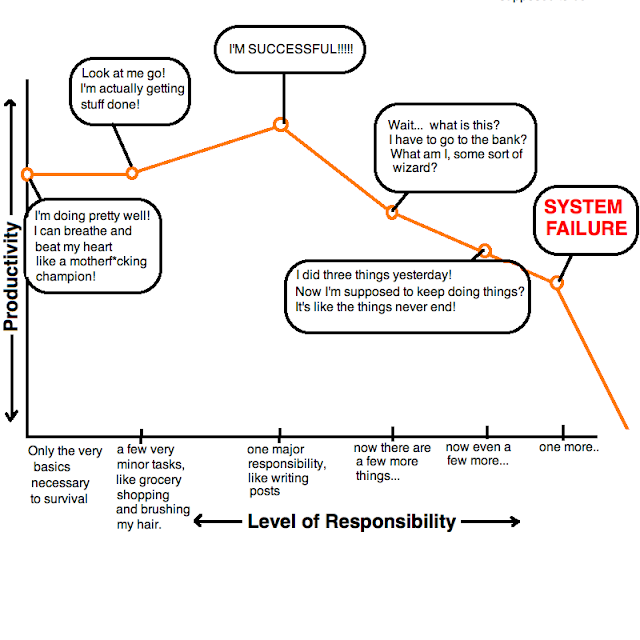
I think the author understands that it is about responsibility and makes no excuses: http://1.bp.blogspot.com/_D_Z-D2tzi14/TBpWM3wxI1I/AAAAAAAADF...
Oh no, I understand what the author says. I just disagree with her views on it. There is a huge difference between "I am not being responsible but want to be, tell me how" and "I take on too much stuff and then give up to surf the internet like a squirrel on PCP".
One phrasing is entertaining, the other isn't. Do you have the same reaction to standup comics?
You may be reading a bit too much into a blog post. But otherwise I agree..
You seem to have a model of the human brain as a machine with a moral selector. If it is set to "good", then the morally-correct neural programs are automatically activated, producing a moral outcome, or at least a valiant attempt interrupted by bad luck.

"If you think that going to the bank, doing your laundry, and answering emails in a timely manner is some sort of accomplishment or difficult, ..."

In reality, the actions of the human brain appear to be directed by a complicated network of multiple pattern matchers that search for salient input. When one of them recognizes a pattern with sufficient intensity, it produces an output that directs attention and activity toward it. These pattern matchers vary across the population. Some people are entranced by music, some by tidiness, some by praise, some by chasing tail, some by financial work that they have been told needs to be done, etc. etc. etc.

There appear to be pattern matchers that work on thought itself, sustaining attention to an idea so that it spontaneously stays somewhere near the focus of attention with little perceived effort. This facility appears to vary a lot between people. Some people get stuck (obsessive-compulsive disorder), most folks remember the more important things most of the time, and for some people holding onto a thought is like trying to catch smoke. Studies of twins separated at birth show that this facility is about as heritable as adult height.

"Going to the bank is hard?!?!?"

Going is easy, but for some people it simply does not spontaneously float into the focus of attention. If the police aren't about the come asking awkward questions, if the person has enough folding money for food, and so forth, then it readily slips out their conscious mind. They'd rather it did not, but a weak meta-mind cannot readily fix itself with meta-thinking.

I fall on the easily-distracted-by-shiny-objects end of the spectrum. Somewhere around here I have a $50 refund check that I've had for ages. The cops don't care, nothing gets turned off if I ignore it, so it keeps falling off the radar. It will probably continue to be forgotten until it has more value as a collectible. One of my descendants will euphorically sell it for Federation credits and then promptly misplace their credit chip. They will feel really guilty, but this will not help them find their credit chip.

"I choose to be responsible because my kids can't do their own laundry or buy their own groceries."

Try choosing to be irresponsible for three straight weeks. Your kids will not be harmed by a few weeks of nachos and slightly-dirty clothes. I bet you couldn't do it. The salience detector in your brain would scream and you would be compelled to obsessively fix it, regardless of your previous "choice" to prove you could, and your brain's storyteller would then cook up a story about how you really meant to do laundry all along.

That line of thinking is well-suited to justify one's own failings while minimizing the successes of others. While I cannot argue against determinism--philosophy isn't my line of expertise--I don't think it is a useful model to go through life with. Call me old fashioned, but even as an atheist I've found having a "moral" view of the universe is far more productive. Personally it is more motivating and liberating to believe in free-will than to believe one is merely an automaton... true or not. Of course you might say I'm compelled to believe in such a way... so I guess we'll have to agree to disagree. :)
One could choose to use it to excuse one's failings but that doesn't make the argument invalid.

You have to understand your enemy. I know I am incredibly absent-minded. I've learnt through such reading that this is not a failing of willpower or discipline so all the people crying 'just try harder, stop being lazy' are wrong. These are not solutions to the problem.

Of course that doesn't mean I give up on being an adult. I just find solutions that don't revolve around some Victorian working ethic; 'hard work is the solution to all ills'

Some people will always fail to reach some goal the same way some may naturally gravitate to it whereas another may need a little work and yet another a lot of work to get there be the issue beating addiction or paying your bills on time.

"Free will" is not some state of consciousness that exists completely isolated from your biological processes, experiences etc. And, quite importantly, if something like it is assumed to exist, it will not be the same level of "free" for everyone.

That said, it is most certainly worth trying to reform one's bad habits. It is just not necessarily fair to make a moral judgment dependent on their success. Naturally this then extends to the bad habit of making moral judgments so I guess that gets us nowhere, which is pretty much how the universe works.

I don't understand why you post that having a 'moral' view is something that atheists don't normally do.

Morality and ethics do not come from religion, they were only absorbed by religion the way bacteria absorbs advantageous genes.

"Call me old fashioned, but even as an atheist I've found having a 'moral' view of the universe is far more productive."

Morality certainly is a useful approximation for rapidly predicting the effects of actions. My point is that it is not a useful basis for hacking the underlying machinery to take different actions.

Here, Here!

And I'm not a youngin'

All this routine Bullshit is "easy" if you turn you brain off. If you've alive, noticing things, going to the bank is torture, idiocy, ridiculous. Yes, young people hate this stuff long after they gain the skills to deal with it because they're brains aren't turned-off yet. And, yes, I'm proud to say I hate laundry, going to the bank, routine, all of it... I'm by no mean young but I'm to still be alive.

"You seem to have a model of the human brain as a machine with a moral selector. If it is set to "good", then the morally-correct neural programs are automatically activated, producing a moral outcome, or at least a valiant attempt interrupted by bad luck."

I don't believe in any of that, but thanks for jumping to conclusions.

This was never about morals to me, it's about someone trying to find a rationalization for a certain set of behaviours that they were comfortable repeating over and over again. I don't think the person who wrote that blog post is a "good" or "bad" person. Saying "oh well, this is the way I am" is not a solution to a problem. It's an excuse. Please also re-read what I said about people with medical conditions (including and not limited to mental illness) too.

I also don't believe that people are lucky or unlucky by nature, shit happens all the time that you cannot control. This isn't about morals at all, it's about getting shit done that needs to get done.

"Try choosing to be irresponsible for three straight weeks. Your kids will not be harmed by a few weeks of nachos and slightly-dirty clothes. I bet you couldn't do it. The salience detector in your brain would scream and you would be compelled to obsessively fix it, regardless of your previous "choice" to prove you could, and your brain's storyteller would then cook up a story about how you really meant to do laundry all along."

That actually made me laugh out loud. I don't do the laundry much (wife dislikes my choices on separating clothes into categories for washing) and I'm down for nachos a few times a week but the kids themselves don't want that. I do get my kids breakfast (always ask them what they want, and give it to them without being preachy or "that is not a breakfast food!" type of attitude), and make lunches for them while my wife gets ready for work.

I also let them dress themselves, and again don't give them the "those clothes are totally inappropriate!" speech either. Bet that surprises you.

The picture of me as some sort of obsessed parent who can't bring themselves to serve their kids nachos or send them to school without crisply-pressed clothes is enough to make anyone who knows me and reads this post laugh.

It's ironic that you have made the same snap judgements about me that I have made about the blog poster. For that I thank you for pointing it out.

  Going is easy, but for some people it simply does not spontaneously float
  into the focus of attention. If the police aren't about the come asking
  awkward questions, [..]
Ah, but there you have it. Given the right incentive, it suddenly isn't so hard to do or remember things that 'should' be done. These people complain that they are 'just incapable' of remembering certain things, but if they were really 'just incapable' of that, then they wouldn't be able to do it in the face of imminent eviction, arrest or death either.

This shows that in fact, the "I'm just not capable" line is just a smokescreen: an easy-to-give, hard-to-criticize excuse that saves them from having to do soul searching and give the true reason: they have chosen not to care and they have chosen not to go through the trouble of trying to remember/do this stuff. Having to defend a choice that goes contrary to societies expectations is much harder than defending a claimed 'incapability'.

So far, so good. There isn't really anything bad about that choice, though I wish people would just own up to it. What's a problem, is that people that don't admit, even to themselves, that they made this choice, tend to become lazy. Letting bills accumulate, feeding yourself badly, dressing in such a way that friends don't want to hang out with you because you smell: these are things that make your life worse. Actually going through the trouble to prevent it from happening would make them happier. People tend to conflate the choice for an alternative lifestyle with laziness, precisely because they tend to go hand-in-hand.

I bet these people have a hard time keeping relationships going. I've never met a girl that didn't feel strongly about something that I couldn't care less about. An example: I never drained the sink after washing up. It was just something that always slipped my mind. However, my girlfriend hates having to stick her hand into that filthy, cold water the next morning to pull the plug and she complained about that a few times. I also hate that when I have to do it, but it kept slipping my mind. At some point, I simply chose to remember it and ever since then: no problem. And you know what, it saves me the annoyance of cold, filthy water as well. I changed behavior that I had for years and that I always said 'I was just incapable of remembering'.

"I never drained the sink after washing up. It was just something that always slipped my mind."

This example is exactly what I'm talking about. The mind that was slipping is called working memory by the brain scientists. It seems to be the seat of focused attention, and is attached to the brain's logic and reasoning circuits.

"At some point, I simply chose to remember it and ever since then: no problem."

Habits and actions like this are stored by procedural memory. It seems to use different brain circuits and signals than working memory, so one can be strong while the other is weak. Once it learns how to do a process, it tends to be tenacious about holding onto the memory. The process tends to be triggered by location (kitchen facing the sink) and circumstance (washing up), without much involvement of conscious thought or working memory. It is the seat of habit and addiction.

Procedural memory is why there are so many funny true stories about absent-minded professors who have moved to a new house (generally involving amusing the new owners, then getting hopelessly lost -- repeatedly).

"I changed behavior that I had for years and that I always said 'I was just incapable of remembering'."

Indeed. But years of failure followed by sudden success is not consistent with a rational decision and a well-ordered plan.

"Having to defend a choice that goes contrary to societies expectations is much harder than defending a claimed 'incapability'."

I think it goes a lot deeper than simple face saving or effort avoidance. (Although there's plenty of that!) The brain seems to have a machine that constantly makes up cause-and-effect stories to explain events, but the logic is usually pretty superficial. For human events, it tends to latch on to choice as the cause. "She nearly hit me because she chose to recklessly answer her cell phone while driving." In reality, the ringtone activated her answering procedure, hijacking her brain. Her fault was not making a decision to be reckless (an act of commission), but rather failing to build a stop-and-think-this-through decision point into the answering procedure (an act of omission). The thing is, her brain probably makes up the same silly story, and she will not improve if she believes it.

There are spectacular examples of this in the brain damage literature. If you ask certain paralysis patients to hand you a glass of water, and then ask them why they didn't, they will tell you the most wonderful malarkey about how they just didn't want to. Or how they don't want to strain their shoulder. Or how they are teaching you to take care of your own glass of water. The OMG-arm-refusing-to-work signal just isn't making it through, but their storyteller is running just fine, thanks.

"I bet these people have a hard time keeping relationships going."

The ADHD divorce and family chaos rate is said to be appalling.

The theory of the brain presented in your third and fourth paragraph interests me. Can you recommend a book, wikipedia article, or white paper on the subject?
Oliver Sacks and V. S. Ramachandran have written several good books about the functional organization of the human brain. YouTube has several Ramachandran presentations, and those will have links to many other interesting videos. They are neurologists, so they excel at showing what happens when certain tiny regions of the brain are damaged.

Scott Adams (Mr. Dilbert) writes about losing his ability to speak, then regaining it using rhyming and singing. http://www.wired.com/medtech/health/magazine/17-08/ff_adams?...

The attention deficit disorder literation has a lot about attention and focus. Edward Hallowell and John Ratey's books are particulary readable; their Delivered From Distraction is a standard work.

Scientists have been mapping the connections between various "machines" in the brain using an MRI technique. It looks remarkably like a network of computers, with different modules for different functional tasks. http://www.sciencedaily.com/releases/2008/06/080630200947.ht... http://www.technologyreview.com/Biotech/21042/?a=f

This is exactly the kind of reply I was hoping for. Much appreciated.
Almost forgot: Mihaly Csikszentmihalyi has written extensively about the "flow" state of mind that people seem to find particular satisfying and attractive.
I know it's a shot in the dark, I'm also guessing that you don't have kids of your own. If you did, you would understand wanting the best for your kids, not the minimum.