Currently the shortest LGW-CDG flight is 1h. There is LCY-CDG lasting 1h 20m. For both cities it takes 30 - 60m to get to the airport from central location and you should be there at least 1h before the departure (for a total of 2-3h non-flight time). This makes total travel 3h - 4h30m.
For comparison, the fastest train is 2h 25m. I guess you need to travel to and from the train station too, but it's definitely more central (2x15 min) and you can easily hop on train even five minutes before the departure - although I usually plan at least another 15 min buffer. That is a total of a little over 3 hours.
I don't pretend to know enough about economy of future trains vs future electric flights, but it looks like short distances will always be a tough sell for airplanes. Personally I also find trains more comfortable and I was never given a free massage for carrying scissors in my pocket when boarding one.
Not to mention that taking the train between London and Paris is actually very pleasant, unlike taking a flight. When I worked in London I often used to go to Paris over the weekend, and it felt so luxurious to be able to wake up in Paris on Monday morning and be at my desk just after 9am in London (due to the time difference). The time on the train is all quality time that you can spend working, reading or eating a nice meal.
I do the same between Paris and Essen in Germany. There is a direct Thalys train connection. Door to door, it takes me the exact same time to reach Paris La Défense with the train as with flying from Düsseldorf. In the Thalys I have a good meal and place to work productively on my code or simply relax and read a good book.
The better idea for the first electric flight is probably LCY-AMS. It's a 35-40 min flight but there's no alternative to it (train 4+ hours, ship 8+ hours). There's a lot of demand for that route, you have more than 15 flights per day across all London airports.
The ferry is OK if you're travelling overnight, I've done it a couple of times.
It's possible to buy a train ticket which includes the ferry, and trains at both ends. (e.g London to Rotterdam.) The ferry itself is from Harwich to the Hook of Holland.
UK border security. On Eurostar journeys all border checks are done at the departure station, and only Paris, Brussels and Lille have the facilities for that. That said, it should be coming this year.
Interesting. I assumed there was one! I regularly take the train between Berlin and Amsterdam and it's awesome. door-to-door it's actually only slightly longer than a flight, but so much more comfortable. I usually get either a ton of work done, or I relax with a movie in the restaurant area. Flying, on the other hand, is about 50% just waiting in line and/or being uncomfortable in some way.
In the US, I travel between Boston and New York City fairly regularly and its the same deal. Even with the less frequent and relatively slow US trains, its still faster because the transit is city-center to city-center.
Definitely agree with this, although I'm not sure where you get the '5 minutes' before departure for the trains. The only train between the two is the Eurostar and you need a minimum of 30 mins. The Thalys was exactly this '5 minutes' before between other European cities, although I think this has been slowed down because of security.
Never-the-less, taking the train is wonderful. It is a much more 'natural' travelling experience in that you're not going to some artificial out-of-city place.
In terms of pleasure of travelling, St. Pancras is a joy to behold, a beautiful building that has been wonderfully converted for use of the Eurostar.
Also anecdotal evidence, but I've struck up conversations multiple times on the Eurostar that lasted the entire journey and even turned into friendships after, but never talked to someone on a flight.
When you take the Eurostar, you have to go through border controls, so you have to been there 30 minutes or 1 hour earlier. (Probably because London is not in the Schengen area)
30 minutes is the cut-off for the non-business tickets; the business tickets have a 10 minute cut-off. (That said, they're not always totally strict with this, especially if it's quiet.)
>short distances will always be a tough sell for airplanes
Glancing at Skyscanner for this Sunday there are about 35 flights a day from London to Paris starting from £39 vs 14 trains starting from £151 single. The flights look like they are doing ok.
What you're saying. The only reason to take a plane vs taking a train for this distance is the price. Usually planes are way cheaper. But the hassle of taking a plane is really making it a tough sell as you say.
Train tickets are anywhere between 60 and 300 pounds for this route. The cheapest plane tickets for the same route I've found were 80 pounds and there is no upper limit. I don't see much difference in price to be honest (+ getting to the airport is usually way more expensive).
I did a quick search for both April and June, and found the prices very similar. EasyJet is cheaper when buying well in advance, but it's not a massive difference.
Of course, budget airlines will also take you all over Europe for low prices. But for the narrow case of just London-Paris, the Eurostar is competitive, which is quite a bit cheaper than I'd remembered.
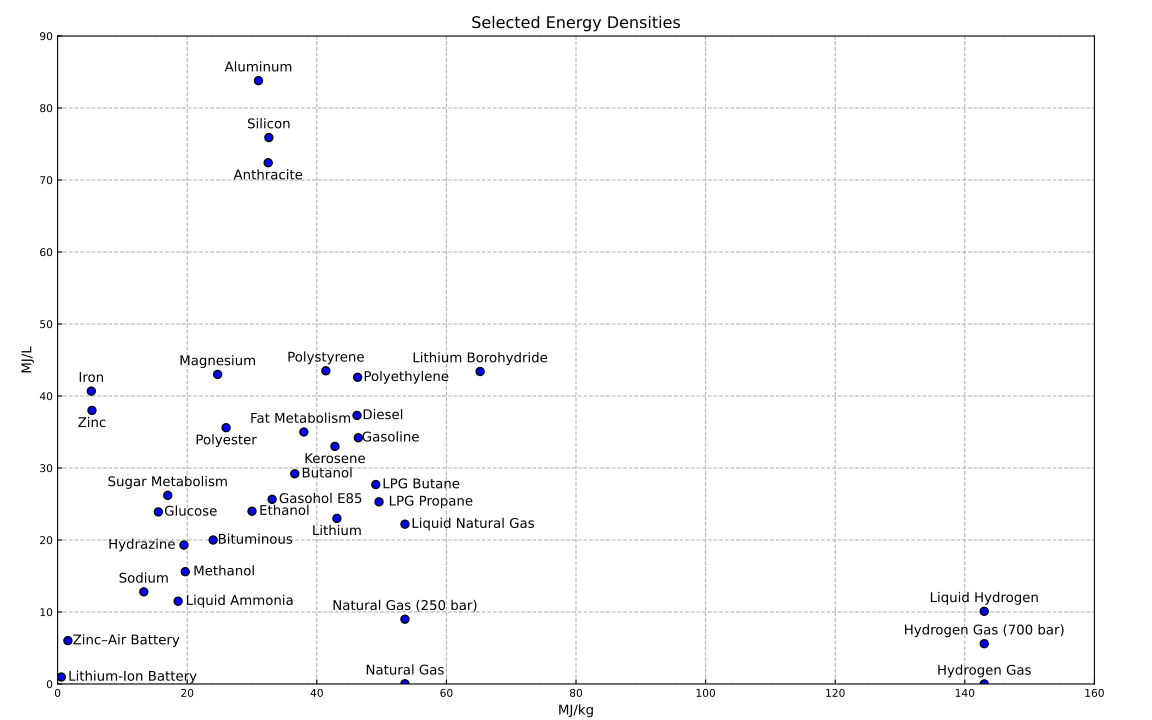
I'm not at the forefront of this field so maybe I missed some great advances in battery technology or airplane efficiency, but how could this possible work when the energy density of a battery (.3-.9 MJ/kg) is 50x less than that of jet fuel (46 MJ/kg)[1]? Or is that simply enough for (very) short haul flights?
That's correct, but note that an electric motor is about twice as efficient as a combustion engine, reducing the factor to about 25x (at least ideally). Typical medium range aircraft burn about 3 kg fuel per km [1], so to fly 1000 km you would need about 3 * 25 * 1000 kg = 75 tonnes of batteries. This should be in the ballpark of what we can pack into an aircraft already, but I guess at least another 2x improvement is needed to make it economical (we want to haul some useful payload, not just the batteries).
There are other considerations, though... The thought of a Li fire on board an aircraft is something that would keep me awake nights.
I'd guess that anybody wanting to put Li technology batteries aboard aircraft is likely to spend the next 10 years jumping through regulatory hoops, so unless rechargeable battery technology is "ready to deploy" right now on aircraft, I don't see any way this is happening within a decade.
Jet fuel isn't very flammable unless it's atomized or vaporized, something which only happens in the engine. And it's pretty straightforward to extinguish an engine fire, and all aircraft engines have systems to do this.
Trivia: there was about as much chemical energy in the fuel of either Boeing 767 that struck the twin towers as the gravitational potential energy released by the towers collapsing.
What's the turnaround for the aircraft though? If they can't turn around an aircraft in 15-30 min, we'll need more aircraft or prices will skyrocket (no pun).
Any sensible proposal for electric systems for commercial aircraft is going to aim for batteries to be safely swappable in 10-15 minutes. (Though they can still make delays from unexpected diversions to airports without a stock of batteries worse)
Hmmm... I wonder. Let's say they design the aircraft around an existing battery (size/weight). If later technology allows for a lighter battery, would they they have to add the weight back in order to keep the cg correct?
And then charge overnight and be used as energy storage for the time they're not in use. As flight times are very predictable, they should be a good use case for battery storage.
Supercapacitors could solve that, but unfortunately they currently have much less density even than batteries. Apparently graphene supercaps may solve that, but not at the moment.
Yes the idea for this will be v. short haul for now which is why they talk about London to Paris; ~215 miles. 25 times further (50x lower energy density, 2x better engine efficiency) would be under 5,400 miles.
Looking at the empty weight, the weight of max fuel capacity and range[1], it seems realistic to fly 200-300mi on batteries without any kind of jettisoning.
So it seems feasible, the next question is where could it be in terms of commercial viability.
FTA: "The company is relying heavily on innovation in battery technology continuing to improve at its current rate. If not, the firm will not be able to build in enough power to give the plane the range it needs."
So, it presumably can't work now but they're putting their money on the idea that it will in the near future.
The equation isn't just energy density; it's also the efficiency of harnessing that energy. Good electric motors are way more efficient than a turbofan.
Electric motors would need to be orders of magnitude more efficient than turbofans (which they aren't). You also need to compare the overall efficiency developed as thrust, not just thermal efficiency.
There's also the issue of the mass of batteries not going away during the flight, unlike fuel, which will require maximum landing weight to equal maximum takeoff weight - this will impose a structural penalty versus IC aircraft.
> There's also the issue of the mass of batteries not going away during the flight
Excellent point; currently as fuel is burned off, planes can climb to higher, more efficient altitudes (known as a step climb). What's the performance penalty for not being able to do this as your batteries aren't getting lighter as the flight progresses.
Such short flights also spend a large proportion of time on the ground taxiing, etc., where turbofans are very inefficient. They spend incredibly little time at their most efficient high-altitude cruise.
One can imagine an electric aircraft relying on powered landing gear (as previously trialled by Airbus/Lufthansa Technik) which would further improve efficiency during taxiing.
Good point, but something to keep in mind is that the efficiency of the motors in turning stored energy into motion is only one part of the efficiency of the aircraft. If a plane is able to fly much higher due to the engines no longer being air breathing, that would also change the equation, as drag would be much lower with the thinner atmosphere.
Also you can tune the location and amount of propulsors, and have a high efficiency rotation rate with direct drive electric motors.
The current turbofan engines are close to the size limits in
relative fan size and bypass ratio without a gearbox, which adds cost and mass. (Only one manufacturer is in the process of introducing a geared turbofan.)
Because of no high speed jet exhaust and large area thrusters, these aircraft have the potential to be able to take off really steeply and to be really quiet.
Subtract again for the fact that you're not shedding half your takeoff weight in fuel over the course of a flight. You land with as much battery as you started with.
Imagine a system where the plan actually jettisons the spent batteries along the way. They could glide/parachute down to a collection depot to be recharged and sent back to the airport for installation.
Speaking as someone with no aviation knowledge at all this seems like an awesome idea.
The plane could take off with battery packs slung under the wings which are jettisoned and become drones, gliding down to a depot.
I'm now waiting for someone who actually knows what they're talking about to point out the flaws. One that springs to mind is the logistics of collecting the drone-batteries and transporting them to be reunited with the parent aircraft.
Keep in mind that all protrusions are going to generate significant drag. So if you can find ways to incorporate the batteries within the airframe, you'd be better off.
There's also the problem of mass-transfer. In general, aircraft should keep the center of mass behind the center of lift, and ... bad things happen when this isn't maintained. With liquid fuel, tanks are actively pumped to retain both forward-aft and left-right balance, something difficult to achieve with solid battery packs.
There's the problem of both energy consumption profiles and battery delivery/drain cycles. An aircraft generally needs maximum power to get off the ground (hence: all batteries delivering at or near their maximum output), but only partial power once airborne. What you'd like to do is to drain a few batteries completely in the take-off and ascent stages, then jettison them, but this doesn't match the batteries' own power delivery capabilities. You might be able to switch to jettisonable packs after TOaA, to completely drain those.
If fit between wing spars, you might end up with a roughly rectangular package which could be ejected aft of the aircraft from the wing, with a door sealing off the cavity. The battery itself would require some sort of deployable wing itself, as well as guidance and control systems and surfaces, possibly a small propulsion unit. A guided descent stage might actually be one of the more viable options.
It's also possible that jettisoning additional batteries on final approach would make landing dyanamics for the aircraft itself simpler.
On whole, though, I'm questioning the usefulness of this, particularly given coplexities, a likely low airspeed, and competition with ground-based alternatives (high-speed rail, Chunnel) which would bypass the power storage requirements entirely, and would likely operate at equivalent or greater speeds, direct to city centres.
The risk of puncture would likely cause the safety precautions required to make this cost prohibitive. That's just one battery specific reason, there's hundreds more why jettisoning isn't done except with military aircraft and even then only rarely.
Planes I've been on regularly fly above the clouds, I wonder how much energy could be generated by covering the entire top of the aircraft with solar panels? I don't work in this field so as far as I know it could be a drop in the ocean.
It is a drop in the ocean. 1 square meter of surface receives at most 1kWh of energy from the sun, and that's only at the equator, on clear day, and without taking any conversion losses into equation.
But for the sake of fun - For a Bombardier Q400(that was the only reliable data I could find)[0], the total surface area is ~213 square meters. That's obviously total surface area, so it includes both the top and bottom of the airplane. For simplicity sake, let's say only half is in full view of the sun - so 107 square meters.
Even if we assume magical solar panels that can actually convert 100% of the energy into electricity, and assume that the plane is flying in full daylight, that's only ~100kW.
The aircraft uses two PW100 engines, each producing....3700kW, so the total output of the aircraft is around 7400kW.
So even if the conditions were ideal, we had magical solar panels, and covered every inch of the aircraft, they would produce....less than 1% of power necessary to fly it. To be fair, a normal 2.0L petrol engine produces more power than what those solar panels would produce.
In reality, those panels could maybe power the onboard lights and computers? Just about?
> In reality, those panels could maybe power the onboard lights and computers? Just about?
Doubtful. I don't have the exact numbers handy, but the power draw there is much higher than you think. That said, if you're unicorn farting skittles scenario was actually possibly (100kW solar per plane), which we know it isn't, then sure, it's enough power for that.
I am really quite confident that no serious development of electric passenger aircraft will take place during the coming decade.
And it is not a question of feasibility, but rather of priorities. There is so much low hanging fruit to be collected! By the end of the decade, if all goes well, we will be in the middle of replacing petroleum fuelled cars and busses with electric ones, and maybe turning our attention to other land-based petroleum consumers such as trucks, agricultural equipment, mining machinery etc.
Airplanes are so far down the list of things we can easily swap over to batteries that it is not yet worthwhile to work in this field.
On the other hand, the majority of the cost of almost any flight is the fuel. Electricity won't be free, but should be considerably less than tonnes of kerosene(I'd love to hear how much less exactly) - which means that obviously airlines can pocket the difference as profit, and they do love that. There's already loads of short connections in EU, so an aircraft like that should be hugely attractive.
Air travel is intensely competitive in most areas, and customers generally have very little "brand loyalty" and buy almost entirely based on price. The difference in expenses should result in lower fares.
And it is yet unknown whether the extra cost of flying tons of batteries around (they weigh the same when depleted, as opposed to jet fueled aircraft which become lighter as they use up fuel), and the extra cost of those batteries, and maintenance/replacement of them, will net out to be significantly cheaper than using conventional jet fuel.
I could be wrong, but I am guessing that batteries + electric motors will be both cheaper and need a lot less maintenance than jet engines plus fuel tanks and pumps.
Airplanes really don't get the same benefits cars do from being hybrids. Hybrid cars take advantage of the fact that cars have to change speeds often and electric motors are somewhat effective at recovering energy when the car needs to slow down. Planes don't have that issue. The engine in a plane generally sits at the same throttle point for >80% of the flight.
TL;DR: If I read things right, the BBC article is highly misleading and the plane still uses jet fuel.
Longer version:
The article mentions "removing the need for jet fuel" but does not explain how the engines of this "electric" plane work. Propellers run by electric motors, or what?
No. Wright Electric's own site is scant on technical details and concentrates on praising the great team in its blog. From browsing other sites [0] it appears that the engines are still using conventional jet fuel to generate the thrust; it's just that the external systems (pressurization, de-icing, landing gear mechanics, fuel pumps etc) that are powered by electricity are using battery power instead of generator in the current jet engines.
This may be a step ahead in energy efficiency but is not that revolutionary, and calling it "electric flight" is simply wrong.
I hope I misunderstood, but Wright Electric really should tell how their electric plane is supposed to work if it is really electric.
    As Bart wisely suggested, we’ve designed our battery strategy to be robust to different battery futures.

    If batteries don’t get dramatically better in the next decade, we design our plane as a hybrid with electric motors, like a Volt. It still has great cost savings as compared to today’s planes, and it doesn’t require massive battery advances.
    If batteries do get a lot better in the next decade, our plane is fully-electric and has fantastic cost savings. See chart #2 below; a near-future jump to a chemistry like Li-Metal doesn’t seem beyond the realm of possibility.
There is no plane. What they have at this point is a couple ideas for potential designs.
>This image shows the potential subsystems that could be powered electrically. (Note: an fuel plane can also install electric subsystems – for example the 787 is making headway in this direction – but the subsystems in an electric plane will be all electric!)
From what I read from the blog, it looks like they are going all electric. So I'm not sure what magic they intend to use in order to propel the plane, but I'll assume propellers until proven wrong.
> TL;DR: If I read things right, the BBC article is highly misleading and the plane still uses jet fuel.
I don't think there's a clear description of the plane, so I don't think you can say what it "does" use.
Their blog says they'll go all-electric if batteries progress fast enough or they describe taking a hybrid approach "like a chevy volt".
> From browsing other sites [0] it appears that the engines are still using conventional jet fuel to generate the thrust; it's just that the external systems (pressurization, de-icing, landing gear mechanics, fuel pumps etc) that are powered by electricity are using battery power instead of generator in the current jet engines.
I feel the same way, and yet, so much happens every single year that I never expected to see in my lifetime. I'm young (and in a tech field), tech isn't supposed to surprise me as much as it does. It's just that the media gets it so wrong so much of the time.
It's good to see YCombinator funding some ambitious and really hard projects, but I'll believe the "in a decade" when I see it. Even if a decade's worth of battery technology improvements allows it to get off the ground, there's still a lot of painful certification processes to work through (and certification authorities likely to be less-receptive than average due to it being a new entity and having less commonality with previous generation aircraft)
A little surprised they seem to be going after the ultracompetitive A320/737 market rather than the shorter-haul, lower-speed, turboprop market as well (closer to their starting point, less competition, even more fuel price-sensitive, airline customers less conservative etc.)
Eurostar have around 80% market share on Paris–London for good reason. At 2hrs 15mins from city centre to city centre it's faster, less hassle, and more comfortable than flying. Security is less strict (you can take liquids) and you don't have to check your bags. Two large items of luggage are also included for every passenger. It's not even more expensive than flying if you book in advance if you include the price for airport transfer.
London–Paris is just an example in the article to demonstrate the range of that hypothetical aircraft. It could also be useful as a demonstrator.
Does depend where you are though. If you're in London or Paris or in easy reach of the Eurostar stations by train, then Eurostar is amazing.
If you're in the north of England, it'll take you longer to get to London than it will to get from London to Paris afterwards. At that point flying starts to look a lot more attractive.
I think the parent might mean eg. travel from the UK outside of London to Paris, and France outside of Paris to London. In that case you'd probably spend longer traveling to the Eurostar in your own country than on the Eurostar. The same would be true if you traveled to an airport in London/Paris to fly, but there's the alternative of flying from a regional airport direct to London/Paris instead.
Please list that 'double digit' number of airlines that fly between Paris and London. I get to max 7 (British, Air France, easyjet, Vueling, Transavia, flyBE, cityjet)
There's no shortage of other airlines selling the BA, AF or Vueling flights under codeshare agreements as a leg of another journey, which is one of the main reasons why demand on that route exists. Iberia and airBerlin sell others' LON-PAR flights under their own code as a point-to-point flight too. Not to mention the daft indirect itineraries you can buy if there's really no other alternatives
>A new start-up says that it intends to offer an electric-powered commercial flight from London to Paris in 10 years.
There is no way a startup without any experience in aviation will design, build, certify and sell a commercial 150-seat airplane in 10 years. Not even mention the immense R&D groundwork required to even prove the concept of using batteries to power short haul flights.
Why do they put out bullshit like this? It just hurts their credibility.
Magical thinking is a very effective VC cash magnet, especially when you have entered the "fear of missing out" stage.
Uber is a company that has a 60 Billion dollar valuation contingent on the idea that it will somehow both develop driverless cars, and maintain a monopoly on them (dispite having zero expertise in this area whatsoever, and competing against entire industries that do) before they run out of money losing 2 Billion+ a year.
Theranos had promises of technology that was not physically possible, and they knew it. Yet the billions still poured in.
I guess the more realistic exit strategy in the next ten years (strategic acquisition by Airbus or Boeing to work on their own projects with much longer time horizons) is less attractive for PR purposes...
Retrofitting an existing jet seems like a vastly more viable option in 10 years. But, with sufficient funding it's possible to start from scratch and get there in 10 years.
Not when you're dependent on (i) aviation authorities to certify your aircraft and (ii) third parties to improve battery technology to the point where it can happen
Based on another article they are not doing 100% electric. They are basically using battery's to replace the alternator/APU attached to the jet engine. That still adds up to a lot of jet fuel, but is only something like 5% total fuel savings.
That's a little more achievable than the "zero emissions airliner" their website promises and would explain why they're talking about going after the A320 market rather than the ATR one (And a 5% emissions reduction over a 10 year horizon is only half what engine suppliers aim for by improved jet technology, though if it's on top of that improvement it would still be very welcome)
But if what they're building is an APU rather than a new means of propulsion involving radical wing redesigns, I'm not sure why they're talking about building their own airframe rather than getting it certified to go onto the next generation of other manufacturers' airframes
To pull this off efficenctly they are going to want a ~20,000 kg battery pack that's easily swapable on landing. That's going to take a fairly significant change to an airframe and weight distribution is going to an issue. On the other hand they would also want smaller gas tanks if it's really only doing 300 mile trips + buffer.
Longer term, they would want to start using electricity for propulsion and ramp that up as batteries improve.
Normally I'd agree with you but seeing that SpaceX was able to go from zero to sending stuff into orbit in a decade, building a plane in that same time period doesn't seem totally unreasonable.
I'd be more concerned with the realities of battery technology not being ready and existing regulations/testing stretching the timetable v.s. pure technical ability of a team to design something that would be fit for purpose.
Building a space craft quickly is in fact more realistic because you're not operating in the conventional flight market which has extremely high requirements and heavy regulation for safety.
If a space rocket blows up, including passengers, it's okay, part of the business - everyone knows space flight is high risk. If a commercial flight crashes, that is simply not acceptable.
They smartly tested the initial rockets in unmanned missions. (Actually, all of them yet.) So they have two explosions, a few minor problems (and many expected crash landings test) but no one was killed.
Rocket launches have pretty high failure rate of 0.8 - 8%[0]. That is not acceptable for commercial flights. Would you fly a plane that fails mid-air one flight out of twenty?
Also, SpaceX is fine with having their vehicles occasionally explode. Which is considered par for the course in spaceflight circles, but not so much in jet travel.
SpaceX was still using "conservative" technology. It was more like a business model innovation than technological per se. And the reusable parts are being developed by steps
Presumably they are hiring people with experience in aviation, though.
"There is no way a startup with no experience in spaceflight will be design, build, certify, and sell an orbiter in ten years." -- Someone just like you in 2002, when SpaceX was founded. It actually only took them six. Acknowledged they are different industries, but I'm wary of confident statements of impossibility, especially without all the relevant facts.
Maybe I don't understand combustion well enough but why isn't there more hype about fuel cells? They seem so much more compelling, in cars or otherwise. Just seems like if Elon Musk decided to pursue fuel cell cars rather than electric cars that those might be more dominant on the market today.
I appreciate Y Combinator at grabbing ppl attention. We need to do more of this ambitious projects.
However, I'm rather disappointed lack of even fundamental technical vision. I get that if you shoot to fly in a decade you can optimistically base your model on other technical advances (e.g. better batteries), but too much short-term hype can be deceiving.
Why not hydrogen? Stuffing a Mirai's guts into a turboprop is a project we could do today. Solves the waiting/hoping for battery technology problem and saves Toyota's $billions invested in r&d from the toilet.
Airlines that switch to electrics will have to resolve a logistical issue -- do you switch batteries between flights, or do you need to buy twice as many aircraft, so half are flying and half are charging? I suspect that battery-switching will be the answer, even though the batteries will be a significant percentage of the aircraft's volume.
It's already possible to swap the battery pack on a Tesla Model S faster than a gasoline car can be refilled.[1] That is special equipment, but presumably modular batteries that are quickly bolted into a large cavity on the underside of a plane would be possible. It might only make sense in hubs, or highly traveled routes to put the equipment in place, though. Slower charging when the plane is on the ground overnight at a regional airport for example probably wouldn't be a problem.
I wonder if any company is seriously considering nuclear-powered planes? The energy density alone would make it extremely competitive.
And, let's be honest, in case of a crash, I'd rather walk away (or be hauled away without a limb or two) to die of cancer ten years later, than be burned to crisp in a huge fireball. Fear of radiation is overrated.
Well, I don't think there's much consideration of nuclear power in the first place by most countries. A nuclear-powered B-36D (large bomber) was explored in the '60s though. Complications included the weight of the lead shielding to protect occupants, and that doing some routine operations in the radioactive areas required a remote controlled robot. The reactor was never used to power the aircraft, and test flights just explored the effects of radiation on everything.
I see some back of the napkin calcs happening here, and feel compelled to point out that in addition to in-flight fuel, current regs require planes to have reserves sufficient to:
* maintain a holding pattern for 30 minutes (45 for recip. engines) PLUS
* perform a missed approach at destination, climb out again, and perform a landing at an alternate PLUS
Why not, a jet powered plane can fly 17,300km, electric plane must have about 2x energy efficiency (70-80% vs 35-40% overall) because it's not a heat machine, so with 50x less energy density it translates to 700km. Actually it can be more because batteries are a lot denser than jet fuel so plane will be thinner, thus having a lot less air resistance, so 800km is possible. As you can see they are shooting for 500km, must be easily possible.
Airbus works on a 1000km battery powered regional plane (catch is, it's probably a turboprop) by 2030, by the way.
LOL energy density is much much lower, but volumetric density is several times higher. Meaning, they take less space for same weight -> airframe can have smaller profile and have less air resistance.
we could save a lot on fuel if they reordered flight plans into a grid, you might not be going direct to somewhere far and popular but they overall impact or the environment would be huge.
What do you mean by a grid? Long-haul direct flights offer many benefits, such as lower drag at cruising altitude, engine efficiency at altitude, etc. [1] Biggest fuel savings are going to come from more efficient engines and weight reduction (composites).
1: https://en.wikipedia.org/wiki/Fuel_economy_in_aircraft
They picked the one city pair already served well by rail??? One where there will be substantial time lost to immigration queues anyway, thus reducing the relative benefit of high speed travel?
SF-LA, London-Dublin, etc would have made a lot more sense.
For comparison, the fastest train is 2h 25m. I guess you need to travel to and from the train station too, but it's definitely more central (2x15 min) and you can easily hop on train even five minutes before the departure - although I usually plan at least another 15 min buffer. That is a total of a little over 3 hours.
I don't pretend to know enough about economy of future trains vs future electric flights, but it looks like short distances will always be a tough sell for airplanes. Personally I also find trains more comfortable and I was never given a free massage for carrying scissors in my pocket when boarding one.