Hacker News new | ask | show | jobs
by Drumlin 3382 days ago
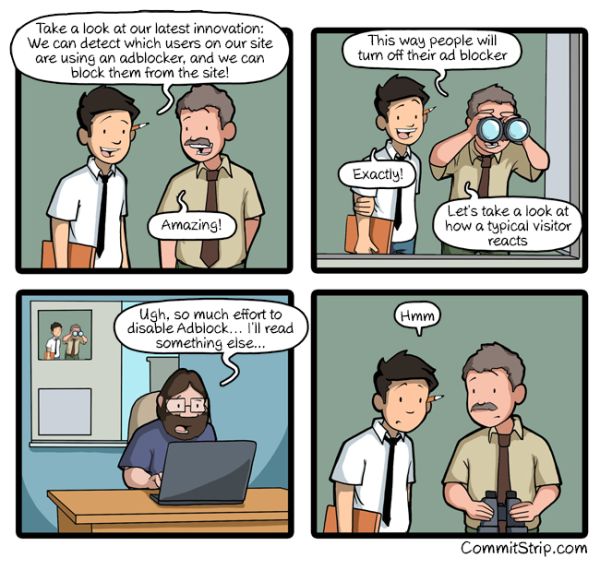
To me, that would be a sign that you are winning the battle. If enough websites fight ad blockers, especially big sites, and the people behind those ad blockers make clumsy mistakes, then users will reach a point where they uninstall the blocker.
5 comments

> people behind those ad blockers make clumsy mistakes

What "mistake?" That the developers couldn't foresee and block the exact elements against ad-blockers before they became real?

Reading the parent comment, it seems users are not opposed to reporting specific instances for the greater good. This is obviously more energy consuming than uninstalling, so where do you get the idea people will all of a sudden stop using an adblock because it failed to get passed one or two sites?

We're already seeing anti-ad-blocker-blockers being developed to remedy this problem. And if they don't come fast enough, users can just turn off their adblock for one page and be done with it.

Direct advertising is a dying legacy tactic. The most successful ads these days are the ones you can't tell are ads. They're also the stronger poison of the two.

It sounds like the people behind the ad blocker broke Ajax for that website while trying to block the ads - that's the mistake I am referring to.

You mention that native ads are gradually replacing direct ads as if it's a good thing. The good guys in the publishing industry go out of their way to prevents ads affecting content, they don't allow their writers/presenters etc to touch advertising and everything is clearly separate.

In the long term, ad blockers will just push out those people who are driven by ethics and you'll be left with the sleazy publications that are driven by PR. This is coming from someone who has dealt with PR agencies and constantly turned down proposals.

> It sounds like the people behind the ad blocker broke Ajax for that website while trying to block the ads - that's the mistake I am referring to.:

> The business I work for tried blocking adblockers and after a bit of back and forth they trumped us by blocking all AJAX requests on our site. We gave in after that.

I took this to mean that adblockers had to evolve and block AJAX on the website to make it accessible. Not, that they were hasty and disabled all functionality.

> You mention that native ads are gradually replacing direct ads as if it's a good thing.

On the contrary: "The most successful ads these days are the ones you can't tell are ads. They're also the stronger poison of the two."

> The good guys in the publishing industry go out of their way to prevents ads affecting content, they don't allow their writers/presenters etc to touch advertising and everything is clearly separate.

I didn't know this. However, I think it's a losing game. Consumers don't seem to care too much about the "good guys," unless a moral campaign is spear-headed (a la Tesla by The Oatmeal), only not seeing ads at all.

It's ironic really. We block ads so we're not influenced by them, but then we lower our guards and become susceptible to the indirect kind.

It's the natural order anyway. There will be those in the coming generations that will be like just like us. Except where we fought against direct ads, they will fight against the indirect. There've always been those unorganized who value critical analysis in all contexts, but their findings and ways never reach the public and make any impact.

Or maybe we've just made ourselves out to be sheep. As long as the coyotes aren't around, out of sight out of mind.

> In the long term, ad blockers will just push out those people who are driven by ethics and you'll be left with the sleazy publications that are driven by PR. This is coming from someone who has dealt with PR agencies and constantly turned down proposals.

As is with all things. You do not survive by being ethical, but by being the most adaptable, and sociopathy happens to be a great adaptation for sales.

I'm more interested in what happens next after the sleaze epoch. Will ads continue to become more and more manipulative then, finally after reaching too far, begin to wither and fade into the anals of history (albeit likely not as known as it should be, because of "out of sight out of mind."). Or will someone finally shake up this industry?

Or they'll stop visiting the site.
+1 - I stopped visiting Forbes because they decided to block ad-blockers. Fuck them; they won't get my eyeballs.
sounds like a win-win
Does it matter if they stop visiting the site? Considering that they are using resources without giving something back in return? I guess it could be argued that they might be promoting the site to other users.

Other than that, they are essentially freeloaders and if a website has too many freeloaders it has to either get rid of them or convert them to something else. Or, I guess, the website could shut down completely.

>Considering that they are using resources without giving something back in return?

Funny. Ads are consuming CPU time and electricity that I pay for in addition to my attention and time, and compromise my decision making. To me, any of those are infinitely more valuable than resources the website expends on serving ads or trying to.

Does it matter if they stop visiting the site? Considering that they are using resources without giving something back in return?

Buzz. I block ads but I also post links to articles on social media that are then followed by people who do not block ads.

I have a couple of areas of focus where I am exceptionally knowledgeable and people who have anything more than a passing interest in those subjects check out links I post.

Or, I guess, the website could shut down completely.

The tragedy of the commons.

If you're going to pirate a movie, you're probably not buying that movie. This is why on the whole piracy doesn't actually affect bottom line that much. Sure some folks would have rented it from their cable provider for $6 or whatever, but on the whole if you're going through the trouble of finding a good torrent and downloading it, you're not in the market to spend money on it.

Just the same, if you have an adblocker installed it's unlikely you're the type of person who is going to be clicking on ads anyway. And PPC ads are much, much more prevalent than impression-based ads. So if someone is blocking your ads, you're not losing anything. You get paid when someone clicks an ad, and if they're going to the trouble of blocking all ads, they're not clicking anything anyway.

You create a system where they won't or can't visit your site, and your traffic decreases, which will have an effect on your ad rates.

Impression ads are important for certain industries and bigger publications. I will agree that PPC ads are common in other areas and ad blocker users wouldn't click them. For impression advertising the ad blocker will result in lost income. PPC ads are the option of last resort for an established publisher because they are almost like gambling.
> Does it matter if they stop visiting the site?

You can have all the ads you want, but if people aren't visiting your site - and sharing links to it, talking about what they read there, recommending it to others - they're not going to get you much revenue.

For informational sites, I'll block sites that violate my preferred conditions, and load them up in third-party tools, e.g., Archive.is, on the rare occasion I find an interest in their content.

Almost universally, it's not worth it.

Rather unlikely. A blocker that fails to block one in a 100 ads is still 100x better than no blocker.