Hacker News new | ask | show | jobs
by kodfodrasz 3425 days ago
This does not seem economical to me.

For a quick calculation operation cost of a bucket with 20W consumption (One CFL lightbulb) consumes 14.6 kWh energy in a month with continous operation. This costs about 500 HUF (~1.8€) according to the electricity costs i could find quickly (32 HUF/kWh ~0.1€/kWh).

This price is comparable to the price of vegetables in the supermarket. This seems economic only for special crops with higher margins.

6 comments

Why would you do the calculation with compact fluorescent bulbs, when the project is really predicated on the efficiency of LEDs? Especially the red/blue LEDs that favor the photosynthetic spectrum.

I'm not saying the conclusion is wrong - this is generally about growing cannabis - but indoor cultivation is surprisingly economical for a variety of scales.

But that is a good comparison for a baseline, correct?

The real issue is that statement about costs being on par with a store...

How much time and energy would I have to input to get a regular crop of [Food-Item] that outweighs the travel time and cost to go get some at a store supplied by a vast industrial scale operation?

I would like to build a diet that is happy eating the same things as often as possible but the ingredients can be changed in their ratios that I get enough of a variety....

I think I could eat boneless, skinless, chicken-thighs for like 50% of the time, full veggie options for 40% and steak as an ingredient for 10%... (I envy my vegan friends)

disrupting the food industry and the palettes of people is hard.

Because at least Red LEDs generally aren't more efficient than CFLs.

You can find tons of articles claiming some lm/w record being achieved in a lab of 110 lm/w, 200 lm/w and other ridiculous numbers, but the reality is most of consumer grade available LEDs will only be 10-30% more efficient than a CFL, and probably _less_ efficient than a t5 fluorescent tube.

I've looked into this extensively when running an indoor garden, and in the end decided to go with FL tubes and a 400W HPS (which was far better than any LED on the market in 2010)

lumen are defined by visibility for the human eye, which is not what you are optimizing for when growing plants.
What was on the market 2010 is significally different from what is available today, progression in this field have been huge during last few years.
I'd be interested in seeing how many hours of operation you need on an LED to beat the low initial cost of some bulbs like these: http://www.homedepot.com/p/Philips-100W-Equivalent-Daylight-...

I expect it would take quite a long time.

who cares about initial costs when you're designing a sustainable system? If you spend $5k / yr on groceries, are you really going to be upset about spending $1k on lights 10 years later?

But to answer your question directly, the efficiency of LED vs CFL in terms of lumens per watt is about 2:1, so on that basis alone the payoff of running for 14 hours per day is about $8 / year / bulb. However, since the bulk of fluorescent output [0] is in the useless trough of photosynthesis sensitivity [1], it is closer to 4:1, so the payoff between your linked $5 bulb and a $35 PAR-tuned grow bulb would be a little under 2 years.

[0] CFL output - https://goo.gl/images/kF1dvH

[1] PAR sensitivity - https://goo.gl/images/dY40YW

> spending $1k on lights

This is about buckets...

> [0] CFL output - https://goo.gl/images/kF1dvH

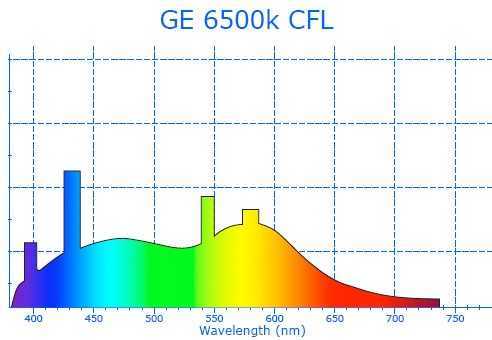
That's 2700k, mine are 6500k, here's the right graph (check that website lol): http://howtogrowmarijuana.com/wp-content/uploads/2014/02/GE-...

Anyways! Here's my calculation. 4 of my cfl's for $10, four of these: http://www.homedepot.com/p/Philips-100W-Equivalent-Daylight-... for $28. The cfls use 23 x 4 = 92W while the LEDs use 14 x 4 = 56W. That 36W difference at $0.12 per kWh will take 4166 hrs (~300 days at 14 hrs/day) to make up the initial cost difference. I googled up weed growth, looks like about 72 days so you can get four pot plants through this thing before you start to regret the CFLs.

You don't use daylight LEDs to grow plants though. The "Green" spectrum is completely wasted. I don't know about weed (I was growing algae in a photobioreactor for a time) but you need a single-wavelength red LED to get biomass growth and blue LEDs to make the thing 'flower'. By using only the wavelengths that photosynthesis requires, you save a substantial amount of energy per photon. It was more of a concern for enclosed PBRs but not having to dissipate all of that heat was a big boon for energy saving too.
So this is actually interesting but it seems that algae is different. I found this subreddit which seems to be the home of a huge spacebucket nerd. Anyways he's got citations but I'm also not experienced enough to really evaluate them. Here's the interesting parts:

>If you find a chart with a deep dip in the green area then it's for some sort of algae or bacteria, not green terrestrial plants. If you find a chart with a bunch of chlorophyll and other pigment peaks then it's only valid as an extract in vitro (in the test tube or cuvette) and not in vivo (the living leaf itself). The pigment peaks can differ depending on the solvent used and the charts do not tell how much there is of a particular pigment so take them with a grain of salt. They are only valid for the particular set up used. As a warning the Wikipedia page on photosynthetically active radiation uses these incorrect charts. Most biology text books get the above paragraphs wrong by not showing the McCree curve while also not articulating how our eyes perceive different colors/wavelengths of light. This is a well known problem with botanists who specialize in plant lighting and causes a lot of confusion and misconceptions. Even Botany for Dummies gets it wrong which is otherwise a very good book.

>Here is a spectral reflectivity profile of a high nitrogen marijuana leaf (Jack Herer). About 90% of the green light is being absorbed (it's on an 18% reflective gray card used in photography) although many plants may be closer to 80% absorption. Plants can use green light and at higher lighting levels green is more photosynthetically efficient than red (pdf file). All the latest research and my own experiments back this claim.

https://www.reddit.com/r/HandsOnComplexity/comments/17nxhd/s...

What do you think? You seem more experienced here

Yeah, this is for weed.
Yeah, I like how the article shows tomatoes and peppers. You'd spent fifty bucks to grow, like, $1.50 worth of vegetables. I don't think you'd ever break even just on the power. Not to mention the veggies will probably taste better if you grow them in sunlight.

And you'll still get caught if you grow your weed in buckets unless you have a separate source of power.

For real.

If this is "not economical" - I wanna know where you're getting your weed. :P

In many regions of the world, the only way to grow fresh greens year round (lettuce, spinach, any Brassica oleracea species) is hydroponically. I do happen to like some nice crisp kohlrabi in the summertime, but it even becomes rare in grocery stores at that time of year. If the world climate continues to warm without check, this produce will become even rarer in stores.

The approach done by spacebuckets isn't very efficient. I haven't looked at the site recently and it currently seems to have been hugged to death, but LEDs have a dramatically lower energy consumption compared to individual CFLs, especially if you use one converter and run them all on the same DC circuit.

There are also parts of the world where you could run this concept economically using solar panels to provide greens that are normally impossible to grow out of season without the added cost of transportation. (You would also have to cool the building, of course, but that can also be done in a carbon neutral fashion.)

Two problems with that analysis. The first is CFL are not LED. The second, vegetables are not as fungible as you suggest.
LEDs are significantly more efficient than CFL. Is there something about the spectrum plants needs that requires CFL?
Not in general. They are both around 60 lm/W. Of course there are exceptions. https://en.wikipedia.org/wiki/Luminous_efficacy#Lighting_eff...
60 lm/W is very low these days. Commercially available screw-base A21 bulbs like Cree's "100W replacement daylight" (17,000 lumens at 15W) are up over 110 lm/W. You can get that for $14 at Home Depot.

http://creebulb.com/100-watt-replacement-daylight

http://www.homedepot.com/p/Cree-100W-Equivalent-Daylight-500...

It depends on the quality of the LED and what it's designed for. Some deliver better spectrum response for plants and for different parts of their life-cycle. Vegetative and flowering stages may require slightly different optimal amounts of energy at particular wavelengths but it's not strictly necessary. A good LED lamp designed for growing should be more than adequate, then tend to have fill-ins for the wavelengths needed.
however, at least during the winter months, any waste heat given off should technically offset one's heating bill. It may not heat your whole house but since "energy cannot be created or destroyed", it should help at least part of the year.
Only if you have resistive electric heat. Resistive heat is a simple X electricity -> X heat added to house. A heat pump uses electricity to move heat from one object to another, so it's X electricity -> Y heat pumped into the house from outside, where Y has some efficiency limits, but isn't directly bound by conservation of energy.

The effective heat gain here is more than 100% of the electricity spent, and we measure it with "Coefficient of Performance" instead of "efficiency". A good system is somewhere around CoP 3.5, making the LEDs a comparatively bad heater.

I don't think his point is that it's a great source of heat, just that electricity used on the LEDs is either being used as light by the plants, or as heat by the occupants of the house, so in a sense, the waste is minimal