Hacker News new | ask | show | jobs
by zeveb 3475 days ago
> You have no idea how hard it is to get Americans to use 100% metric everything, even in the year 2016 in a highly technical field. It's incredibly frustrating.

I'm equally frustrated by how hard it is to get others to use standard units instead of the French ones. There's no particular reason why 'technical fields' should mandate use of French units: one can fly an æroplane, run power to a lightbulb and get a man to the moon all in standard units — indeed, that's how those things were initially done.

6 comments

>get a man to the moon all in standard units

Not quite. At least as far as the flight guidance and navigational systems, NASA used metric internally for the moon missions and had the computer display the converted equivalent in US customary units to the crew.

http://www.doneyles.com/LM/Tales.html

There is a reason technical fields should mandate uniformity and compatibility, and that isn't going to happen with customary units (so called because they're not even compatible with pre-metric British units).

Sure, you can fly your plane with bolts measured in inches and fuel measured in pounds, but good link getting replacement parts or accurate refueling next time you're in a stopover in Japan or Italy or Egypt. And have a good time trying to sell machine parts into an international market, or trying to buy from that same market.

Zeveb, the US customary units, "based on English measure passed by parliament under the reign of Queen Anne in 1706" [1] are inferior to the international SI units.

- prefixes based on powers of 10 are better aligned with how we calculate today, namely with base 10 numerals, and decimal fractions (unless we switch to base 12 or base 8 numerals).

- a single unit per physical quantity, together with prefixes, is better than the proliferation of units in those customary systems (often with different units of the same physical quantity in different contexts, for example length vs area vs liquid volume vs non-liquid volume, or mechanical energy vs heat energy).

- the system is coherent and somewhat minimal.

- the units are derived from the world, not from the length of some king's feet or arms or what have you. Of course, that's a somewhat subjective benefit.

At any rate: the original metre was 1/10,000,000 the distance from equator to pole (that's why 90*60=5400 nautical miles = 10,000 km, approximately). The original kilogram ("grave") was the mass of 1 dm^3 of water.

Of course, one can fly an aeroplane or get a man to the moon without SI units. One can also do it without GPS and without computers and without internet and without antibiotics and without all the other achievements of civilisation. But why would one?

[1] https://en.wikipedia.org/wiki/International_System_of_Units#...

> Zeveb, the US customary units, "based on English measure passed by parliament under the reign of Queen Anne in 1706" [1] are inferior to the international SI units.

FabHK, no, French units are inferior to the standard units:

- 2 and 5 are poor factors; 2, 3, 6 & 8 are superior. We ought to switch to base 12: among other things, ⅓ is not a non-terminating duodecimal.

- It is better to have multiple units for multiple purposes: anyone measuring interstellar distances in inches or metres rather than in parsecs or lightyears is, simply, wrong. One always has the freedom (and indeed, the professional obligation) to use only one unit where it matters (e.g. anyone measuring bread pans in fractions of a mile or metre is, again, simply wrong.

- The system is scaled to human beings, and eschews superficial minimality (BTW: steres and hectares). There are many useful units at human scale, with a few units where needed outside that scale (there's not really much need for a lot outside of human scale).

The units are derived from the world: the nautical mile is equal to one minute of latitude (that's 1/60th of 1/360th); a pint is a pound of water.

- The units are useful for manipulating concrete quantities. Half a volume of liquid is itself a useful measure, as is double (it goes mouthful → jigger → jack → gill → cup → pint → quart → pottle → gallon and so on, doubling all the way up until a tun). As a computer guy, it's pretty awesome to see 64, 128 & 1,024 in my unit quantities.

As I note elsewhere, I'm in support of rationalisation of the system: history has not been kind (c.f. rulers who kept the tax per unit the same, but decreased the size of the unit). I think that there's definitely improvement to be made.

But throwing it all out and adopting a decimal system goes in exactly the wrong direction.

I enjoy the discussion, and agree that base 10 is suboptimal. Base 8, 12, or 16 would be preferable (8, 16 due to affinity to the binary system; 12 due to the factors). However, we are stuck with 10 for now. (Surely there's an argument against God here.)

If we lived in a base 8 or base 12 world, a radically rationalised version of the customary royal measures based on doubling or factors 8 or 12 might be preferable. But we are not.

> It is better to have multiple units for multiple purposes.

Why?

Differences in scale are easily accounted for with the prefixes:

mili, micro, nano, pico, femto, atto takes you down to 10^-18; with zepto and yocto you get to 10^-24.

kilo, mega, giga, tera, peta, exa takes you up to 10^18; with zetta and yotta you get to get to 10^24.

Why do you call them French units while it has been an internationally agreed system for decades?
"french" units?

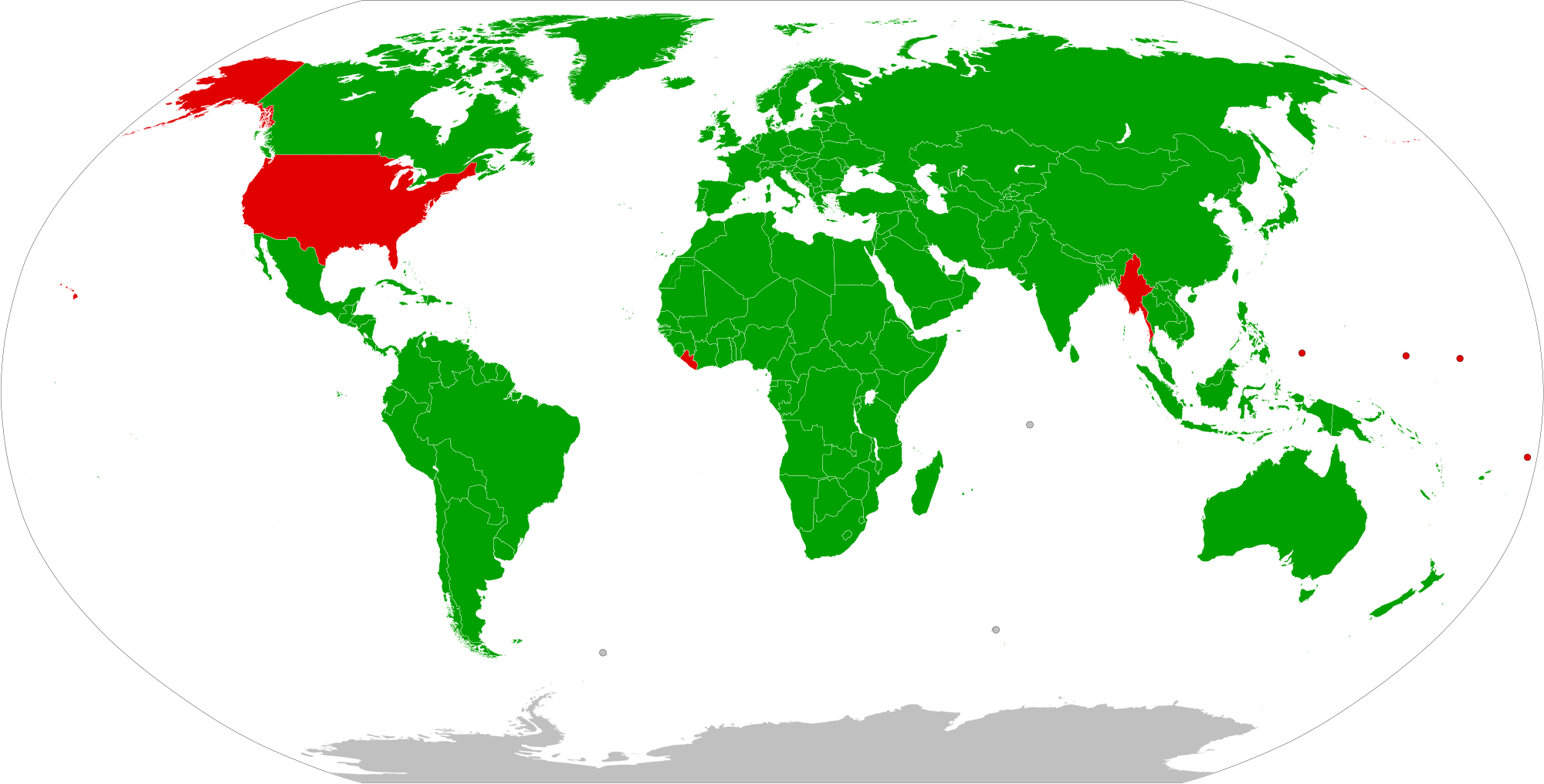
countries which have officially adopted the metric system vs those which have not: https://upload.wikimedia.org/wikipedia/commons/thumb/a/ab/Me...

You'd have a stronger point if you had France vs. US and no other standards.

In reality, you have the accepted world standard and the US one, with a small smattering of UK units thrown in. To argue the entire world should switch back to the US standard instead of the other way around is ridiculously obtuse.

> To argue the entire world should switch back to the US standard instead of the other way around is ridiculously obtuse.

The entire world switched to one country's system once. All of Europe used substantially the same system, and switched from it to one country's radically different system.

There's no reason it couldn't be done again. If it made so much sense to do one thing (of course, I don't actually think it did make that much sense: it was in the main driven through by governments seeking to radically break with the past) then surely if it makes sense to do something else, we all ought to?