We live in a weird world where insane prison overcrowding like conditions and total lack of privacy exists in some dysfunctional workplaces, but its only culturally acceptable to complain about the quiet little keyboards. Sure if my stomach rumbles, we're so tightly packed that I just cost the company $500 by throwing ten developers out of "flow" for an hour and thats OK, but oh god no not a keyboard that clicks.
At home I think my model M is pretty quiet and its certainly not disruptive but my entire family is not required so spend ten hours per day within an arms reach of me as though we're on a small rowboat together. Also textile floors and textile drapes and my office has acoustic foam ceiling tiles makes an extremely quiet environment whereas a hipster office of steel glass and concrete might reflect and echo all sounds.
I am using a model M right now. I bought three at a computer fair for $3 each about 20 years ago to save space on my desk.
The advantage, other than the tactile and sonic feedback, is that my wife can tell when I am working.
> whereas a hipster office of steel glass and concrete might reflect and echo all sounds.
Yep. I had my second Model M shipped to the office and kept it there for a few days, but thanks to it being feng shui certified (wtf?) it was an open floor office, with the company meeting room only separated by a thin glass wall.
Sudden 140wpm bursts on a Model M under that conditions surprised quite a few visitors, even with the door closed, and was compared to "machine gun fire" when I was asked to finally take it home.
I don't think I've ever heard a Model M to compare but if I my uses the DasKey (blue switches I think) while I'm working it can get to me after a bit. Oh I did use a Model M in elementary school a couple times.
I've got a cmStorm with green switches as well as a Model-M. The green switches make the same sound as the blue switches, and all I can really say is that the sound of the buckling-spring switches is very distinctive. Where the Cherry MX switches give you an alto, medium-volume "click!" sound, the buckling-springs give more of a loud, tenor "clack!" sound.
While I do very much like my cmStorm for many tasks, when it comes down to just typing (writing documents, writing code, etc.), I very much prefer both the feel and the sound of the Model-M. The solid steel plate backing makes it into a suitable weapon, too -- I could probably cudgel an intruder to death with it and the thing would still work for another 30 years. Nice and heavy, it won't slide around or anything even during intense sessions.
Another thing that's great about the Model-M is that the keys actuate at precisely the moment the spring buckles and you hear the "clack!". This means that the keys need to fully reset before they will actuate again. I've noticed on my cmStorm that the Cherry MX switches click just a tad before the keys actually activate. As a side-effect, with some practice, you can actuate a key multiple times without letting it reset, and thus bypassing the click and a good amount of initiation energy.
In terms of feel, the Model-M has a bit more travel, and perhaps a tiny bit less resistance than the green switches (but still far more than blue switches).
Added bonus: the Model-M's circuitry is completely sealed within a membrane, while the actuators are sealed within the plastic housing, and it's got drainage built-in. Like, it has some shallow little canals between the keys, complete with drain holes on the bottom. Did you spill coffee on your Model-M? Whoops! No big deal. Maybe rinse it off with some water and wipe up your desk. No harm done!
Unicomp, the current holders of the buckling-spring patents and the Model-M IP, sell PS/2 and USB variants of the classic Model-M (though rebranded). They're even manufactured on the same equipment. Furthermore, they run considerably cheaper than most of the Cherry MX boards I've seen. Mine was, I think, $90 USD including shipping, compared to $130 for my cmStorm. And, yeah, despite the fact I got it in different colors than the original Model-M, it feels just the same as my Model-M. 10/10, would buy Unicomp again.
One potential drawback to the Model-M, though, is because of its matrix activation, only 2 or 3 keys will register at one time when multiple keys are held. This is true even for the USB model, because the connector is not the limiting factor, but rather the way all the keys are wired. For typical typing tasks, this is not a problem, but if you're a gamer you may want to consider sticking with the Cherries.
Another potential drawback is its size. The thing is huge compared to modern keyboards. To compensate, it's got a handy "pencil tray" up top.
Where do you work that ten developer hours is only valued at $500?
I also totally understand the feeling that we're overcrowded, and that may be true in a lot of cases. However, products do take developers, and to be responsible citizens we can't use a too much space. So it's kind of a necessary evil.
One way this can be assuaged is with a stronger commitment to remote work or flexible hours.
I have a Model M at home, and while I find that the sound helps me keep my rhythm while typing, it can be really annoying in an office environment.
At my last job, being unhappy with the keyboard I had, I brought the Model M to work one day (it was just gathering dust at home). While typing was much more pleasant, I quickly discovered I had to stop typing whenever my coworker's phone rang. This, in turn, quickly became annoying for me, so at the end of the day, I packed it up and took it back home.
The Model M is one of the best keyboards I ever had the pleasure of using, but I would not like to inflict that level of noise to coworkers at the office.
(The best keyboard I ever used, interestingly, was a Natural Ergonomic Keyboard 4000 made by Microsoft. I am not a big fan of Microsoft, but they really know how to build a great keyboard. Unfortunately, this was the only keyboard I ever managed to spill tea on... and on its identical replacement. I took that as a hint that some higher power might not want me to use Microsoft keyboards.)
Add to the Model M the acoustics of a typical open office plan found at most startups and its unbearable. Its not uncommon to have a startup in a concrete loft type space with a group of people who insist on using whatever the modern $200 hipster version of a "buckling spring" keyboard is. It's "cred" man.
Unicomp sells actual buckling spring keyboards. They bought the tech from IBM -> Lexmark. Not bad keyboards, and pretty cheap compared to some of the hipster keyboards. I got mine with hardware Dvorak layout.
WAIT, my Model M blasts Slayer at every keystroke. Doesn't yours? It also has Metallica's Kill 'Em All pre-loaded in ROM. I heard if you achieve a fast enough rate it'll go straight to Seek & Destroy :).
Seriously though, these keyboards are LOUD. Most of the folks at my office use very loud keyboards, but we don't mind. We all know that we type faster with them, and we all have noise canceling headphones.
I do have a coworker I currently share an office with who would actually like blasting Slayer. ;-) (Interesting thought experiment: Can I type faster than Dave Lombardo can play the drums?)
It's extremely cheap to built and operate. Cleaning one large office is fast and hence cheaper, than 10 smaller offices.
Often the "lost productivity" isn't factored into the cost of open plan offices, mostly because it's to complex I think. Interestingly the gain from better communication is always factored in as a positive.
I do know people that prefer open plan offices. They all have headphone on for a large part of the day though. People that prefer an eerie silence, like myself, aren't normally not considered when planning office building.
Peter Drucker is often attributed the quote "Culture eats strategy for breakfast". For some reason many organizations seem to believe that in the modern office, furniture will eat culture and turn it into an Aeron chair clone.
With the right combination of people, it can actually be quite fun and encourage communication, IMHO.
However, if people have to make or take phone calls, it can become really annoying quickly. Try to focus with two or three people sitting around you talking on the phone. Especially if one or more of these people talk to people who are on construction sites or inside industrial plants, so you have to talk rather loudly so they can understand you... On a few occasions (rarely, though), I have just put on headphones and listened to white noise to drown out their talking.
The right combination of people doing the right combination of work. One of the ostensible purposes of open plans is to facilitate communication and collaboration. Unfortunately, every collaboration session throws off those around who are not involved.
That's why I like open plan in small spaces -- IE, a conference room with 4-8 desks in it for a single agile team. All business-related conversations probably apply to all or most of the team anyway, and at least for a development team the phone chatter will probably be minimal. The walls keep you from distracting unrelated employees with your discussions, but the openness keeps the highly-relevant people in the loop.
It's funny you mention that Microsoft keyboard. I was reading your story about the Model M and thinking "Yeah I'd love to switch to a mech keyboard again but I love my Natural Ergonomic Keyboard 4000 by Microsoft too much." It has pretty much saved my shoulders because, instead of having to put them together to type on a normal keyboard, I have space to angle them out. It's great!
I have an Ergodox I picked up from MassDrop that I absolutely love. I used to use an MS natural keyboard for some of the same reasons you mention and now I have the best of both worlds!
One thing I liked about the 4000 was that it was loud enough to give a reasonable feedback while typing, but not annoyingly loud (at least when alone - I never tried it in an office environment). And that pad to rest the palms one was amazing.
One way to make it quieter is to put a bit of grease under the keycap -- that softens the sound that the spring makes when it buckles. However after a while the grease can leak down into the keyboard membrane.
Another method is to put a piece of dental floss down inside each spring. Supposedly that reduces the sound quite a bit.
It's hard, because the Model M relies on a steel spring buckling, which is inherently noisy. You can dampen some other sounds (like the keycap hitting the key's fixture, either with grease, or permanently with rubber rings), but with how little space there is in a key, it's hard to silence that particular sound.
IBM themselves went with regular rubber domes for their "quiet touch" Model M variants, which are unpopular due to not being mechnical.
Much louder than the cherry mx blue. There's a spring inside which buckles sideways. The point at which it buckles provides the physical and audio feedback.
Which is the big difference to all the Cherry switches: Those are inherently linear (and quiet), some variants just have plastic latches glued to a side to emulate the clicking noise and tactile feedback (both of which useless, because they're decoupled from actual actuation).
A typewriter. Not quite as loud as a mechanical typewriter, but slightly louder than an electronic typewriter and, since you don't have to wait for the keys to come back, there is practically no limit on how fast you can type.
I had many mechanical keyboards. Blue, brown and red cherry switches, topre, you name it. I got rid of most of them and I regret having spent the dollar on such a meme piece of equipment.
Elitism and fetichism aside, the sound and key travel is just a matter of preference and at the end of the day they won't make you type faster or help with RSI (the ones with high required actuation force can actually worsen it).
I wouldn't trade my current Microsoft Sculpt for any of my previous keyboards. Both my colleagues and my wrists are glad I switched.
My recommendation is that if you are going to pay a premium for a keyboard, at least focus on ergonomic features rather than gimmicks.
> at least focus on ergonomic features rather than gimmicks
FWIW, mechanical switches have helped with my own finger/wrist pain significantly, for one major reason: I don't have to bottom out the keys to make them register. The lack of a sudden stop reduces the stress put on my fingers by a significant amount over 8 hours. I can't make it through 8 hours typing on a mac chicklet keyboard, but I can with any of my mechanical keyboards (red, brown, topre, etc).
The durability of a mechanical keyboard also helps make up their up-front cost - where a rubber dome keyboard tends to only last me 6-8 months, I've yet to replace a mechanical keyboard due to key failure.
I also wouldn't underestimate the value of "personal preference" for something you use for well over 40 hours a week.
An UltraErgo Wireless Split Keyboard, and set it on the arm rests of a nice chair, something like the chair of the captain in the Original Star Trek Enterprise.
>I wouldn't trade my current Microsoft Sculpt for any of my previous keyboards.
That is a fantastic keyboard. I was starting to have wrist pains and got the Sculpt. The pain went away within days.
I would like it to have the angle between the two sides be a bit larger, so that my wrists would be completely straight. On the other hand I'm sure Microsoft have a good reason for it being at the angle it's at.
Thanks for the recommendation. I love my Topre keyboard (the typing ergonomics are better than with the cheap keyboards I had before), but then again I have never before even heard of Sculpt. I'll try to keep this one in mind.
Shout-out to Unicomp[0], who make new USB Model M's from the original specs. I love mine and my wife hates it because it's too loud and clakkety. Their website is horrid and the fit-and-finish on the product leaves a bit to be desired, but the switches are great.
Yep they make pretty decent clones. I have special edition they did on Massdrop but sadly the 70g keys are causing major pain and I have to use my other keyboard with Topre switches for doing work :(
IBM outsourced keyboard production first to Lexmark, and then to Unicomp. Unicomp then later went and bought the patents and everything to spin-off their own products, still with the original tooling.
You'll find a lot of "Original IBM" keyboards that were built by Unicomp in license. I have a Model M4 from 2000 that was already built by Unicomp, sold by IBM with their own branding.
It was so terrible the first time. I wanted to cut off my hands. It went away and I got back to work. Eventually I had to stop work every hour from the pain.
It can't be the keyboard! My precious PS/2 buckling spring model M! I've been using it for fifteen years without trouble! THIS IS THE BEST KEYBOARD IN THE WORLD! I am such a fool.
I have trouble with warm restarts losing the USB controller on which that keyboard is connected. No other keyboard causes this problem, and it is definitely the entire controller. Scary to imagine what they could be doing in that driver.
I use a unicomp keyboard, and I have the same problem. I think the problem is that it draws quite a lot more current than other USB peripherals. I have mine plugged into a powered USB hub, which seems to help.
It definitely pushes the envelope on power, if it's connected to a port that doesn't deliver, it won't work right... much more than typical membrane keyboards. They also have issues with some KVM switches that don't provide enough power. Wound up using a split power cable (like one that's usually for extra power to USB external drives, so I could push extra power into the USB interface.
Love the keyboards though... despite some QC issues.
Not only are their keyboards great, their support is superlative too. I'd have bought more, only the unit I bought six years ago is still going strong :)
That cracks me up. Back in the 80s, I wrote a little TSR for a guy who missed the Atari 800 keyboard click tone on his new clone PC. I had wired a switch in line with the speaker in my Atari so that I could turn off the tone and not wake my roommate.
The Atari 800 also had some fun event sounds it made whenever it read or wrote a floppy disk sector or had an I/O error. People got used to those audible feedbacks, just like the physical drive crunching noises and other "side-channel" outputs.
I worked with someone who had a Model M. I thought he was a super fast typer, until I realized the keys make a sound on the way down and the way up, making his perceived words per minute (PWPM) twice is actual WPM.
Cherry MX brown keyswitches are they usual recommendation for tactility + quietness, but the tactility is pretty subtle, no comparison to a Model M. I've heard several recommendations for Matias Quiet Click keyswitches [0] as having much more satisfying clickiness while being very quiet, but sadly haven't yet been able to try them yet.
Strictly those aren't exactly "keyboard" recommendations, but as well as selling keyboards Matias also sell the switches separately, so you can get a keyboard base to your preferences and solder keyswitches of your choice to it yourself, typically on a group-buy site like Massdrop. Eg I'm currently waiting for the Ergodox infinity drop[1] (split, non-staggered, open-source hardware and firmware, reprogrammable), but there are a bunch of more conventional keyboards available with a choice of keyswitches as well.
To run down the switches (that provide physical feedback).
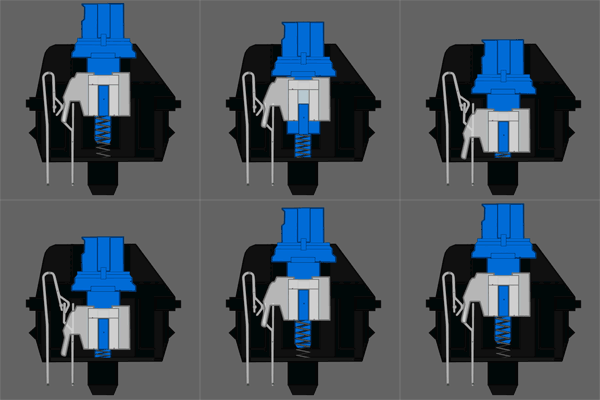
-MX Cherry Blues: Their action has the same feel of a Model M (kind of) they only require ~1/2 the force to switch as a Model M. Their sound is also quieter (then a model M) they're still much louder then a rubber dome. It has a higher pitch clip/clop rather then the Model M's thunk.
-MX Cherry Greens: A stiffer blue (commonly used for space bars).
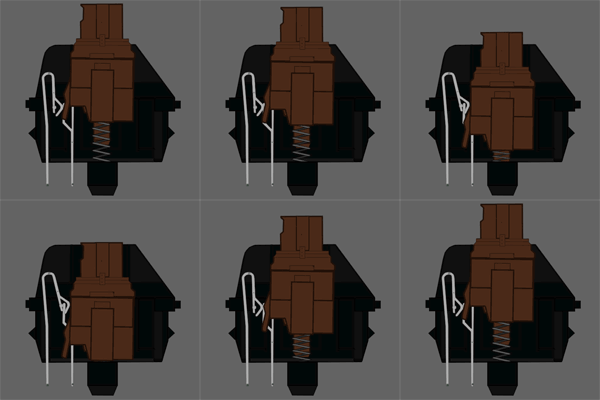
-MX Cherry Browns: Same action as a blue, but rubber dampened to be quieter actually inline with a rubber dome. They still provide the physical feedback of a Blue.
-MX Cherry Clear: A stiffer brown.
-MX Cherry Whites: Somewhere between a Brown and a Blue in sound and force. They still provide feedback.
I was speaking of the feel of the action. The brown still has the physical bump caused by the outward swing on the guide arm much like the blue.
There isn't the extra chunk of free riding plastic that helps generate a lower sound tho. I was purely wrong the rubber wrapping, that was just me being ill-informed.
I think there's a pretty distinct difference in feeling though- once a blue switch clicks, you don't get any more tactile feedback from the switch because the part that gets feedback is sitting on the bottom, but with browns it's still rubbing up against the contacts- which leads to browns feeling a bit mushier after the click.
Mind you, if you're in a noise sensitive environment then browns are definitely what you want.
Well the blue switch breaks meaning the force required to depress the switch changes. But this break occurs after the switch is triggered. This break is also when the sound is generated. Which again, after the key is triggered.
Buckling Springs is the only switch where the break, sound, and switch engage all happen in the same instant ,by the same mechanism (the spring buckling).
I really enjoy the original Apple Extended Keyboard II. I'll be honest that I haven't used an actual Model M, but it's got a wonderful feel and not so horribly loud that you'll disrupt the world.
I think those have Alps key switches. I liked Apple's ADB keyboards as well, and I kept one even after moving a few times, in the hope that I could use it again some day.
I wonder if I could find a USB adapter for one. Microchip actually has an application note on talking ADB with a PIC, and there's probably an Inside Macintosh book on the subject, so if it came to it I think I could make one.
Apple Extended Keyboard 2's varied a lot, I had a few and some were a lot better than others. Their ADB sockets were also pretty sensitive, and then USB/ADB adapters got real flakey.
Then I moved to the Model M, and the AEK2s gathered dust in the garage after that.
(At one point, I had a Dell monitor, Microsoft Mouse, and IBM keyboard connected to a Graphite G4 tower.)
That doesn't seem possible. A good part of the MM's ergonomics are the force feedback, and the physical click as the spring buckles. You really can't get anything like that without a click of some kind.
I've seen those quiet Cherry MX switches: they just go all the way down, no force feedback at all. Honestly, I'd say they're worse than dome keyboards.
The quiet switches you talk about are probably linear, they indeed go all the way down without any feedback. There is also a middle ground - MX Brown and MX Clear - they have some tactile feedback but without the click. They're not ideal though and some people refer to them as "scratchy". Here's a handy comparison of all Cherry MX and some other Cherry switches:
They're most popular among gamers, since they activate really high on the travel, and are easy to spam. I've typed with them, and you don't really need the feedback, since they activate pretty much the moment you start pressing them down.
Of course, that's a double-edged sword, since I've also activated them while just resting my fingers on the keyboard just a bit too hard.
There are a lot of mechanical keyboards out there with a similar heft as the Model M. The trick is the switches. I like the Cherry red switches, which are quiet. Cherry blue switches are clicky like the old model M.
I can see the appeal for gaming, but not so much for typing... imho nothing works as smoothly as a model m as long as you aren't bottoming out, you can actually type pretty lightly, relatively speaking...
I don't even see the appeal for gaming: Maybe at insane skill levels, but even on a Model M, the keypress time is a fraction of your response time, maybe ~10ms at worst. Although I haven't counted.
Topre key switches aren't bad. They're more expensive than they're likely really worth, but they feel like a cross between a cherry-mx-brown switch and a rubber dome switch. Good feedback, easy on the fingers, and no sound from the switch (it's capacitive, not mechanical).
That said, nothing (silent) quite replicates the action of a buckling spring. MX Blues come close (since they have a piece that "gives" under pressure), but they are not precisely silent (since they have a piece that "gives" under pressure).
Hmm, cool. I've had a read about them since they were mentioned in another post here.
They look prety good and I'd like to try a topre keyboard, but they cost the sort of cash you put down when you know you want them for sure. Will look out for one in a physical shop to try out.
Unicomp does make keyboards in the same form factor as their model M clones, but with rubber domes instead of buckling springs, though they're considered silly. The brandname is 'QuietTouch' or something.
Another serious question. I used to love my Model M but switched to a cheap Fujitsu split keyboard. Anyone have a view on which is the best Model M-alike with a split format?
I have my own office so I don't care how loud it is.
Mk II was a wonderful no-nonsense keyboard. Super light and had PCB-mounted MX Blue switches. Despite a big & plasticy case it felt like a precision tool to me. I wish I had bought a PCB mounted successor instead of a modern plate mounted one.
Seeing how it's cross-compiled into Windows, I reckon the reason it's not made for macOS yet is that there is no way to cross-compile into that OS yet. We have similar difficulties in building Octave for macOS.
This is really frustrating. Because Windows is so foreign, free hackers worked hard to make it palatable and created mingw32, which allows wonderful things such as being able to build for Windows without having Windows. Because macOS is "Unix" and, look! it has a few scraps of "open source" in it, nobody ever felt the need to reimplement its API for free hackers and thus allow cross-compiling.
And no, homebrew is not the answer. People seem unaware that there's much more to Unix than a passing familiarity in the CLI. The different audio and graphics and lack of X, and many other differences in macOS make it a very foreign OS for free development. Porting Octave to macOS has been a tremendous effort of many years that has never really yielded completely satisfactory results.
Well, porting to Windows is actually easy thanks to mingw32 and MXE. At least easier than macOS. It's also far easier to get Octave on the BSDs. So frustrating that macOS is the most difficult target.
Author here. I've looked into support for Mac OS some time ago. The audio code is portable enough given OpenAL, but getting global keyboard events on Mac is not trivial. It also doesn't help that I don't own a mac myself for development...
A lot of the new clicky keyboards are sold at incredibly high premiums, usually as gaming keyboards, or as specialty items - see Das, HH, etc.
These are ripoffs. You can get a Model M from Unicomp for between $80 and $100, which is significantly cheaper, and feels way better than most of the MX keys.
I have a Das Keyboard Model S for Mac that I got for $125. Yes, that's at least 25% more expansive than your example, but as a well paid engineer it's still in the same ballpark an, it's made for Mac which you don't find in the real Model Ms. I also happened to really like the look of the Model S vs a lot of other keyboards.
While I've scoffed at some that are well over $200, there are certainly more modern conveniences that come with these more expensive ones:
- You (often) can choose the type of switch in the keyboard
- Media/macro keys
- USB hub/ports
- Backlit (if you like that kind of thing)
If you know what you're getting for the price, it's not a ripoff, a price premium, sure. I've had my Das for, I think, 6 years now and it's been flawless. If they're all constructed as well as the Model
M and enjoy nearly the same lifespans the price difference is effectively not even a factor in my decision.
That's fair enough, but the ones that are closer to $200 are crazy.
As for the rest of what you mentioned, the hub's nice, but macros are what the function keys are for, and I never really got the point of backlighting. But that's just a personal preference.
As for the switches, I haven't tried all the MX switches, but I really like the Model M feel, and the quiet MXs provide no feedback... yuck.
I loved the old Model M I somehow got as an impressionable youth, back when PS/2 keyboards were fancy and USB keyboards weren't a thing yet.
Eventually I moved away to USB keyboards and hated the mush feel and looked around for options but balked at the price. Finally I ran into a couple of guys who'd made the jump (not to Das though) and I started looking around. I found the DKs to be really good looking and I really like how they feel (I've got the clickiest switches they offer for the Mac).
I think over $200 for a keyboard is crazy as well, especially if it's because people are getting conned into thinking they're getting more than they really are, but I won't begrudge someone's decision if it came down to, "I know what I'm getting and I'm fine paying this premium because of [insert deciding factor]"
I wouldn't do it, but 10 years ago I wouldn't have spent $120-150 on a keyboard either.
Regarding media/macro keys, I use an autohotkey script to map Win+[,],\ for volume down,up,mute... don't really miss the play/pause (spacebar usually works for that). Which covers my own 98% use case.
I prefer the buckling spring click/feel over most of the keyswitch keyboards I've tried... if I went that way, would lean towards cherry browns, but that's just me.
Agreed.. I'm actually on osx mac and linux daily.. more osx at work, more windows/linux at home. Most of the time, I just use the gui tbh. my htpc is ubuntu, and that has a wireless keyboard better suited to the job, with media keys.
Feeling better than the MX keys is definitely a matter of opinion. And many good mechanical keyboards can be had for not much higher than that price, the ones you pointed out are just a few overpriced brands.
The Das Keyboard 4C Professional is $99 on their website, and it's also brand new.
I believe it has generic Cherry MX clones, but the regular 4 Professional has genuine Cherry MX keys, but costs $170, which is kind of steep. Then again, the front panel is aluminum, which is kind of nice. I personally have this keyboard and it seems like a quality unit. It's very heavy. The only thing that sucks is that the keys aren't back lit.
It helps you see where the keys are when the room is dark.
While I can type without looking at the keyboard 99% of the time, sometimes I still need to look down to get my bearings when pressing some of the lesser used keys like the optional media keys, etc...
I don't need an emulator :) I still think my buckling spring Unicomp (basically a Model M) is the best keyboard I've ever used since the IBM unit that came with my original PC:
I thought of trying this to use the ridiculous CSI/hacker beep sound at each keypress. Replaced the .wav files with a short beep sound I had once downloaded and works fine (couldn't stand it after a minute). If anyone mad enough to try it, the .zip containing the properly named .wav files is here[1].
Edit: Sorry I'm new to sharing .zip files - uploaded to another site - link updated.
I used to work for a company that had a box full of Model M keyboards that people didn't want to use. I knicked one when I left, and unfortunately It's since died.
If you work for a company that bought any IBM servers in the last 20 years, there is a chance you'll find something similar (probably not actual model M's, but still damn good keyboards!) in the server room spares boxes.
Speak to your friendly SysAdmin and see if you can strike a deal :-)
I know Jack Zylkin personally and was there at Hive76 when he made the first USB Typewriter. It was a joke that took on a life of its own and ended up playing its own joke on its master. He made the first one for a contest on Instructables.com, intending to sell a kit version for anyone to make anything into a keyboard. He got so many calls and emails asking for pre-made typewriters that he basically had a business drop in his lap. I know they originally started out around $250, fully assembled, but last I checked he had bumped up the price to at least $700 just to try to curb demand (building the first or second is fun, definitely not the 15th or 30th) It somewhat unintuitively had the opposite effect as he started showing up in a number of luxury goods blogs.
They are quite labor intensive to build. He was never able to find someone with both the manual dexterity, electronics knowledge, and willingness to scrape by on a pittance to be able to live an independent life to bring on as help.
Wish I'd gotten one when they were $250... at the current price (over $1250) just can't bring myself to do it... though sourcing original materials is probably part of the increased cost, and the labor. Really cool concept. I have a spare computer setup to keep people off my desktop, at home, and this would be cool to have on that.
At least 5 years ago he was starting to talk about how it was getting harder and harder to find intact typewriters. Apparently there is a very limited, dwindling supply, thanks to people converting them to keyboards.
If you can find a typewriter of your own, he sells kits for much, much less. They don't require any soldering and the logic board comes pre-programmed, you just have to pay attention to the instructions.
Mechanical typewriters are mostly antiques, and can't imagine how many have been recycled or in landfill space over the years at this point. So I would think that sourcing would be the biggest issue in this. Though having used a mechanical typewriter when I was young, it's hard to imagine many people preferring the experience.
I know it seems kind of crazy for this thing to cost as much as a nice computer, but you have to understand: the guy was killing himself building these things for people. When he first started doing this, I argued with him for so long about raising his prices. He was getting super depressed about working on these typewriters all the time. He thought raising the price was selfish. He just couldn't see that he needed to do it just to protect himself.
He sells the kits at a much more reasonable price. But if you want him to build you one, you definitely pay a premium.
I still have my old Model M. Unfortunately, I was banned from using it in the house (by the girlfriend), but it is now connected to a FreeBSD box (which still has PS/2 connectors) in the garage.
One does not realize how truly annoying the sound is until one sits in a room and has to listen to someone typing on it with reckless abandon. That's how she convinced me to stop using it.
May want to look at some cherry mx brown or blue keyboards... I like brown better, imho closer to m in terms of feel... that said I haven't tried one with mx-clear.
I had the same problem too. I'm using Windows 10 with the anniversary update.
(I'm not sure its use of a global hook stored in an EXE is safe anyway. I think you have to have these things in DLLs, because the hook runs in each process's context, so each process needs its own copy of the code. Obviously it must work for at least some people though... I wonder how? Will have to try building it when I get a moment.)
It's very possible this isn't quite the same as the original, which I've still yet to actually experience - however you do get a click each time you press and release a key, so it's presumably not a million miles off.
If your coworkers' typing is too distracting, your work environment is probably a bigger problem than the keyboards.
I used to work in a semi-open office with cubicles with people using protein shake mixers and a goddamn espresso machine. The building piped in white noise because it wasn't annoying enough already.
I use a Das Keyboard, which I think is probably similar. I actually felt bad for a while and asked all of my coworkers if it was too loud and I should use a different keyboard. They all insisted that the noise doesn't bother them. Now I just type with abandon.
It's a lovely keyboard. It feels like silk under my fingers. Lovely, clicky, noisy silk. It was actually left in the company by a former employee, and I nabbed it at once.
Also, I just realised my keyboard isn't quite as noisy as a model M. I don't think it has quite the same spring mechanism. It's clicky, but apparently tolerable.
I use a mechanical keyboard with brown Cherry MX switches and am hated enough already. Sometimes my coworker even leaves the room. Good thing is, he's one of my best friends otherwise I probably wouldn't be allowed to use that keyboard at all.
I work for IBM and found a couple of rather old and somewhat broken Model Ms with RJ45 connectors (!) lying around in our hardware lab. Anyone know whether adaptors for RJ45 keyboards are a thing?


At home I think my model M is pretty quiet and its certainly not disruptive but my entire family is not required so spend ten hours per day within an arms reach of me as though we're on a small rowboat together. Also textile floors and textile drapes and my office has acoustic foam ceiling tiles makes an extremely quiet environment whereas a hipster office of steel glass and concrete might reflect and echo all sounds.