Hacker News new | ask | show | jobs
by zenogais 3628 days ago
Perhaps offering some sort of crowdsourced funding mechanism and a reputation system would go a long way toward correcting some of these incentives?

For example, giving authors / organizations a Bitcoin address where they can receive funds from individuals / organizations who want to support their research.

Also, awarding reputation to authors based on the level of peer review their research has successfully undergone (number of peers, level of rigor, etc.), and conversely awarding reputation and funding to those who perform peer reviews. Allowing users to contribute to a peer review fund for individual articles or in general.

All that to say this is very exciting and opens up a lot of new possibilities.

1 comments

> For example, giving authors / organizations a Bitcoin address where they can receive funds from individuals / organizations who want to support their research.

That's a fantastic idea. Maybe we could call this "depository" of money to conduct research something like, hmmm, what's a good word… a grant?

> Also, awarding reputation to authors based on the level of peer review their research has successfully undergone (number of peers, level of rigor, etc.), and conversely awarding reputation and funding to those who perform peer reviews.

Sounds fantastic as well! Maybe these authors could create like, a website or curriculum vitae where they could list their accomplishment to establish their reputation. You know, they could have a section in their medium of choice that could be titled something like selected peer reviewed articles where they'll list their publications along with their coauthors and the journal it appeared in. Maybe these journals could devise some kind of ranking to measure reputation. Maybe they could call it something like… amount of impact or maybe just impact factor for short. I think this could work really well.

> Allowing users to contribute to a peer review fund for individual articles or in general.

Maybe a general fund should be created to support science! Maybe a national science fund or something, governed by a so-called national science foundation who can vote scientists, engineers, and the like onto their board to steer the allocation of funding.

I really think you're onto something very good here!

> Maybe we could call this "depository" of money to conduct research something like, hmmm, what's a good word… a grant?

Nah, that word is already in use for stagnant allocations of academic welfare to work on bullshit instead of transformative techniques (e.g. CAR T-cells, which NIH refused to fund for years). Need a new word to signify "money that is actually intended to produce results" instead of "a pension for irrelevant tenured senior PIs to pay non-English-speakers below-minimum-wage to work on topics that became irrelevant a decade ago".

> Maybe they could call it something like… amount of impact or maybe just impact factor for short. I think this could work really well.

Ah yes, impact factor is such an amazing tool. It allows "executive" "leadership" types to predict (very poorly, but who cares?) how many citations a paper might receive if it survives the months or years between submission and publication in a major journal. Trouble is, JIF is massively massaged and the COI that Thompson Reuters has in equitably enforcing it is ridiculous.

WARNING: Non-peer-reviewed work ahead! If you're not careful, you might have to apply critical thinking to it!

http://biorxiv.org/content/early/2016/07/05/062109

> Maybe a general fund should be created to support science!

That's a great theory. Perhaps it can be as well executed as the CIHR fund (where study section has given way to "ignore everyone who doesn't suck my dick directly") or NSF (whose yearly funding is dwarfed by the R&D funding at a single company). This approach is working out very well!

You know, if I didn't know better, I might think you were the sort of researcher that fails to look at the details and just submits your most fashionable bullshit to whateve journal at which your pals happen to be editors. I might get the impression that you're the cancer which is killing grant-funded science, which prizes large labs over large numbers of R01 projects, which believes that O&A is an entitlement to take out mortgages on new buildings instead of to pay for the costs of disbursing and administering a grant. But, since the evidence isn't before me, I won't.

It would be nice if you thought a little more carefully about what you wrote. The devil is in the details.

> or NSF (whose yearly funding is dwarfed by the R&D funding at a single company)

If the worst thing you can say about the NSF is that they need more money, that makes it sound like GP has come up with a nice way to allocate the available funding towards particular research projects.

> It would be nice if you thought a little more carefully about what you wrote. The devil is in the details.

Details like how to get "crowdfunding" to put up enough money that "independent scientist" can be a full time job and not just a hobby for the odd few who somehow already have most of the needed lab facilities/equipment?

Also: I still haven't heard (from either you or the previous parent poster) how journal impact factor can possibly be justifiable as a metric for relevance.

Anyone surveying the actual citation distributions at major journals will immediately note that a metric assuming near-normality cannot possibly summarize non-normal distributions of citations. The latter describes nearly all journals, thus even if JIF were not manipulable by stacking, self-citation, and negotiated exclusion of items to decrease the denominator, it would still suck.

https://quantixed.wordpress.com/2016/01/05/the-great-curve-i...

Look carefully at the details! This metric is among the most frequently emphasized by researchers who comprise study sections, and it is objectively terrible.

I'm not whining "just because" -- many of the lines in my CV end with NEJM, Nature, or Cell (no Science paper yet). I'm saying that at least one of the commonly accepted metrics for individual investigators is broken. That sort of detail corrupts the entire rest of the system.

I'm also not saying that a direct public-facing system wouldn't have huge potential problems (although it is nice to see attempts like experiment.com seemingly doing OK, and the funders realizing, hey, there are a lot of shades of gray between "utter bullshit" and "exactly the right experimental design for the question being asked").

One of the nice things about talking directly with folks at NIH, for example, is that they recognize there are serious issues with the incentives in place. If they are willing to collect the data and evaluate (publicly, e.g. in Chalk Talk postings) the findings, doesn't that suggest room for the current system to improve?

I take it you're not familiar with "crowdfunding" sources like the AACR, LLS, ASCO, or other professional societies?

As someone who is funded by several of the above, and who noted that their review processes were substantially less bullshit-intensive yet no less rigorous than NIH review (which has many benefits, efficiency not among them), I'm going to go out on a limb and suggest that it's possible.

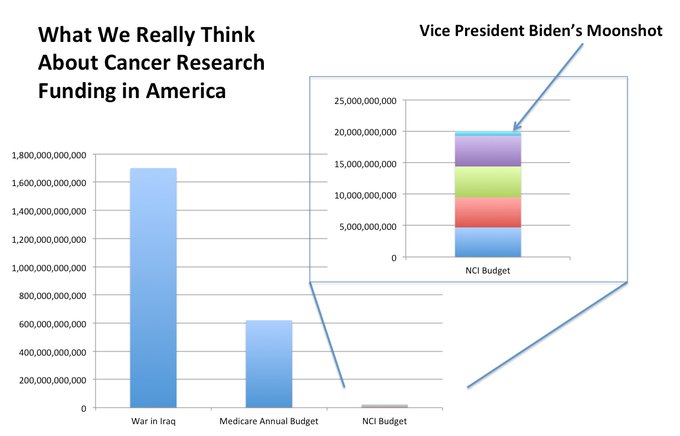
As far as the NSF, they do a good job with what they have, but what they have is not commensurate with what we as a society could stand to spent on science. Even NCI is a far cry from that: https://pbs.twimg.com/media/CmLJzKQWkAAl372.jpg:small

Distributions are similar for various other avenues of funding, and it is quite clear that the overhead & administrative costs requested by many recipient instutions are far out of proportion to actual needs, so the impact of the funding allocations is further reduced.

Thus it appears that a direct conduit from potential patrons to researchers is, in fact, desirable. Otherwise, services like experiment.com would not exist. They're not at the level of an NIH study section (duh?) but they have consistently produced a small stream of usable results that belie their supposed irrelevance. Once upon a time, the Royal Society existed for just such matchmaking: find a rich patron and a promising young scientist and line them up. You've likely noticed that many if not most major universities and "centers of excellence" rely upon exactly this model, supplemented with NIH or NSF grants, to exist. Further modularizing the model so that an administrative hand yanking out bloated "indirects" at every turn is not mandated might not be the worst thing, or (alternatively) being more transparent with said O&A requests, might at least bring some of the bullshit under control.

The public clearly wants accountability. The masses may be asses, but if we want their money, we really ought to be transparent about what we're doing with it.

The difference between professional societies and crowdfunding is that professionals, not the crowd who donate directly, decides which projects to fund. In this sense, I do not see a great qualitative different to government funding agencies --- if you do, please elaborate.

EDIT: And to clarify, in the societies I know, general members do not directly take part in grant decision processes. Rather, the decisions are made by a small panel, possibly together with external reviewers. This is fairly different from crowdsourcing.

It's different from crowdsourcing, but the source and sink for the funds also tend to be more closely related. Ultimately I don't really believe that major initiatives (eg P01-level grants) can be adequately reviewed by anything other than genuine peers.

But by the same token, an exploratory study requesting $30k for field work or sample processing could very well be evaluated by less skilled peers. Actually, I think I'm going to try and shop this to a friend at NIH. I'll fail, most likely, but at least I won't just be whining.

For example, pharma and big donors use the LLS review system as a "study section lite" to hand out grants larger than a typical R01. The paperwork and BS isn't really necessary at that level and just gets in the way. If something like this existed for "lark" projects, inside or outside of NIH/NSF, perhaps more diverse and potentially diversifying proposals would be worth submitting.

To some (fairly large, in the case of ASCO or ASH or AACR, perhaps smaller for LLS or AHA) degree, the dues-paying professionals in these societies are the crowd. I would say they are a middle ground between something like an experiment.com or similar at one extreme, and NIH (which has inordinate purely political input -- ask your program officer!) at the other.

We shan't discuss scams like Komen here, but genuine research foundations can exist along a continuum.

The paperwork burden for an NIH grant (relative to a society grant) is often a large scalar multiple. The accountability is often on a par with, or less than, the typical society grant. It mystifies me why this should be so.
I feel like those fields with highest facility needs / costs would come last if at all. There are many fields that require pretty small amounts of resources for example: Computer Science (I did most of my research on a personal laptop, with other equipment costs <$5,000), Mathematics, Philosophy, Economics, Psychology.

All of these seem very possible to crowdfund with the ultimate goal of unhooking them from perverse incentive systems of typical universities.

at least three of the above are in fact supported by experiment.com backers, although largely as a "bridge" to more traditional scholarly outlets. That said, if you go out and get extramural funding for your work, generally that is the definining characteristic of a successful PI, so...
I wasn't saying the current system is great, there's a lot wrong with it yes I agree. The impact factor thing is also a pretty silly metric to me as well, I agree with you there. The point I was trying to make, albeit sarcastically, was that the system the guy proposed is what we have today just without the extra hoops to jump through. Like I have absolutely no interest in maintaining a Bitcoin wallet or whatever nor do I want anything to do with them. I'll take my funding in dollars or euros or something real and tangible please.
Mostly agreed, although I did consider using an HPC allocation to mine bitcoins & hire work study students. But then it turned out that if you study interesting stuff and write the ad correctly, you'll have to beat them away with a stick. For good measure, I convinced one of our corporate patrons that they ought to pay for one of the students.

As far as extra hoops, it's not clear to me whether endless NIH paperwork bloat and ICMJE declarations are more or less onerous than crowdsourcing type stuff. I tend to think there must be a happy medium, but I could just be naive.

Oooo sarcasm. You're probably right though, the old system seems to be working out pretty well. Besides, science is all about never questioning existing institutions right?
It was sarcasm yes but my point was that what you proposed already exists, just without the crypto currency bullsht and extra hoops to jump through.

I didn't say the current system was flawless. I'm just saying your proposal is the current reality already.