|
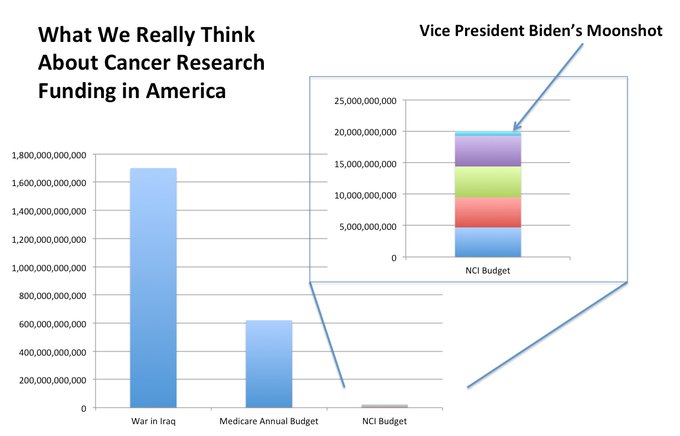
I take it you're not familiar with "crowdfunding" sources like the AACR, LLS, ASCO, or other professional societies? As someone who is funded by several of the above, and who noted that their review processes were substantially less bullshit-intensive yet no less rigorous than NIH review (which has many benefits, efficiency not among them), I'm going to go out on a limb and suggest that it's possible. As far as the NSF, they do a good job with what they have, but what they have is not commensurate with what we as a society could stand to spent on science. Even NCI is a far cry from that: https://pbs.twimg.com/media/CmLJzKQWkAAl372.jpg:small Distributions are similar for various other avenues of funding, and it is quite clear that the overhead & administrative costs requested by many recipient instutions are far out of proportion to actual needs, so the impact of the funding allocations is further reduced. Thus it appears that a direct conduit from potential patrons to researchers is, in fact, desirable. Otherwise, services like experiment.com would not exist. They're not at the level of an NIH study section (duh?) but they have consistently produced a small stream of usable results that belie their supposed irrelevance. Once upon a time, the Royal Society existed for just such matchmaking: find a rich patron and a promising young scientist and line them up. You've likely noticed that many if not most major universities and "centers of excellence" rely upon exactly this model, supplemented with NIH or NSF grants, to exist. Further modularizing the model so that an administrative hand yanking out bloated "indirects" at every turn is not mandated might not be the worst thing, or (alternatively) being more transparent with said O&A requests, might at least bring some of the bullshit under control. The public clearly wants accountability. The masses may be asses, but if we want their money, we really ought to be transparent about what we're doing with it. |
EDIT: And to clarify, in the societies I know, general members do not directly take part in grant decision processes. Rather, the decisions are made by a small panel, possibly together with external reviewers. This is fairly different from crowdsourcing.