Hacker News new | ask | show | jobs
by fennecfoxen 3672 days ago
The F train to Coney Island is actually three track for a portion of the route, IIRC. (So are many of the above-ground sections on the numbered lines, especially the 7.)

But more generally, I don't think that 4-track is quite the pancaea you suggest. In fact, they've been moving towards "FastTrack" repairs which involve a total shutdown of a line overnight or over a weekend. The MTA likes it. It's faster and cheaper and less dangerous for the crews involved. The thing that makes it not-so-disruptive, though, is that the NYC subway is massively redundant: if the Second Avenue Subway is closed you can take the Lexington Avenue Line which is a block and a half away (Lexington = 3.5th Avenue). Four-track service has nothing on this.

Of course, building it as 4 tracks should have been eminently feasible on the budget and timeline the city has , but the ways that NYC finds to waste money and not-make-stuff-happen are legion and run the gamut from transit to education and beyond...

2 comments

> Second Avenue Subway is closed you can take the Lexington Avenue Line

It's funny that you picked this as an example, because the 2nd ave subway has yet to open even it's very short initial segment, and the 4-5-6 (Lexington Ave line) is the least redundant part of the whole NYC subway system. It's the only north-south line on the East side, and it carries more people per day than the entire subway system of any other North American city.

Once they build out the 2nd ave subway to the bottom of the island things will be redundant...but that's decades away. (They won't even start construction on the second phase, which only takes it up to 125th st, until 2020.)

You point generally applies to the rest of the system, though.

That's true.

But as far as making the second-avenue 4-track, it isn't the sort of thing that's going to make the subway open sooner to achieve that redundancy. Indeed, it was planned as 4-track and this abbreviated over-budget late 2-track stub is what we got instead.

It's shameful, but that's basically the story of NYC transit, dating back to when the city first drove the IRT and BMT subways into bankruptcy and then followed headlong after them.

How did NYC drive IRT and BMT into bankruptcy? It's my understanding mass transit isn't profitable in the modern era.
NYC had a contract with the IRT and the BMT. The contract said that fares would be a nickel. This was before the modern era in which inflation was a thing (historically deflation was more common than inflation, barring gold rushes and the like) in 1913 or so.

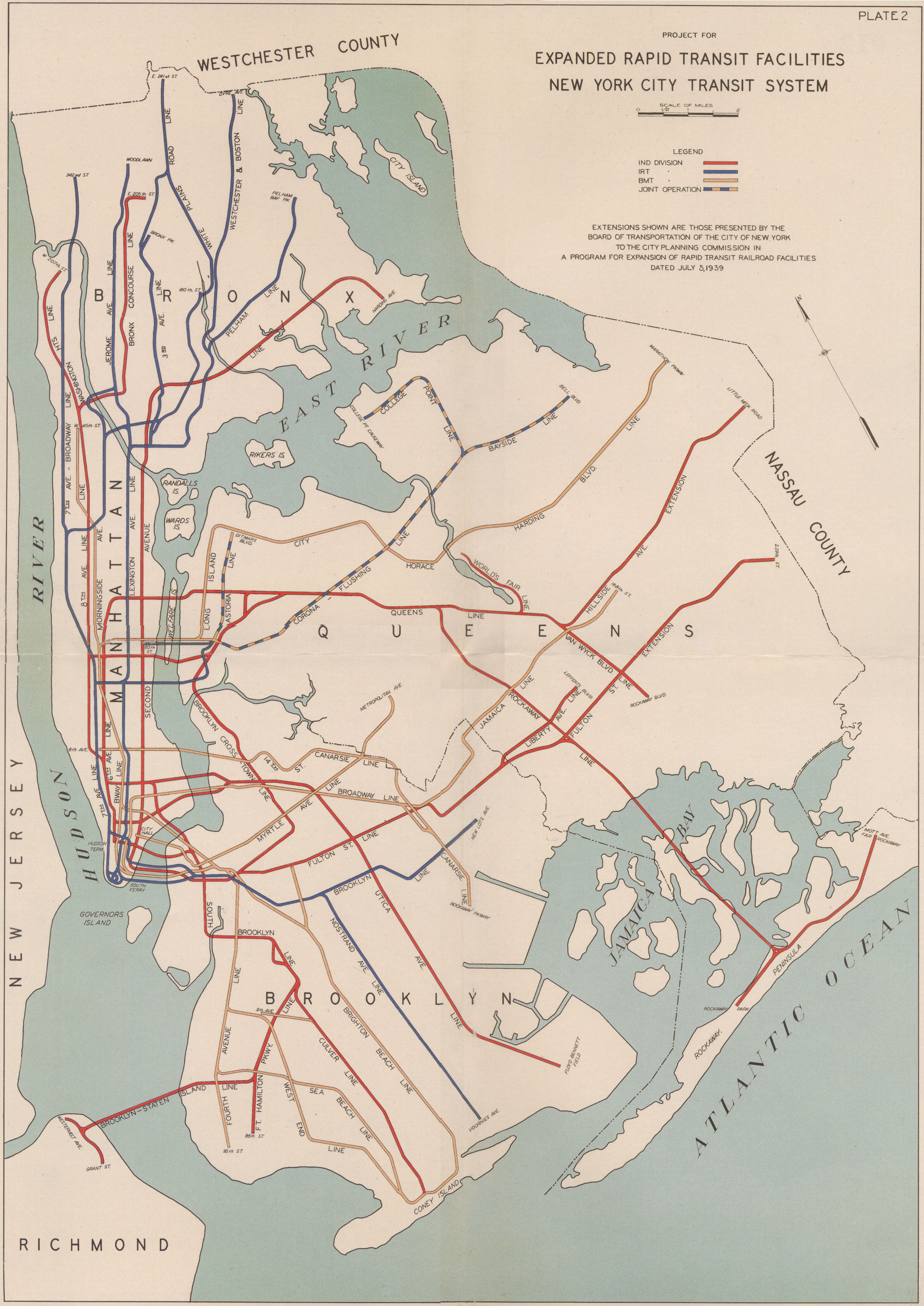
Fast-forward 5 decades. Inflation is real but fares are still a nickel. The city is quite happy with this contractual arrangement, quite happy to make the railways stick to it, and quite happy to take over their operations once they fail. Then they started their big "IND Second System" plan to build a kajillion subways out into all the different stretches of the boroughs (including the Second Avenue Subway up to Throgs Neck): https://upload.wikimedia.org/wikipedia/commons/b/b3/1939_IND...

... and by 1975 the city was on the brink of bankruptcy too.

As for mass transit in the modern era, it's certainly not surprising that it's unprofitable given who's operating it. Profitable mass transit is surely impossible today... politically, anyway. :b

Thats a wonderful map.
They didn't New York City bought the IRT, BMT and the IND - the original competing subway lines. The thought was that that the city shouldn't be beholden to privately owned transit systems. The sick irony is that now New York City is beholden to a monopoly(MTA) and as with most monopolies they are a dysfunctional, bloated bureaucracy, who have little incentive for improving service or innovating.
It is, in Hong Kong, and massively so. The MTR there had to reduce fares temporarily... to avoid too big a profit.

The real MTR strategy, though, is that they get to choose where stations go. That allows them to buy up land in the area, before they announce a train is going there. The land next to the train station suddenly skyrockets in value... and the MTR make out like bandits.

This is a Manhattan-centric point of view though. Lines are close in Manhattan, especially downtown where they converge. They're much farther apart in Brooklyn, Queens, and the Bronx. Four track is very useful for running express trains also.