| In a properly tuned system with sufficient CPU capacity there should never be any full GC pauses with G1. To get 10msec pause times with such huge heaps requires burning a LOT of CPU time with the standard JDK collectors because they can trade off pause latency vs CPU time. This presentation shows tuning with 100msec as the target: http://www.slideshare.net/HBaseCon/dev-session-7-49202969 Key points from the slides: 1. HBase setup with 100 GB heaps 2. Older collectors like CMS (still the default) sometimes take long pauses, like 5 seconds (not 5 minutes). 3. The new GC (G1) must be explicitly requested in Java 8. The plan is for it to be the default in Java 9, but switching to a new GC by default is not something to be taken lightly. G1 is, theoretically, configurably by simply setting a target pause time (lower == better latency but more CPU usage). Doing so eliminated all the long pauses, but a few collections were still 400msec (10x improvement over CMS). 4. With tuning, less than 1% of collections were over 300 msec and 60% of pauses were below the target of 100 msec. Given that the Go collector, even the new one, isn't incremental or compacting I would be curious how effective it is with such large heaps. It seems to be that a GC that has to scan the whole 100GB every time, even if it does so in parallel, would experience staggeringly poor throughput. Value types will certainly be a big, useful upgrade. |
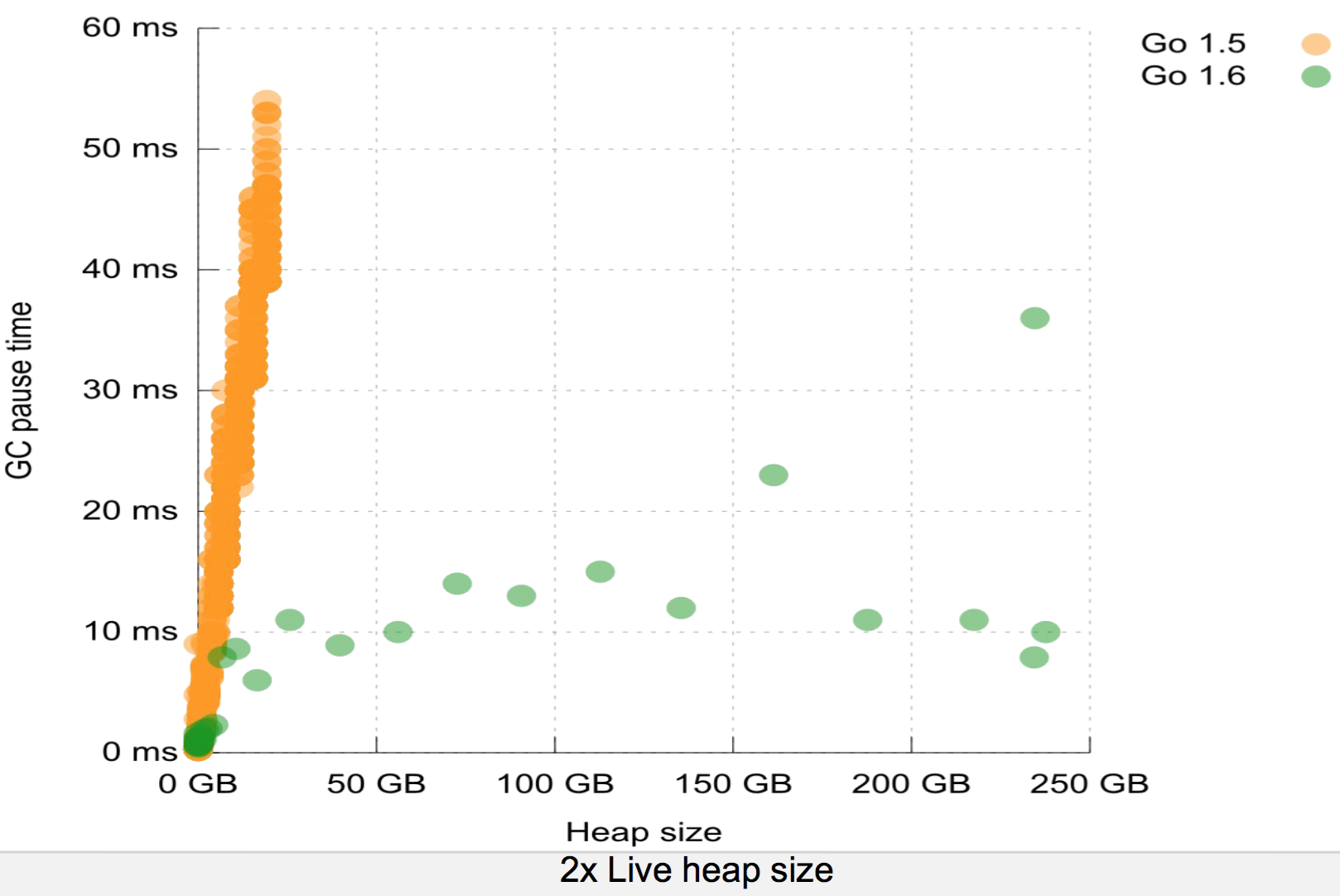
So you use a language without value types that makes you pay for two or three times more memory than comparable languages, and then you spend your time re-tuning the GC every time your allocation or usage patterns change. Then you hope to never trigger a full GC that could stall the VM for many seconds (or in extreme cases that I have seen even minutes). That makes very little sense to me.
I cannot speak to the performance of the current Go GC for 100G heap sizes. I never tried it and I haven't read anything about it. It's not my language of choice for that sort of task either.