Hacker News new | ask | show | jobs
by rgbrenner 3733 days ago
The growth in hard drive space is called Kryder's Law [0] (like Moore's law). There's a paper from 2012 on the cost of long-term storage [1].. and here's a quote from the researchers blog[2]:

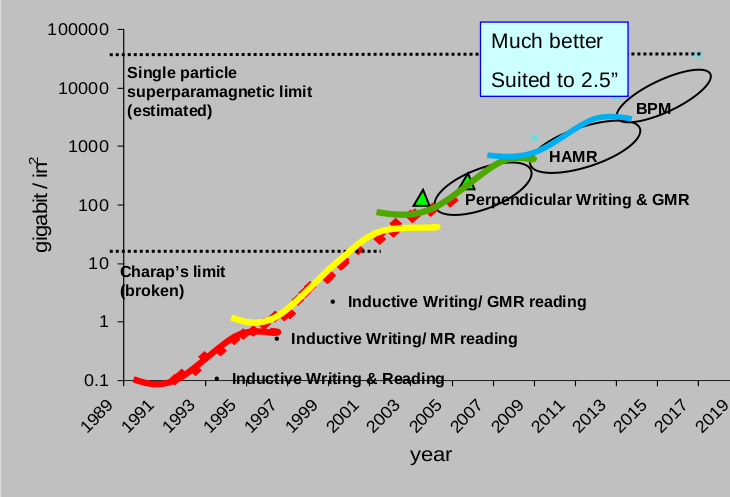
Here is a graph I got from Dave Anderson [director of strategic planning at Seagate] years ago. It shows that what looks like a smooth Kryder's Law curve is actually the superposition of a series of S-curves, one for each successive technology generation. Naturally, because the easy transitions get done first, the cost of each successive transition increases, perhaps even exponentially. Since margins are constrained and so, these days, are volumes, to generate a return on the investment in each transition requires that the technology be kept in the market longer. The longer interval between transitions translates to a lower Kryder rate.

http://4.bp.blogspot.com/-bkuDDrBpcZE/TpMsLTEspsI/AAAAAAAAA9...

0. https://en.wikipedia.org/wiki/Mark_Kryder

1. http://www.lockss.org/locksswp/wp-content/uploads/2012/09/un...

2. http://blog.dshr.org/2012/10/storage-will-be-lot-less-free-t...

2 comments

FWIIW; worked in Kryder's lab at Hammerschlag Hall as an undergraduate in the 90s: he's one of the best people I've met in the sciences. The E.O. Lawrence of hard drive technology.
So, the rate if increase (in density) is slowed by lack of demand for storage?
> lack of demand for storage

and in turn, demand for storage is slowed by lack of need for storage.

The real question should be: Where's my 4K video? My 10-bit-channel images? My lossless audio?

Yes they are here but not nearly as common as content delivered in ancient formats from over a decade ago. For example go on a wallpapers subreddit, the vast majority is still in 8-bit 1920x1080 JPEG. Video is still mostly 1080. The leading music services still deliver in 2-channel lossy formats. And this is 2016.

Most of this I suppose is because of the general slowness of the internet and the usage caps in many areas of the world.

So maybe improve internet service -> create more detailed content and let people save it -> people will want to demand more storage to store all that in.

>Yes they are here but not nearly as common as content delivered in ancient formats from over a decade ago. For example go on a wallpapers subreddit, the vast majority is still in 8-bit 1920x1080 JPEG. Video is still mostly 1080. The leading music services still deliver in 2-channel lossy formats. And this is 2016.

Ever experienced YouTube buffering on an average connection? And that's for the metropolitan US -- consider the developing world, or even rural US, the mobile internet caps, etc.

Not to mention that even if you have enough speed, still you don't get much benefit from 4K video for 99% of stuff out there. Diminishing returns. I should know, I have projected good 1080p video to movie theaters, and nobody would call it bad or inadequate. On an average 15-27" monitor? It's not even an issue...

The rest of the world doesn't matter. If there is sufficient demand for 4K video and faster connection speeds, there will eventually be a product for them.
>The rest of the world doesn't matter.

Said the American. In fact, probably the US doesn't matter in this regard, as it has lower average speeds than most of Europe and SE Asia.

For a lot of things, that extra resolution is not really any benefit. Particularly for content that wasn't ever recorded at that level of fidelity anyway - I don't need 4k versions of Seinfeld re-runs, or SpongeBob SquarePants for the kiddos. Most of that stuff doesn't even need to be 720p.

Besides, pirated video content was really the only thing that most normal people could fill up their hard drives with (okay, maybe GoPro people or people with huge Steam libraries, too), but the Netflix and YouTube and Amazon Prime have taken a huge chunk out of that.

Also people who shoot raw photos. They're like 35MB each, an order of magnitude bigger than jpegs. They can eat up gigabytes (though to be fair, not terabytes) pretty fast. I have about 525GB of photos and videos that I've taken over years. Something like 300GB is jpegs. If I'd exclusively shot raw files I would need 3-4TB to store everything.
And 4TB these days only costs ~$120 http://www.amazon.com/Seagate-SATA-3-5-Inch-Desktop-ST4000DM... though it's still a chore to manage and backup so many photos
> it's still a chore to manage and backup so many photos

I can't wait for a photo manager with some kind of AI that goes through the pictures I've taken myself and offers them based on "feel good vibes", "eerie", "cozy" and so on, and learning what I like as it goes.

Apple please?

And yet, have you seen the 4k content out there? Breaking Bad was awesome, but is that really better in 4k than, say BSG or Planet Earth? I bought a 4k TV to use as a monitor several months back and started researching content - Most of it is eyebrow-raising, to say the least. I remember when 720/1080 were first introduced, there was an expected dearth of content, but at least what was out there was worth high-def (flyovers of tourist destinations, PBS nature documentaries, etc). For example - Here's some of Netflix's offerings in 4k:

  Series:
  House of Cards
  Marco Polo
  Breaking Bad
  The Blacklist

  Movies and Documentaries
  Smurfs 2
  Philadelphia
  Jerry Macguire
  Crouching Tiger, Hidden Dragon
  Oceans (documentary)
  Forests (documentary)
  Flowers (documentary)
Edit:formatting
Right. Did you know that DVD's still outsell BluRay's?
Maybe consumers only see the hard resolution as a differentiator and they're both 1080? Maybe BluRay has some uncomfortable restriction.

Either way it's the content producers and publishers' job to create more higher-quality and make consumers aware of it and make it easier for them consume it.

In this Age of YouTube, some of us can play our part by recording (as some recent phones/tablets can) and uploading in 4K. Design wallpapers in 4K. Even just seeing the higher resolution in the list of available options will increase awareness and pique more people to try a 4K display out.

While we're at it, let's make 10-bit/channel content more common too, now that the latest Macs and iPads have 10-bit displays. Anime fansubbers have already been producing 10-bit videos for a while.

Yes that's an important point. There are diminishing returns with better resolutions. Twice the resolution doesn't mean it appears twice as good, and at higher resolutions it can even be hard to tell. At some point you exceed the resolution of the human eye and ear.

But I think storage space still matters on mobile. I haven't come close to filling up my laptop after 4 years of use, but I have to be careful about putting stuff on my iPod. Still it can store dozens of hours of audio, so it's not the biggest issue.

If VR gets popular, it might be a driver for higher storage demands. For non-foveated imagery 4K is even quite limited.
Sure, perhaps there isnt strong consumer demand. But with analysis and value-extraction from big-data becoming easier, and machine learning becoming more accessible, i think there will be plenty of commercial and industrial demand which can drive up need.
>and in turn, demand for storage is slowed by lack of need for storage.

Are you talking about consumer storage? Because need for enterprise storage (which I sell), is only increasing. What is decreasing is the revenue/profit per TB (naturally).

> Are you talking about consumer storage?

Once content producers make more higher-quality content, and enough consumers start consuming it, then won't the content providers need the extra storage too to serve that content from?

Also form factor is getting smaller
Sure, that's at least part of it.. since if demand is lower, that increases the time required to recoup the investment on new storage technology.