Hacker News new | ask | show | jobs
by mmastrac 3773 days ago
This might give people a taste for what really modular devices like Ara can offer, but the fact that it doesn't do battery swaps without powering down is going to make it far less interesting to people. An internal battery to give you 30-60s in an emergency hibernate mode would have been game-changing.

Kudos to LG for actually taking this step though. With luck this will whet the appetite for phones that are truly modular (and show manufacturers that there is a market for swappable parts).

4 comments

I've never heard of someone needing a phone to stay on while changing the battery.
Few people may _need_ for a phone to stay on while changing the battery, but is a huge plus. I spent over a year on a phone that could hot swap a battery if you do the swap smoothly, and avoiding the need for a reboot was definite pleasure.
My last iPaQ could do this trick. There was a button cell NiMH next to the LiIon cell to keep it going.
Well as the article points out, adding modules involves taking out the battery. There might be other design options besides an extra battery/super capacitor, but it kinda weakens the utility of quick change modules.
> Well as the article points out, adding modules involves taking out the battery

Are those modules hot-swapable? If the hardware and/or software does not support hot swap, there is a distinct possibility that they intentionally designed it this way: i.e. you have to power down before replacing modules. It would not be much more difficult to switch to "push-to-eject" battery mechanism which would make powering down optional when changing modules. Food for thought.

I bet a huge majority would prefer it. It's just not really been a sensible compromise, so no one even thinks about it.
Of course they would prefer it, if there were no trade-offs. But as you point out it's not currently sensible.
It's pretty common in enterprise-grade handhelds like Windows Embedded devices to include a little bridge battery.
I switched from Android to iPhone and hence had to switch from swapping out batteries to plugging in an external battery. Now I'd never go back, the whole reboot/swapping procedure is kind of a PITA
I'm someone who regularly swaps batteries (a few times a week) and don't give a slightest toss about this feature.

I can wait 30 seconds while the phone is off.

My lenovo x250 laptop has an internal battery that does exactly this, lets you swap the external one without interruption. I haven't used this much but I can see how important it is for someone on the go.
> internal battery to give you 30-60s

you meant a super condensator, right?

Supercap or battery: anything with a decent enough density to give you enough time to swap the battery without losing state or being stressed out.
A cap like that might not fit.
Maybe .. another battery? One with 5-10% the size and capacity of the main one? Although in both cases the power management is a little tricky.
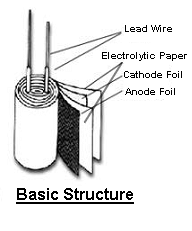
Capacitors can be made in a variety of shapes, internally they're a simple sandwich-like structure of a couple different types of material:

https://upload.wikimedia.org/wikipedia/commons/thumb/3/35/Pa...

Capacitors are usually cylindrical to increase the available surface area whilst keeping the horizontal size down ( http://www.camion.com.tw/images/en_basic_structure.gif ), but they don't have to be designed this way. Here's an example of a flat supercapacitor:

http://gpsworld.com/cap-xx-launches-0-6mm-thinline-supercapa...