Hacker News new | ask | show | jobs
by smegel 3810 days ago
> explodes on landing

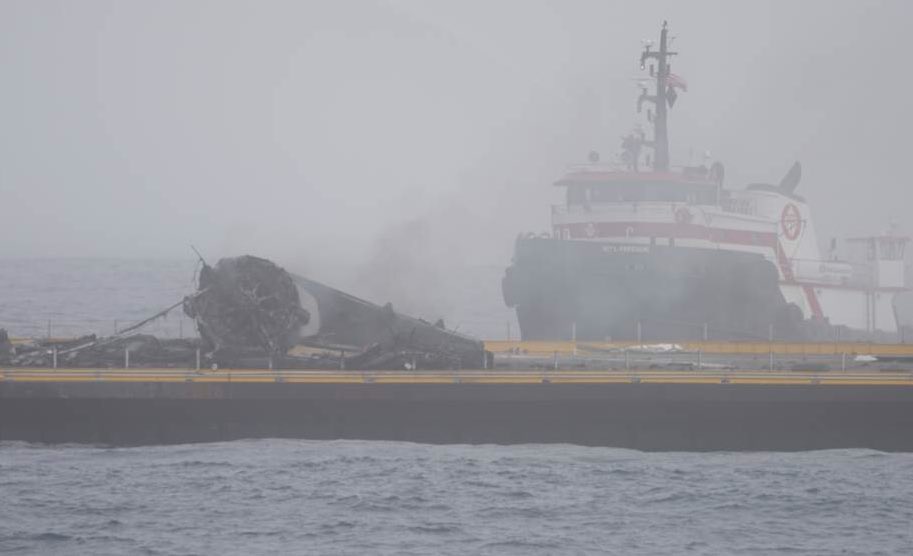
This is a pretty unfair characterization. It actually made the landing for most purposes, then a specific failure occurred - a leg failed to lock and it fell over. And yes, when a rocket falls over it will often explode.

4 comments

As someone mentioned on Reddit

  Succeeded to land. Failed to stand.
Haha... Made me think the Olympics. What if they had a rocket landing event.
It landed, just didn't stick the landing :-)
"Explodes after landing" would be more accurate, I think.
and the "explosion" is borderline, it's very close to just "burns really fast", especially when you see what's left after the fire goes out: https://pbs.twimg.com/media/CY8-PdyU0AABqaa.jpg:large (there's quite a lot of rocket left)
That's a trick of perspective and scale, you are not seeing a rocket but one landing leg intact attached to the engine block. The tube exploded as you'd expect when it fell over and disintegrated.

Not really important though, they got the hard part right.

I'd work on engineering that, if possible. I mean if 10% of rockets fall over, but you could get them to not explode then you'd still be up.
I think people have a hard time grasping the scale of this stuff, and therefore the fragility involved.

Getting the rocket to survive falling over is extremely difficult. It can't even survive normal flight loads without the propellant tanks being pressurized, because it needs the extra rigidity to avoid collapse.

The margins involved are extremely slim. For a more familiar point of comparison, consider that a 747-400 (which is about as long as a Falcon 9 is tall, not that this means a whole lot) weighs about 180 tons empty, and can carry about 170 tons of fuel. The Falcon 9 first stage weighs around 25 tons empty, and carries about 400 tons of fuel and oxidizer. (Note that numbers are approximate, since official numbers are hard to come by.) That means that, sitting on the pad and ready to go, a Falcon 9 first stage is about 95% fuel, and 5% everything else. That 5% has to account not only for fuel tanks, but engines, hydraulics, support structure to hold up the ~100 ton second stage and payload, landing legs, and everything else that makes it a rocket and not just a pair of tanks.

Now you bring it back, let it fall over, and catch it in a way that doesn't break it. This is something about as tall as a decent-sized office building, with a roughly zero tolerance for sideways force of any kind. Imagine tipping over the Statue of Liberty and catching it without bending anything.

It's orders of magnitude easier to make sure the rocket doesn't fall over in the first place. You want to concentrate your efforts where they'll have the best return, and in this case there's no contest, it's not even close.

The video pretty clearly shows/sounds like an explosion. Not a huge one, but one none the less.
Borderline?

https://www.instagram.com/p/BAqirNbwEc0/

Definitely an explosion.

"Burns really fast" is literally the definition of a chemical explosion.
Suboptimal occurrence after a near-perfect landing forces SpaceX to reconsider strategies for next launch.
As a (student) pilot, I agree. You aren't landed until stationary and stable.
"Explodes after landing" would also make for a great ship name from Iain M. Banks' Culture series too, as Musk likes :)
> And yes, when a rocket falls over it will often explode.

Why? Why would a small hit make it explode, when the stress of going from orbit does not?

Because like all rockets it was designed to handle any expected aerodynamic loads with a certain margin with minimal mass.

Essentially the right parts just popped like a balloon. Falling on your side involves much different loads than being propelled into orbit. There's little value to designing a rocket to withstand such a fall.

I assume it's due to the liquid oxygen remaining in the booster; essentially its a towering pressurised container falling on its side causing a breach.
Different stresses.
To elaborate, the rocket can take only about 1 atmosphere of pressure in the radial direction, but much more force in the longitudinal direction. It's designed to withstand the stresses of going in a straight line, but as soon as it bends it'll crumple, like a toilet paper cardboard tube.

So when the thing topples over, it bends. And when it bends, it ruptures because it's far in excess of the loads under standard conditions.

It's not an unfair headline. It did explode when it landed. This is not good, no way how you twist it.
It's actually quite good. It's not as good as if the rocket was recovered intact, certainly, but for the fourth landing attempt ever of a highly experimental test program, this is a very good result.
It did not explode when it landed. It exploded after it landed. This is an important distinction, because the latter is a thousand times harder to accomplish.
Let's say they permanently remove one leg and it now always tips over on landing and has no stable landing configuration. Could they bill that as a self-landing rocket?
The point is that the ability to land is much harder to develop than the ability to stand up after landing. Improving the leg locking mechanisms is relatively trivial compared to developing the ability to turn a booster around in space, fly it back to earth and land on a floating platform.

If I was involved in SpaceX then I would be proud to have helped solve such a tricky problem, and optimistic about fixing the far less difficult leg locking problem

I agree it is a big achievement. I just wouldn't call it a successful landing. If the moon landing had involved immediate tipover and explosion with a leg that didn't deploy, I think a subsequent landing would have been considered the real first successful landing.
Eh probably. What a strange question.