Hacker News new | ask | show | jobs
by newman314 3841 days ago
While it's nice that you have your own spreadsheet interface, how hard would it be to hook Excel in as a front end?

I deal with large enterprises primarily and I've been looking for a nice relational backend for Excel for years.

So breaking out the roles of a consumer vs. a creator, I would like end users to consume without knowing that there is a different backend to the Excel sheet they are using while still freeing up the creator to do what is needed on the backend.

For example, we have extremely complex pricing spreadsheets that we use to estimate projects, it would be fantastic to be able to collate and manipulate data on the backend as well as data sources while being able to tell an end user to keep using Excel as the front end as before.

Maybe this is a fit, maybe it isn't but any insight/feedback would be welcome. Thanks.

4 comments

Thanks! At some point I think we'll have an integration that allows data syncing to and/or from a spreadsheet like this.

The spreadsheet isn't ideal as the primary UI for a number of reasons. That's why we built our own UI, inspired by spreadsheets but fundamentally breaking from the model to be more like a relational database.

But a spreadsheet connection could be great for reporting, modeling scenarios, etc. – basically, all the things that spreadsheets are actually good for.

I've been shocked at the number of enterprises with workflows involving shared Excel docs (particularly in the eCommerce space). One of my (Magento) community members has a business which seems to tackle some of the issues around this: https://www.cobby.io/

Might be worth having a chat with him.

I disagree strongly with an interdependence on Excel. Instead, it would make sense to ask what new functionality could be added - and start by looking at major applications of databases (you might be surprised to hear that scalibility and reliability are much more important than most think - and almost always beat other features for adoption by paying business customers). The Excel UI is a boat-anchor to innovation in the space (no reliability/scalibility or modern architecture). The Web is the new de-facto GUI, and it should be possible to start adding functionality that Excel would be hard-pressed to replicate.

I should add that I was once a Product Manager for core database at Oracle. We had constant requests for an Excel front-end to Oracle. I don't know if we had any major customers who didn't ask for a spreadsheet front-end at some point. But we were busy making money on other things, and it just wasn't a priority (though consulting routinely built hooks.) So I think that this has the potential to be a huge product - especially if it can leverage new technology in ways which Excel can't. Don't let Excel and Microsoft drag this product down.

Hi, sheetsu.com creator here. If you are looking for an Excel as DB for your front-end give it a try. Paste link to your Google Spreadsheet and then you get an URL to the API. You can CRUD your Spreadsheet using that API.

More info here - https://sheetsu.com/docs/beta

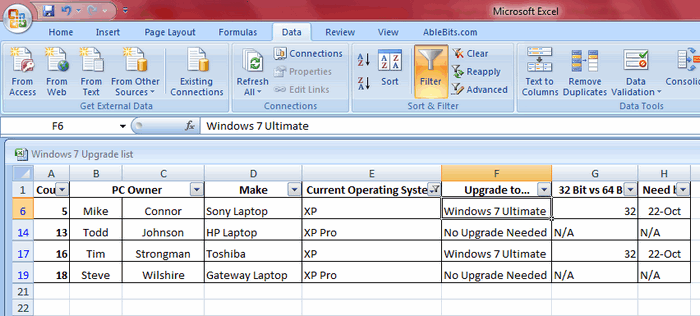
Excel-as-a-front-end hooks in so nicely and easily to SQL Server Standard via standard ODBC/ConnectionStrings. You get audit tables, integration with Active Directory, SSRS, concurrent modifications, the ability to dynamically perform queries (i.e. [1], if you enable a filter clause on your projection from one of those DropDownLists, it will send it out to SQL Server and then return the resultset), audit trails, permissions, and most importantly you can set all of those NON NULL, FK, restraints at the database level, and use SQL Server Reporting Studio (comes with Standard) to perform your reporting. Priced out per CPU you can get it for under 10k. I've done it legally for free too[3] in my early years, but if your client won't pay 10k for a RDBMS, you've got a tire-kicker who won't respect net/90 much less net/30. I've done literally dozens of times for every type of industry you can imagine and I can count on my left hand the number of times those clients needed to later supplement their infrastructure with an actual data-warehouse. (Also the newer Excel versions allow data constraints to a certain degree, so you can avoid that unnecessary transaction/lock acquisition in an anticipatory fashion.) Combine SSAS/SSRS, and the free downloads of PowerPivot and PowerBI and you have a _very_ robust, flexible system that can handle millions of rows easily.

[1]https://www.ablebits.com/_img-blog/find-duplicates-excel/sel... [2] https://www.microsoft.com/en-us/server-cloud/products/sql-se... [3] SQL Server Express + the Express version of the Business Intelligence Suite was free for production use up to 4 GB and 2(?) processors [things might have changed since then, SQL Server 2008]. A few hundred lines of SP's to dump stale data out and the client was golden.

How much of this is manual effort vs. built-in? Every example I've seen that actually updates data in the database winds up with a pile of VBA.
I've done it one of two ways - via VBA and via VSTO Add-ins. My VBA version has been carefully crafted to emulate a pseudo-ORM based off INFORMATION_SCHEMA and all, making it pretty portable. It works fairly well because what usually ends up happening is say Partner Foo will have his read-write to his schema and it will all be segmented up via catalog views and other rules. There are the standard concurrency issues (you have to discuss with your client whether you want him to take a mutex on the result set, or potentially allow stale data) so it's fairly naive in that regard. The upside of it it's all self-contained (i.e., not a pile) and portable because you effectively get "reflection" with any sufficiently decent RDBMS impl. Maybe 10-15% of that VBA has to be tweaked based on their business requirements (defining behavior like if pri_row gets deleted in table foo by user bar, do you offer a prompt to cascade delete[1]?)

In some situations [such as a cascade delete], the business requirements need the Stakeholder or PM or TL or whomever to authorize certain events due to internal corporate governance policies. At that point, the VSTO add-in route is taken because usually there has to be integration with other governance/workflow software (one of the subsidiaries for Blue Cross/Blue Shield I worked with was notoriously bad re: pushing the buck and over-complicating workflows). Anyways, the MSVS sln I use with that is pretty much the opposite of a VBA pile.

[1] There's almost never any destructive DELETE's taken, rather a boolean active flag is toggled, and a new row is inserted with a more recent timestamp so you can '...order by timestamp desc limit 1'. That way if auditors come in, not only do they have the full audit log but we can reconstruct state at any given time.

Either way, a naive VBA implementation that doesn't appeal to system tables for all the schema info can easily be written (in a maintainable fashion, as maintainable as VBA goes at least) in under a week.

Thanks for taking the time to fill in some of the details!

This is the most detailed explanation I found regarding the VBA method: http://www.toadworld.com/platforms/sql-server/w/wiki/10392.e...

And the company you linked originally gives away a generic VSTO add-in: https://www.ablebits.com/excel-addins.php#sql-server

The part I was missing was when you said 'audit tables [and] audit trails' (etc.)... it sounds like this would all be build-it-yourself.