Hacker News new | ask | show | jobs
by astrocyte 3979 days ago
All of this works in cycles. There once was a time when people were flocking to the suburbs. Now, it is fashionable to live in the city. This too will pass when people (a generation maybe) comes to understand the little value obtained from all the chaos and activity.

What are people chasing? Technology has made it easier to be in touch and socialize w/ people beyond physical geography. Transportation is getting better. Yet, people are centered on cramming into cities. The concrete jungle... Living among all the action but having no time to enjoy it because you're too busy busting your ass to pay for the insane cost of the 'privilege'.

I used to live in Mountain View, CA and knew more about San Francisco and the cool things than most of my friends who lived in the city. Many times, I could get to places in the city faster than friends living in it.

What's the allure? When I think of California, I think of the beautiful outdoors and geography... Not cramming into a concrete jungle.

Hey look, I live in the city. I don't have a car. I pay a company to clean my place. I pay a company to do my laundry. There is no parking available for friends visiting me. I can't host anything at my place because its so small. I have to do all of my get together events 'out'.

The city generally provides the illusion that you are part of something that's bigger than you really are. Young people haven't formed a clear definition of this. So, they flock to the city which provides it in 'instant' form. This changes when a generation after realizes the cons of one thing and seeks out the pros in another. Or, when you get older and wiser.

As the saying goes, a smart investor is selling when everyone is buying and buying when everyone is selling. With all of the distractions of technology around me, I desire peace and quiet when i am at home. When I want noise and chaos, I go to the city. The big thing is, I have a choice in the matter and live by the beat of my own drum.

When you are young, you have no sense of this 'beat'. The city provides a steady one. Will the youth be able to maintain affordability of the city? How long will this cycle last?

https://resilienceeconomics.files.wordpress.com/2013/03/40-y...

Arcade Fire - Album (The Suburbs) 2010

Choice song (Suburban war)

7 comments

When I think of California, I think of the beautiful outdoors and geography...

Which an office park isn't, either.

Of course the outdoors and mountains are very attractive but they're not a viable workplace. While many of your city complaints are valid, it's not as if the suburbs solves all of them.

"There is no parking available for friends visiting me."

Sure, and if you live in the suburbs there is plenty of parking but nothing to do.

>Sure, and if you live in the suburbs there is plenty of parking but nothing to do.

It all depends on the person. When I was younger I enjoyed city life, but now that I am older and have kids I prefer hanging out with them at the park near my suburban dwelling.

The city offers certain people plenty to do, and the suburbs offers other people plenty to do. Finding out which one appeals to you and getting there is one of the tricks to enjoying life.

100% agreed. That being said, there are larger trends beyond an individual. Dominant ideology exists beyond my experience and your experience. When I was younger, I had a blast in SF. I wanted to be seen. I wanted to be discovered. I wanted to discover. Then you find out the truth and grow beyond it.

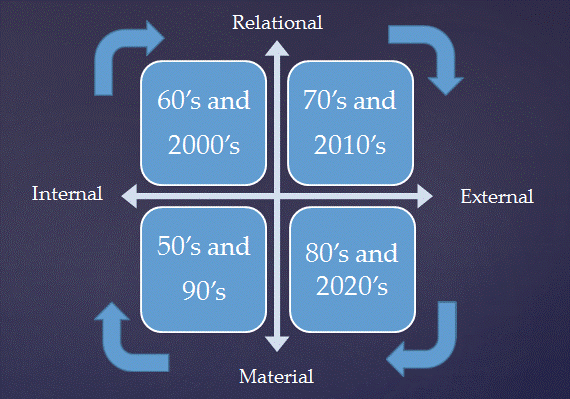
Some generations grow up believing they need to be in the city .. Some generations grow up believing the city offers nothing but noise. A more external generation loves the idea of a dense city. A more internal generation sees it as a chaotic detraction. This sets the tone beyond our anecdotes. Right now the tone is : external (city). This larger trend will change. It already has been demonstrated by the huge suburban dwellings that built en masse and the multiple generations who grew up in them w/ no desire for the city. I developed lasting relationships .. What did I do as a kid in the suburbs? LOL, I got an education and enjoyed an innocent and beautiful childhood. College/20's .. I enjoyed the city but never frothed over it (I was part of the suburban generation). There's a new wave that feels that no life exists beyond the city ... It's a cycle.. A trend ..

Taking the bay area as an example, living further towards south bay allows me to shoot out to the outdoors much quicker than being in the city. Office park? When I'm at work, I want to be focused on my work .. Not distracted by the noise of a city.

As for the city, when I want to go there and enjoy something in particular, that's what I do. You can list off every music venue, club, restaurant, cultural event, park event in the city .. I've probably been to the majority of them. It's called getting off your bum, and going to where you want to be. I can jump on 280 and can get to many places in the city (40-45 min) a lot faster than my friends who live in it.

Weekend in the city? Jump on BART and go explore. Bike around the city? Jump on BART and bike around the city. Uber/public transportation are there for me just like it is for people in the city.

The thing is : When i want peace and quiet I can get it. When I want to focus in my own space, I can have it....

The noise/chaos is attractive when you're young and have not found your own sound. When you have, the city becomes a lot less attractive. More interestingly, the city doesn't necessarily help you find yourself any faster.

The noise/chaos is attractive when you're young and have not found your own sound. When you have, the city becomes a lot less attractive. More interestingly, the city doesn't necessarily help you find yourself any faster.

Absolutes like this don't really help. That may be true for you, but it isn't for all of us.

Of course the outdoors and mountains are very attractive but they're not a viable workplace. While many of your city complaints are valid, it's not as if the suburbs solves all of them.

Given all the technology that supports remote working, it's a terrible shame that we still take this for granted.

This is not a cycle. What happened to urban development in the mid 20th century was a historical anomaly. People have always lived closely. Look at any historic town; they were designed for walking. And if you lived outside of a town or city, it was because you farmed the land.
Cities grew for thousands of years. Suburbs have had a 50 year run. Maybe it's oscillation on a exponentially increasing frequency, but I'm more inclined to think that suburbs were a temporary aberration.

People seem to like to be together, and throughout technological history the infrastructure scales better in cities as well, so even if people were indifferent to isolation vs. socialization the economics would favor urban development.

I'm skeptical that you can call this a cycle when we have no idea what's going to happen... Suburbanization isn't some recurring thing that's happened countlessly throughout history.

It's also possible to have urban, walkable neighborhoods where parking isn't extremely difficult or expensive. SF is pretty atypical in the US when it comes to population density.

Side note, living in a concentrated city is better for the environment since there's less human sprawl.
Actually it isn't (several studies have highlighted this). The reason why a lot of cities aren't better for the environment is that the insane cost force many people out to the cities edge who then have to commute in... negating a good deal of the concentration benefits.

Further, cities can wreak havoc on health due to the concentration of pollution, noise, etc ... Increase mental health issues due to stress/etc.

Human beings weren't meant to be crammed into concrete jungles in shoe boxes filled with noise and chaos.

Your data must be from the industrial revolution.

We have decades of data from dense European cities that indicate better health and quality of life. Also just look at the health of rural people versus urban people in the US--the obesity crisis ain't happening in cities.

>The reason why a lot of cities aren't better for the environment is that the insane cost force many people out to the cities edge who then have to commute in

That's not urbanization. Urbanization is where people live densely, removing the need for so much driving. Half of a suburban family's energy use is devoted to driving.

My data is on the analysis of U.S cities. Please use Google. That's what were talking about right?

Dense European cities are not designed like U.S cities namely in way of transportation systems... That's the number one point you're missing. Europe != US. Europe has tons of suburbs btw. You should travel outside city cores the next time you're there. Europe's transportation network doesn't revolve around highways and individual vehicle transport. Thus, they don't have the problem the U.S has in way of how people get into city cores.

Not to mention, you're missing a huge difference w.r.t to how jobs are scattered throughout the U.S vs europe and the affordability of housing therein.

Since the U.S's transportation system is not like Europe's nor are the city centers, the U.S's cities are most definitely not more efficient when you consider the total cost (the huge pollution cost, the time cost, and inefficiency of people who can't afford/fit in the city commuting in)

I really wish people would do more research before down voting people's comments and rebutting commentary with unsound rebuttals .. Downvotting is not for voting down comments you don't favor. You express that in comments and allow for responses to clear the air... which I have

> Also just look at the health of rural people versus urban people in the US

The rural/urban comparison (most studies of which include suburbs in the "urban" side) is a very different thing from the suburban/urban comparison.

> --the obesity crisis ain't happening in cities.

Yes, it is -- sure, its higher in rural areas, but the urban rate is quite high, too.

> All of this works in cycles. There once was a time when people were flocking to the suburbs. Now, it is fashionable to live in the city.

American suburbs are something of an anomaly. They've existed for a relatively brief period of time, and they seem to be waning now after a few generations. I think you may be conflating "small town" and "suburb" to some degree, when I wouldn't consider those things to be exactly the same. Towns have more centralization and more personality. Suburbs are characterized by sprawl and you tend to end up with chains and nothing really unique or notable.

> Hey look, I live in the city. I don't have a car. I pay a company to clean my place. I pay a company to do my laundry. There is no parking available for friends visiting me. I can't host anything at my place because its so small. I have to do all of my get together events 'out'.

I don't have a car payment, or a car insurance payment, and I don't have to deal with maintenance (cost or time associated with sitting at the mechanic). I actually do clean my own place and do my own laundry, but I've considered paying for these things to free up more of my time. I don't see essentially buying more time as a bad thing. I frequently host things at my place, but then I prefer smaller gatherings anyway. We cook, we drink, we talk, we play games. There's plenty of room for that.

> The city generally provides the illusion that you are part of something that's bigger than you really are. Young people haven't formed a clear definition of this. So, they flock to the city which provides it in 'instant' form. This changes when a generation after realizes the cons of one thing and seeks out the pros in another. Or, when you get older and wiser.

This seems like maybe a weird over-generalization of personal experience. I don't think I know anyone that's moved to the city to "feel like part of something bigger". There are a ton of good jobs here. I rarely have to leave a 2 mile radius because my favorite restaurants, doctor's office, grocery store, parks, museums and stores are all right here. I live a pretty quiet, comfortable life where a lot of nice things are very convenient.

> I have a choice in the matter and live by the beat of my own drum. When you are young, you have no sense of this 'beat'.

I honestly don't even know what you're talking about here, maybe another generalization of personal experience. I didn't move to a city to "find the beat of my drum" or learn who I am as a person or any of those things. I've lived in rural, suburban, small urban and massive urban areas. Both urban areas were far and away more enjoyable than the suburbs or rural.

I visited a friend out in suburbia recently and found the identical office parks full of identical grey rectangular prisms and identical houses and Chipotle after Chipotle depressing. All there seemed to be to do was drink shitty beer at depressing "Irish" pubs. She complains that my city is too dirty and requires too much walking. To each their own, I guess. But I don't think your change in personal preference is indicative of any massive cyclical shifts. I'd also argue that it's not neccisarily indicative of being "older and wiser".

> Suburbs are not an anomaly. They even exist in Europe in good numbers if you get outside city centers. The biggest reason why this is not so apparent to tourist is that they never go outside city centers. Many people commute and Europe has a good transportation network as the U.S will soon have to? Then what .... then city centers become less attractive as you can more easily get to where the action is without living a stone's throw from it.

Suburbs are not characterized by sprawl. There can be some suburbs that have sprawl. Others that don't. You're saying that the majority of the bay area is an anomaly? San Francisco is not the center of life. It used to be an average neighborhood with lots of poverty..(Cycle) ..

Most of the good restaurants are outside of it.. This clamoring to live in the city core is a new thing sparked by a generation in search of an advertised lifestyle of activity... The bay area's layout flies in the face of your sentiment.

> I live in the bay area too. I spend lots of time in the city. There are pros and cons. I have lived in both dense urban areas and suburbs. As such, I am not disillusioned about either.

> It's the stuff of million dollar research studies. There are macro social trends that function beyond your or my specific experiences. I am speaking about those and I am speaking about the general drivers that compel a whole generation to seek out things beyond a previous generation. It is a generational trend... One that will be cut short by the insane costs, the true economic correction, and technology that better improves transportation and telecommuting. And again, i have lived in dense cities and have been in every corner in SF.. I hear you. It's just not that serious. Take a look around you.. The majority of tech companies aren't in San Francisco. You think that's an anomaly? It's not. Start thinking beyond your own experience. Just because a bunch of social app companies are in the city and some scattered tech companies doesn't make for a big macro trend. The majority are outside of cities in suburbs.

> Your lack of understanding of what I'm talking about speaks to either your lack of experience outside of a city core (urban) area, lack of experience due to age, or bad experiences in Podunk suburbs. The majority of the bay area is a suburb. Get out of SF and talk to the people who live in it...

The majority of the bay area is a suburb. Get out of the city sometimes. It is most definitely not marked by shitty beers and chipotle. Some of my worst eating experiences have been in the city .. Some of the best restaurants are outside of it.

The bay area isn't some podunk suburb or rural area.. That's the big difference.. If you came from middle of nowhere suburbs to the bay area (straight to San Francisco), I'd question your 'experience' a little more and suggest you ask others for details about things you don't understand.

> Suburbs are not an anomaly and exist all over the world. The world outside city cores are not marked by chipotle and shitty beer. If you've traveled places and gone outside tourist areas or even explored the bay area beyond San Francisco, you'd know this.

The night-life in the city is unbeatable. That gets old as you age and desire more engaging experiences. Most things in the city can be enjoyed without having to live there. Insane costs push out culture anyway... A lot of the attractive/cool things in SF went to Oakland in search of a more affordable foundation... The upcoming generation isn't doing too hot in way of wealth.. As a result, interesting things are popping up in lower-cost areas.

Look up the demographic change that has happened in San Francisco in the last decade. The writing is all around you regarding cycles... Whether or not you're seeing it or not is another thing and you can live a long and enjoyable life not seeing any of it. To each their own w.r.t to personal happiness. Beyond that, you're going to have to dig a little deeper and draw from more varied experiences if you feel you want to chime in on such matters.

> Many people commute and Europe has a good transportation network as the U.S will soon have to? Then what .... then city centers become less attractive as you can more easily get to where the action is without living a stone's throw from it.

This is the crux of the issue. Cities were built around different modes of transportation (walking, biking, driving, trains) whereas suburbs were built up entirely around the automobile. This aversion to driving is something unique to Millenials; owning a car meant freedom and marked success to previous generations. These days, young people are comfortable with streaming services and the new shared economy, so "owning" something isn't important as it once was. Additionally, we face economic concerns (we're making less money and cars are expensive), political concerns (oil, in many cases, directly supports oppressive regimes), and ecological concerns.

In a generation or two, suburbs will have had to adapt to this change in lifestyle and commuter rail/light rail projects are already underway to connect the first ring to the urban cores. Additionally, I think more emphasis will be placed on rebuilding a town center/main street in the areas that can support it. Finally, self-driving electric cars will calm traffic immensely (imagine if all vehicles report to a centralized dispatch AI that can calculate the most efficient routes available, knowing exactly when to turn, stop, accelerate, etc using computer vision, path finding and flocking algorithms.) Cities and suburbs around the country are already adding bike lanes and pedestrian to roads.

From what you've said, it sounds like SF and the Bay Area may be more of an exception than the rule for the US as a whole. My only experience with it is one trip to Santa Clara, so SF is not what I'm basing my opinion on. Most suburbs that are not immediately outside of a major city are probably what you'd consider pretty podunk.

I've lived in places that really ran the gamut from middle-of-nowhere bible belt where we shared a party line with the few other trailers, podunk suburbs, to a small city, to NYC.

I don't do night-life, and I know a number of other people that don't really do the club/nightlife thing either. So maybe the whole find the beat of your drum/chaos/excitement thing is more referring to that. I have a pretty quiet, boring life in the big city and I love it. I'm a short walk away from a great greenmarket, tons of parks, a great bookstore, tons of good food, coffee, beer, etc., etc. And I never have to drive or sit in traffic.

>Now, it is fashionable to live in the city. This too will pass

Yes, when you decide to have children.

Or, when a generation who flocked to it, realizes it wasn't all that instrumental to their formation .. Just served as years of noise and chaos. So, they'll flee the city in droves , set up in the suburbs and then suburbs will be all the rage for young people hoping to have a more peaceful (involved) experience beyond the hustle and bustle of the city...

You say that will never happen? It already has and will again. It's the reason why there are seas of built up suburbs and a generation of kids and their kids who grew up in them.

There are cycles that exist beyond you... And sure, when you age and have had all your 'experiences', you get to reflect on which ones were of most value and you try to provide those for your kids. Of all my years of partying/being in the city and living it to its fullest, my biggest take-a-way was : I'm glad I experienced it enough to know I have no grand desire for what a city has to offer.