Hacker News new | ask | show | jobs
by zamalek 3991 days ago
I'm no engineer and my knowledge of CPAP extends to the amount of Googling I did since I saw this post.

Their constraints do seem very tight but I can conceive at least one way in that you could shrink the device down. There would be multiple actions in such a device:

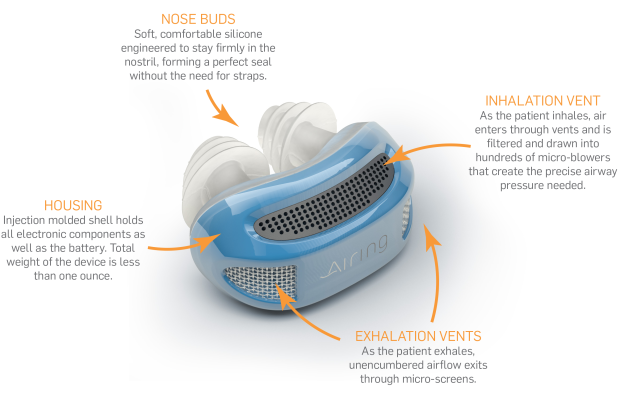
1. During the inhale increase pressure. As noted by the image[1] this is achieved in the device with "blowers."

2. During the exhale present a restriction to airflow, but don't cut it off entirely. You could use something similar to an aperture to restrict airflow here.

3. Between the exhale and inhale maintain pressure. If you use an aperture-like-device you can simply close the aperture completely.

This means that the device becomes partially passive, reducing power requirements. I'm no expert but let's assume that you are only inhaling 50% of the time - this cuts down the amount of time the "blowers" need to run by 50% (or can double their power consumption or something in-between). My uneducated opinion is therefore: remotely plausible.

http://res.cloudinary.com/indiegogo-media-prod-cld/image/upl...

1 comments

I don't follow your logic at all.

And you do not escape the fact that the device has got to move almost 3 kg of mass with about 1 watt.

> I don't follow your logic at all.

I have another try at communicating the idea.

It sounds like the main problem with sleep apnea is that the air passages are collapsed when it comes time to start inhaling - preventing the process from occurring. Therefore the core of the solution is having "inflated" air passages at the point when inhalation starts.

The idea is to kick-start the next inhalation with the current exhalation. When you exhale you increase the pressure in your air passages which is work ("wattage") that completely goes to waste - it all goes out your nose/mouth. The device would gradually restrict the passage of air out of the nose (as the exhalation process completes), eventually cutting it off completely. This means that once you have completely exhaled your air passages would still be "inflated." This is what (2) and (3) do. In this situation conventional CPAP would be providing pressure (even though it's not needed) and would hence be wasting work.

That is the special sauce: relying on the human to do work that they don't have problems with. This will reduce the amount of work you need to do to assist with their medical condition: possibly down to 1 watt, or at least way less than you'd need with conventional CPAP.

> 1 watt

The problem is collapsed airways and not dysfunctional lungs, there's still plenty of wattage there: all you need to do is keep the air passages open using (1).

As I said: a long-shot, remotely plausible. Most importantly: if the above is a plausible idea there is no guarantee that it's the same as theirs or that they even have one. Show me the patents.

At the same time it's better to ask questions before initiating a witch-hunt. I think the first plan of action would be for them to prove that they have a working device instead of the seemingly common "warning off people" suggestion. A better suggestion to people is encourage them to ask for proof.