Hacker News new | ask | show | jobs
by nimos 4036 days ago
I wonder if stagnating CPU requirements might make AMD competitive again.

I have a 4 year old i5 laptop that can handle 100% of general office/home use. Battery life and gaming are the only two weak points. AMD aren't going to compete with Intel on battery life but with overall cpu/gpu power consumption falling it's not as big of a problem as it used to be.

Wish they weren't stuck on 28nm still. It seems like Intel will be pushing 10 before they get down to 20/22... Maybe I'm just nostalgic of my overclocked Athlon 64 but I'd love to see AMD make a comeback and the nm gap between AMD and Intel just seems like kneecapping the underdog.

Realistically they are going to be launching this against Skylake and I can't help but think all the advantages they are promoting are going to get nullified by that. (HEVC and gaming performance)

5 comments

It looks like AMD is skipping 20/22:

http://en.wikipedia.org/wiki/Zen_(microarchitecture)

http://www.pcgamer.com/amds-next-gen-zen-cpu-due-in-2016/

Seems like the next chip after Carrizo is targeted at 14nm fin-something.

Which, if it pans out, would put Intel & AMD on the same node for the first time in a while. Supposedly Intel's first 10nm part isn't due until 2017:

http://en.wikipedia.org/wiki/Skylake_%28microarchitecture%29

The issue with TSMC/GF "16/14 nm" is that not all important features have been brought down to that level, so the actual shrink is less pronounced than usual. Furthermore, Intel's FinFET's are likely to be more mature than the competition, so I'd be wary of calling the two nodes equivalent. Close, certainly closer than the past, but Intel might retain its lead a bit longer.
Sure, they aren't equivalent, but at least it's closer than 28nm :) Also, while TSMC/GF are fudging the whole "14nm" thing, I would bet Intel is too. Node names are all marketing, and Intel is not above marketing.
nm has been rather misleading for past few generations, Intel is just as guilty as other fabs.

Not everything gets shrunk in modern die shrinks.

What my limited understanding is that transistors might be getting shrunk but wiring connecting transistors is not getting shrunk it is still at some larger number (65nm?)

CPU perf requirements may be stagnating, but perf/watt definitely isn't.

And it seems very unlikely for AMD to ever be competitive on that front.

That being said, that is exactly what Carrizo is about.
> It seems like Intel will be pushing 10 before they get down to 20/22...

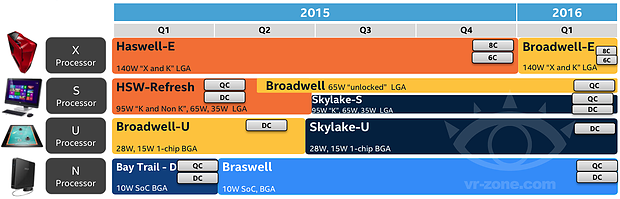
Intel seem to be struggling though, with shrinking not working out as they planned. They've missed one upgrade-round with the delay to Broadwell, and if the rumours are correct and they're releasing a couple of CPUs and then jumping to Skylake - that's quite a hit to ROI given the investment they've put in to an 'unused' chip family IMO.

Broadwell was delayed but Skylake is well on track. While there are not many Broadwell Desktop CPUs worth buying right now (Core i7-5775C and i5-5675C offer superb perf/watt though, especially the iGPU) the new round of mobile CPUs is still impressive and will certainly sell well before skylake comes around.
Thanks, that's good to know. Guess I'm a bit sore as I held out for a 97 chipset motherboard for months (when I really needed a new PC) with the aim of using Haswell and then switching to Broadwell and future proofing. With the lack of Broadwell desktop CPUs I could've saved money and gone for 87 chipset, and planned a Skylake replacement...
Is Skylake on track for laptop OEMs to ship new devices in 2015?

Lenovo released Broadwell laptops in Q1, it is hard to believe they will release Skylake before 2016.

Guess it's their time for another Pentium4/Bulldozer mistake ?
> AMD aren't going to compete with Intel on battery life

Why not?

Intel's ever-widening process advantage makes that unlikely, processor design entirely notwithstanding. Unfortunate, but it's the result of being stuck on 28nm for 4 years and counting now.
I wonder what would happen when the process shrinks stop in say 5 to 10 years.
Will it? Sure we're getting close to the physical limits of our current types of designs but a processor that uses light instead can get significantly smaller and 3D. Perhaps we will end up transitioning to systems that use light and continue shrinking.

Not sure what happens after that though.

You mean "when" :)