To me, the choice to use off the shelf hardware reflects Amazon's dedication to lean values. In this sense, they're doing the absolute minimum (using off-the-shelf hardware instead of spending 2 years spinning their own SoC) to verify that their product (on-demand household commodity ordering) is actually something people want. Makes a lot more sense in terms of turnaround time and money - if the idea proves valuable, they can start expending the effort to reduce costs through SoC development.
As the top commenter pointed out, though, I don't think they would really need to spend the time recouping those margins - since all the brands signed up for this service are big-name brands owned by Proctor and Gamble, it could indicate a relationship wherein P&G helps them absorb some of the costs of the hardware in exchange for what is effectively marketing.
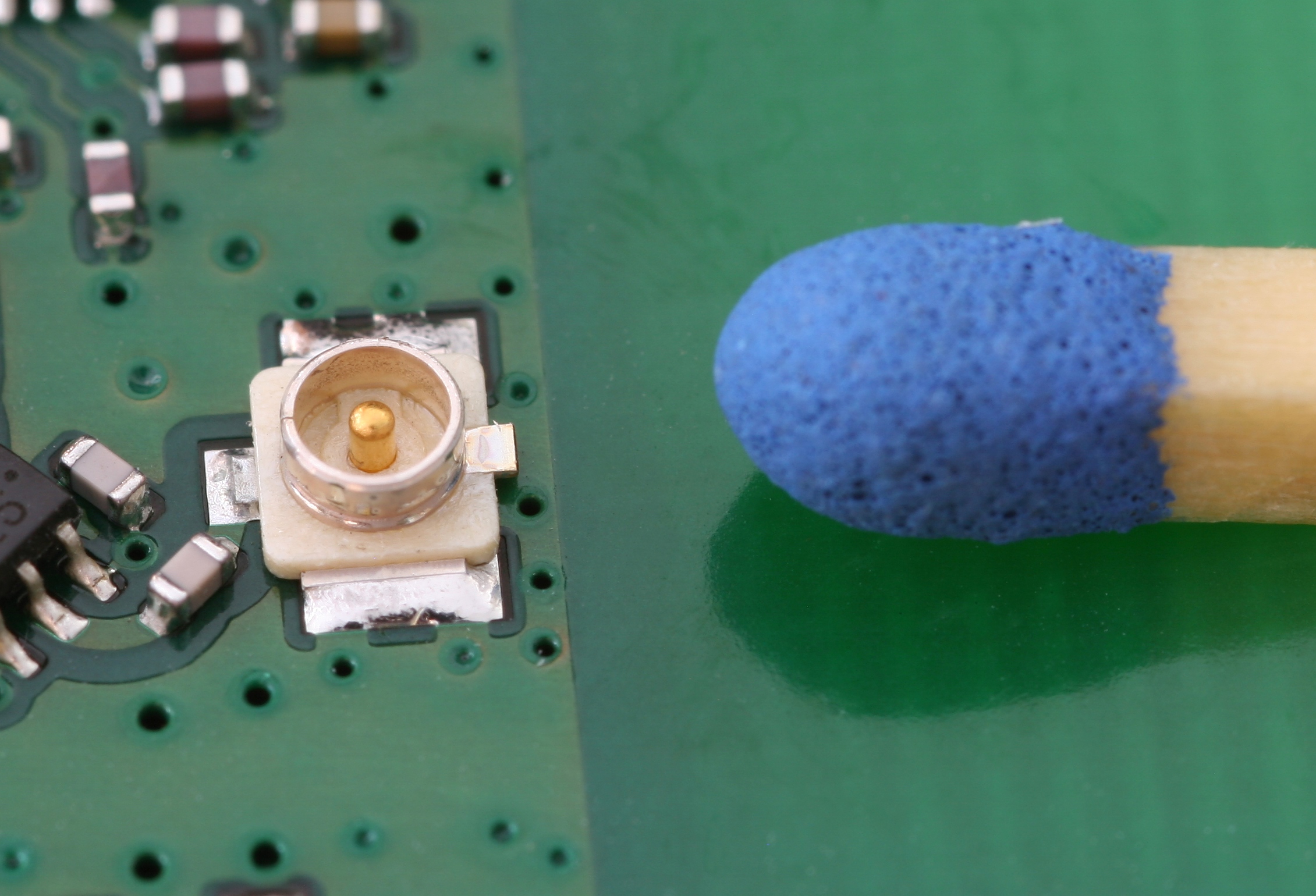
What's also interesting is that the circuit board left on the micro-SMA connector for an external antenna.
The early press releases mention deeper hardware integration with consumer products. I'm guessing they're going to be dropping this board into other things besides the Dash product.
That's actually an RF testpoint, not an SMA connector (by which I think you mean UF.L connector, like this guy: http://upload.wikimedia.org/wikipedia/commons/c/ca/U.FL_conn...). It functions like a switch that is closed when the RF tester connects to it.
In a sense, you're right - it's meant as a quick release testpoint for conducted radio performance on a manufacturing line. Theoretically, you COULD hook up an antenna to it, but you'd have to know some substantive details about the integrated PCB antenna (impedance, center frequency, etc) to get good or even comparable performance out of the external one. Probably not to a male UFL connector, in any case - I'm 99% sure this type of connector is not compatible with UFL.
Mileage may vary, of course, but in my experience this type of connector is more frequently used to get conducted power RF measurements in manufacturing settings.
The article is estimating the price of one of these things as being $5 - I imagine that at least for an initial trial Amazon have decided they can make a decent return on them at that cost without certifying their own components.
A lot of people prototyping in the IoT space are using the precertified modules.
There's not much more to it: the transmitter is already soldered to a small piece of PCB but has the antenna and necessary tuned discretes on there and ready to go. Doesn't add much to the cost: like BillinghamJ says it's the certification time and cost that's not really worth the trouble if you can just amortize it into the cost of the module.
As the top commenter pointed out, though, I don't think they would really need to spend the time recouping those margins - since all the brands signed up for this service are big-name brands owned by Proctor and Gamble, it could indicate a relationship wherein P&G helps them absorb some of the costs of the hardware in exchange for what is effectively marketing.