|
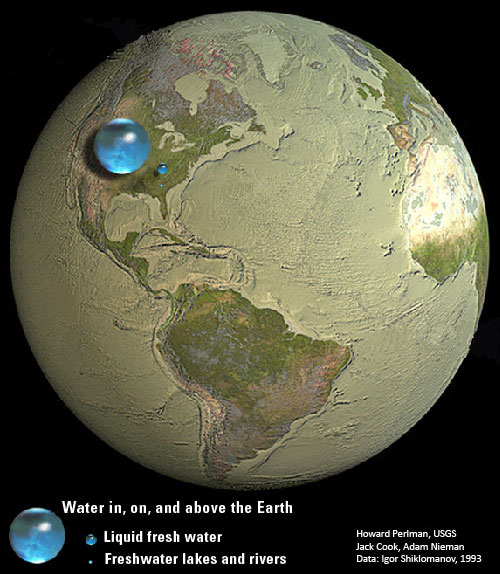
Considering drinking water is some tiny, tiny fraction of the world's water, it's probably not going to be a crazy idea to just dump the salt etc back in the oceans where it came from without causing any crazy imbalance, because we're talking about less than 1% of water. About 2.5% of all the world's water is fresh water, and of that about 65% is in glaciers and icecaps. The roughly 0.8% of the world's water that remains, another 65% or so is permafrost and ice, only about 0.5% of the 65% of the 2.5% of the world's water is in river's for example. See for example: http://water.usgs.gov/edu/pictures/watercyclekids/worlds-wat... So the notion of taking a small fraction of the ocean, desalinating it, and dumping the rest back in the ocean (as will eventually the water itself, later on in the process) probably isn't a big deal. But then it's just inference, I'm not intimate with the subject. Biggest hurdle for me was always that desal was crazily energy intensive. I can't imagine it's become orders of magnitude more efficient, and as energy costs didn't plummet on such a scale (orders of magnitude), I thought it'd still be. But it turns out the costs are dropping fast. I mean, I can easily see desal working for drinking water & cooking (few litres a day) for everyone on earth, but things like agriculture are a whole different beast. A kilo of wheat for example averages over 1.000 litres of water, while meat can go all the way up to 20.000 litres. I can't imagine desal for the billions of farm animals we slaughter every year (yes, billions :-/) , each weighing tens if not hundreds of kilos, for example, or even just agricultural production. I'd be happy to be enlightened! |
I can think of several countries that did this incorrectly and killed large portions of their coastal ecology as a result.