Hacker News new | ask | show | jobs
by mikeash 4112 days ago
It's a rather amazing coincidence that the "teeth" are the exact size and position of the JPEG macroblocks, wouldn't you say? The "eye" precisely occupies four macroblocks, too. Hmm.... I don't suppose you have an uncompressed original to compare to....
4 comments

And now I can see it, since it was explicitly pointed out. That doesn't make me think it's anything other than visual artifacts as you suggest, or a random bit of coloring.
I linked you to the original photo at NASA.gov, if you want to reproduce:

- Install Gimp

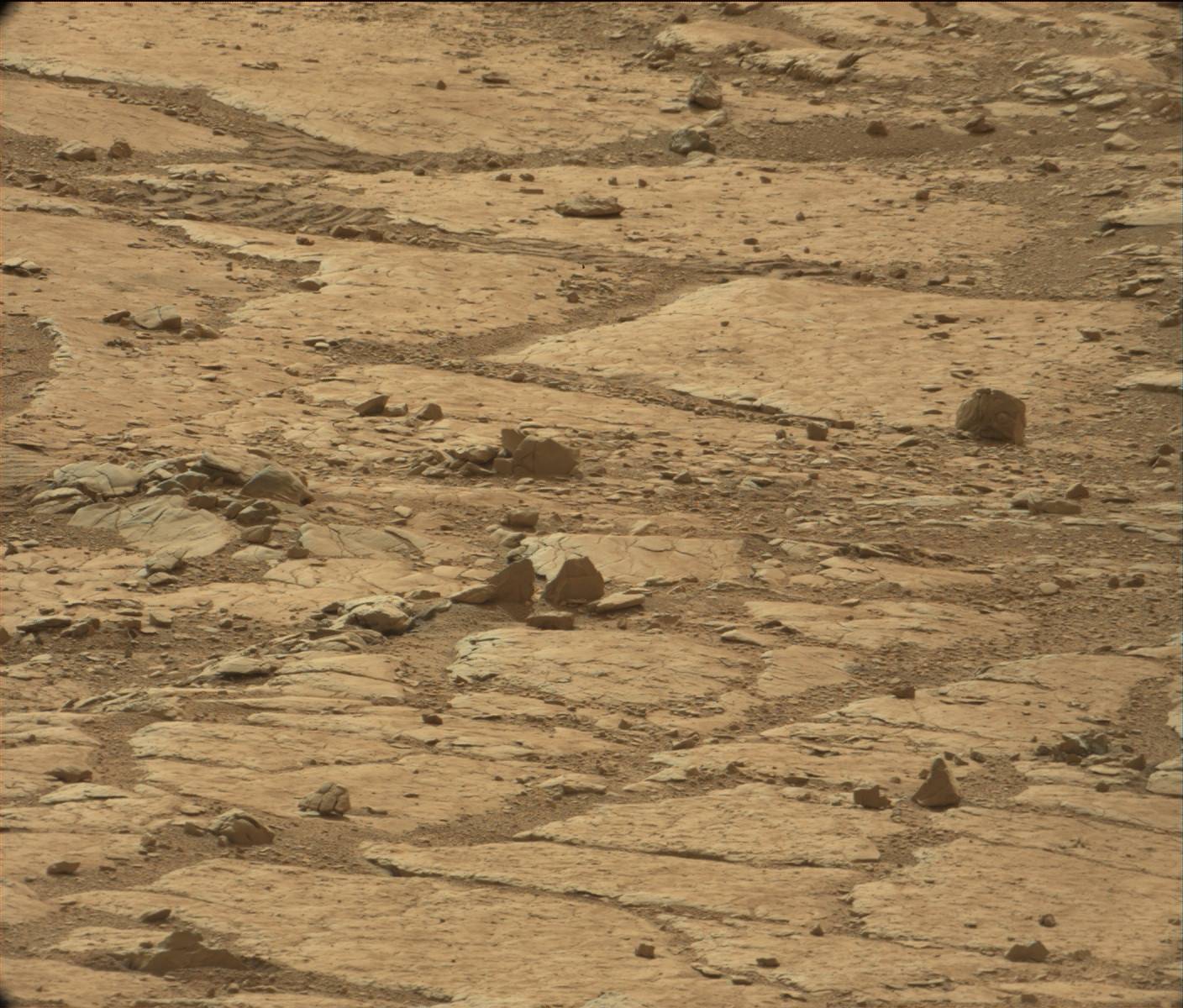
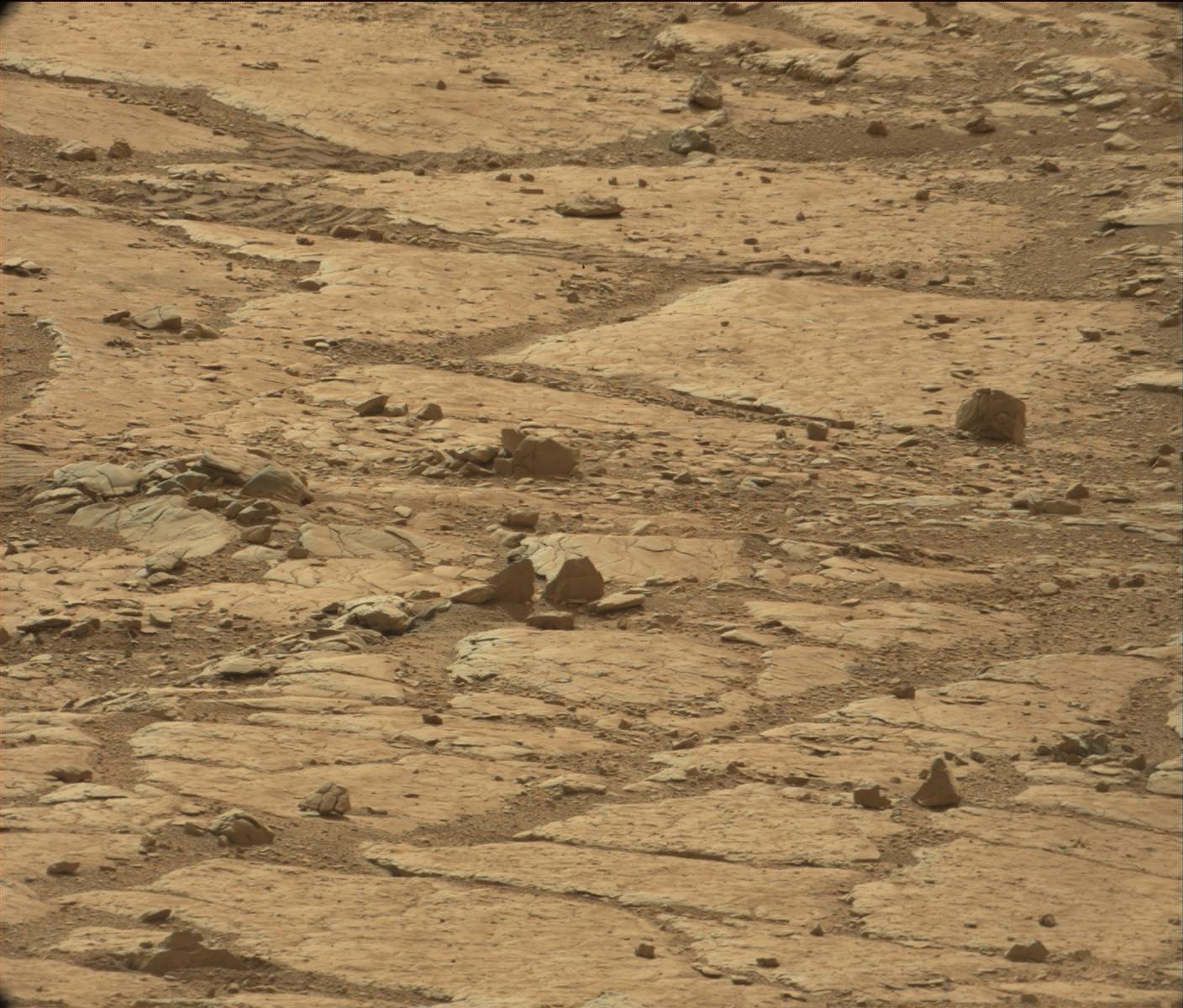
- Download the original Nasa image linked here: http://mars.jpl.nasa.gov/msl-raw-images/msss/00184/mcam/0184...

- Open the picture with Gimp. Crop out the face. Under the image tab, choose scale image. Scale the image to 300 percent of original size. There is an interpolation option when scaling the image. You have to choose Sinc Lancoz 3 because that is the interpolation option that will preserve the data in the jpeg pixels. If you choose cubic or linear it will be lost.

- Under the colors tab, open curves. NASA obscured this image by destroying it's dynamic content, so you will need to expand what is there by pulling the line to perfectly match the top and bottom of the image data. This will render the jpeg blocks and show you the image data they contain.

- Under the filters tab, mouse over enhance and choose the last option "Unsharp mask". Apply unsharp mask twice with the default settings. The picture will become clear enough to show.

You linked me to a JPEG at NASA.gov. The features we're discussing line up perfectly with JPEG compression artifacts, suggesting they're not real. I was asking if you happened to have an uncompressed version of the image to compare to. I guarantee you that the JPEG file is not the original data that came off the rover.
I agree with all your comments in this thread (edit: and the one below, thanks for the great response :) ), though I have to wonder if you're really that confident in the idea that the features are merely JPEG compression artifacts, or if you're just asking for evidence that's hard to obtain. (Context for this line of thinking: http://lesswrong.com/lw/1ph/youre_entitled_to_arguments_but_...) You may have noticed the URL of the image is in a folder called "msl-raw-images", so even if they're JPEGs, as far as most people are concerned these are the 'raw' images. It's unclear to me how one would get rawer images without a Freedom of Information Request. Do you know a way?

Also, suppose he did come back with a rawer image that still showed the features. Is that going to convince you to say "oh wow maybe it was carved, it couldn't have naturally occurred!"? (http://lesswrong.com/lw/wj/is_that_your_true_rejection/)

I'm totally behind the JPEG artifact theory and am definitely not making that point just so I can ask for unobtainable evidence. It is, in my opinion, blindingly obvious upon zooming in on the original JPEG.

For anyone not versed in this stuff, JPEG works by breaking the image up into 8x8 squares (possibly 16x16, or 8x16, or 16x8, but 8x8 is standard). For each square, the encoder then transforms the pixel data into the frequency domain using the discrete cosine transform. The frequency data is then what is ultimately losslessly compressed and encoded in the actual JPEG data.

Now, here's a zoomed-in screenshot of the rock in question, taken from the original JPEG with no alterations whatsoever:

http://mikeash.com/tmp/screenshot_F574A0FB-5919-4E2C-AEA3-C3...

The 8x8 grid stands out like a sore thumb at this zoom level. You can clearly see that the vertical separation of the "teeth" are just macroblock boundaries. There is clearly an actual horizontal dark streak in there, but the division of the areas above and below into separate vertical "teeth" is, to me, blindingly obviously a JPEG encoding artifact and nothing more.

Would I be convinced if the raw images showed these features as well? Probably not. But that doesn't invalidate my point. If somebody showed a picture of Bigfoot, and I noticed that their supposed Bigfoot is wearing a digital watch, it would be perfectly reasonable to point that out. Explaining away the watch would not silence my doubts, but it's still a completely reasonable thing to point out when someone shows a picture of Bigfoot and he's wearing a digital watch.

Do I know how to obtain a raw image? Nope. I wish I did. I briefly searched around for one, but with no success. My point is simply that JPEG images cannot be relied upon for fine detail, and if one is going to make claims about Mars rovers finding alien statues, the evidence needs to be clearly not due to JPEG artifacts, preferably by finding the original, uncompressed data. Scientists don't use JPEG-compressed photos for analysis, and this is why. The fact that a raw image is difficult to obtain is unfortunate, but completely not my fault, and doesn't alter the facts that 1) you really need a raw image to say anything about this photo and 2) the "teeth" in this photo are really, really, really clearly JPEG macroblocks.

NASA almost always releases raw data at some point, but not always right away. It may simply be they haven't released it yet. You might be able to get it pre-release by contacting the experiment leads at NASA.
By performing interpolation on the image, adjusting the color levels, and applying sharpening filters, you are seriously distorting the image. The resulting image is in no way representative of the original data.
Okay, so that image looks to be on this page[1] as Mastcam: Right 2013-02-11 00:30:54 UTC. The full res link here is named slightly differently[2], but that appears to be the same landscape. It looks less whitewashed in these images, but around the same quality. There's another image with the same rock just before that time.

If you really want to go deep into this, try some of the other cameras around that time, maybe you'll see it from a different perspective.

1: http://mars.jpl.nasa.gov/msl/multimedia/raw/?s=184&camera=MA...

2: http://mars.jpl.nasa.gov/msl-raw-images/msss/00184/mcam/0184...

It's clear from this other shot there are no teeth there, and not much of a face either.
Nevermind jpeg compression, this is a simple example of pareidolia. Could be anything, really.
I totally agree, but once I zoomed in on the original the macroblocks stood out like a sore thumb, and it was obvious that much of the "detail" revealed by the supposed zoom and enhance procedure was just macroblock borders.
"Cropped with contrast added" == "imaged processed until I got to see something I wanted"