You're misunderstanding the relevance here. Water the molecule is common throughout the solar system, typically as ice. It makes up a significant fraction of the mass of many of the moons of outer planets. It's a common component of comets and other minor planetary bodies. Titan, for example, is about half water ice, but it is so cold there that it is effectively a rock.
What we've been learning is that there is water ice in some places we didn't necessarily expect it before (such as in the form of permafrost underlying much of the Martian surface) and most importantly that liquid water is not as uncommon as we once thought. Liquid water is what's most interesting from the point of view of looking for environments that can support life forms. Previously we thought that the presence of liquid water required not only the presence of water as a material but also overall planetary temperatures in a temperate range, the so called "habitable zone". Which, as it turns out, is a fairly narrow zone. But we've learned that there seem to be numerous circumstances that allow the existence of substantial quantities of liquid water in conditions that otherwise would not support it. Europa, for example, has frigid surface temperatures (150 to 200 degrees C below freezing) but it has a sub-surface ocean due to tidal interactions with its neighbors. That sort of thing seems to be much more common than we knew previously.
It's surprising (water is perceived to be scarce) because:
- oxygen just as readily binds to everything else, to form metal oxides (the well-known rust on Mars) or silicates (rock) or just CO2 (Venus)
- hydrogen is so light it readily escapes into space from anything smaller than Earth
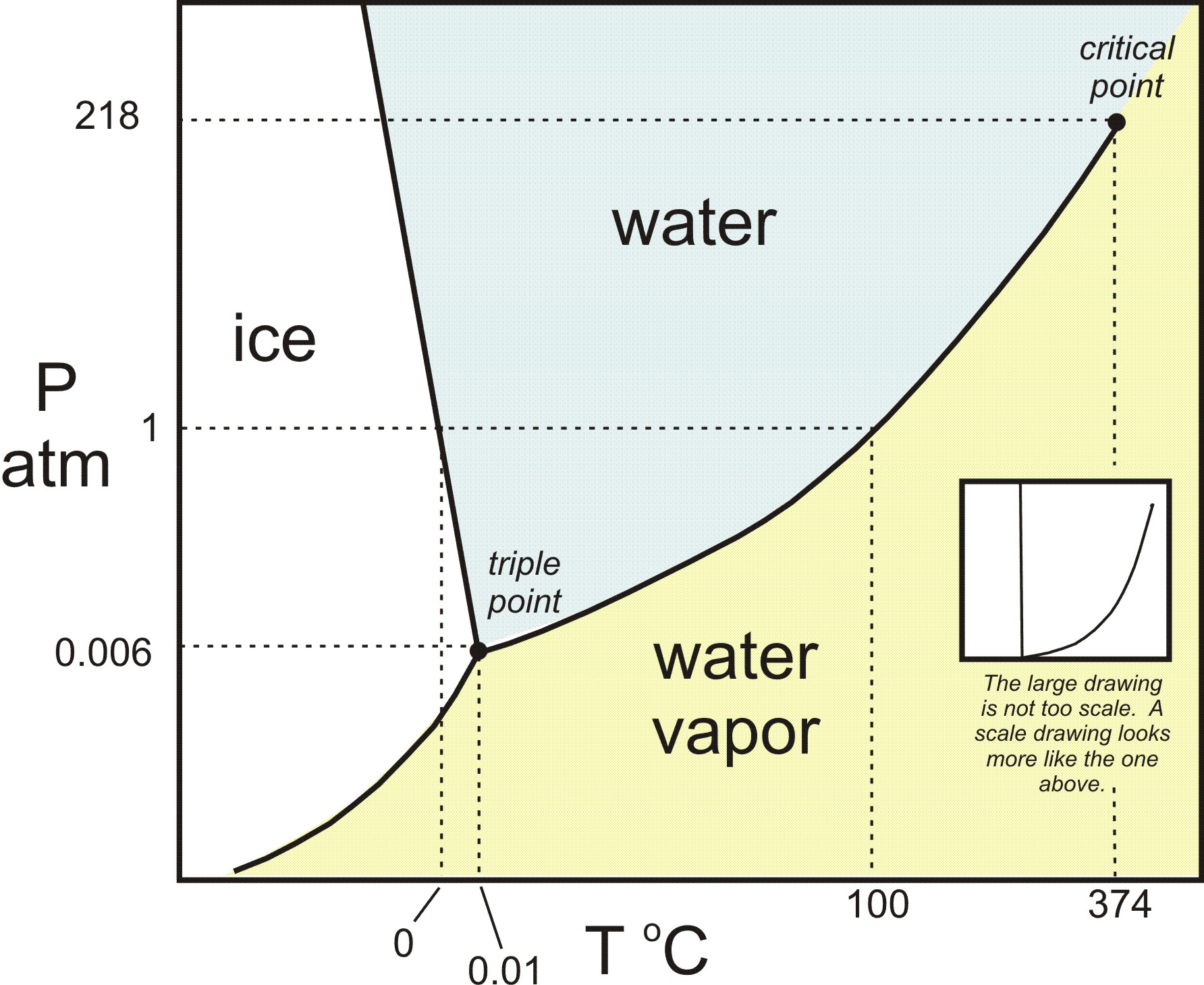
- H2O as solid ice is common anyway, but not as liquid water, which is more relevant for potential habitability and life. The conditions for the liquid phase of water are a remarkably narrow area on the phase diagram. That we have found in few locations, and it's news when a new such place is discovered.
If there is both vapor and ice, there must always be at least some water. If water is plentiful, space is cold, and planets are hot, liquid water should be common, regardless of how narrow the temperature conditions for it are. All temperatures from cold space to molten rock are well represented on planets.
Yes. The pressure of space is not sufficient for liquid water, regardless of how hot or cold it is. This means that regardless of how much ice or vapor exists on separate terrestrial bodies, we cannot assume that there is liquid somewhere in between.
Now, if there was a single planet that had both ice and vapor water, and that planet had an atmospheric pressure of greater than 0.006 atm, then I agree that there must be some liquid water somewhere on that planet. But ice and vapor on a single planet with a sufficient atmosphere is a much higher bar to clear than two totally separate places that combined have both ice and water vapor.
If you actually read what I wrote, you would have understood I was referring to water on planets. Obviously there is not likely to be liquid water in the vacuum of space. The "space is cold" "planets are hot" might have been a pretty sure clue that I was referring to water between a planet's hot core and cold vacuous space.
What we've been learning is that there is water ice in some places we didn't necessarily expect it before (such as in the form of permafrost underlying much of the Martian surface) and most importantly that liquid water is not as uncommon as we once thought. Liquid water is what's most interesting from the point of view of looking for environments that can support life forms. Previously we thought that the presence of liquid water required not only the presence of water as a material but also overall planetary temperatures in a temperate range, the so called "habitable zone". Which, as it turns out, is a fairly narrow zone. But we've learned that there seem to be numerous circumstances that allow the existence of substantial quantities of liquid water in conditions that otherwise would not support it. Europa, for example, has frigid surface temperatures (150 to 200 degrees C below freezing) but it has a sub-surface ocean due to tidal interactions with its neighbors. That sort of thing seems to be much more common than we knew previously.