Well, firstly, we should define what "sigma" means. Most people interpret it as it relates to the Normal Distribution.
In that case, a +10 sigma event will occur with probability 4.26361e-81. Each year consists of about 3.1536e+22 femtoseconds, which are 1e-6 the length of a nanosecond, which is the smallest unit of time I've ever heard mentioned in Finance. So, even on that time scale, and with millions of derivatives and securities, I'm not seeing much possibility for a 10 sigma event.
It's less a matter of snow fall and more one of snow accumulation.
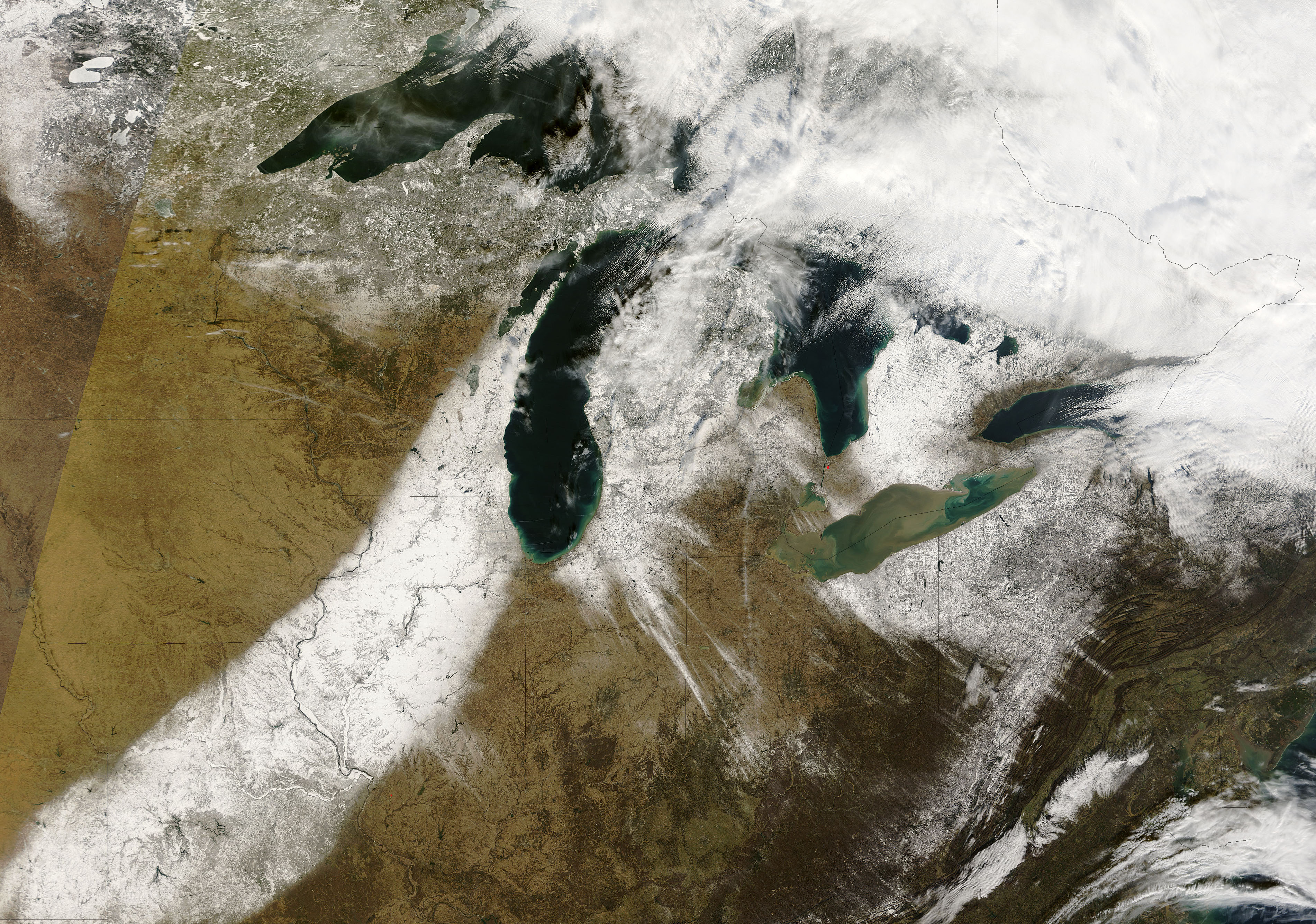
For snow to fall you want warmer temperatures (relatively) which allow large amounts of atmospheric moisture. Ideally striking a cold air mass which then causes snow to fall. Most notably in the U.S. in the form of "lake effect snow", where warmer, moister air over the Great Lakes moves (typically NW to SE) over colder land, and dumps often major amounts of precipitation:
For snow to accumulate you need annual temperatures which remain below freezing. In this case, even with modest amounts of annual precipitation you can achieve large ice sheets. The annual precipitation over the Antarctic is quite low: "As strange as it sounds, however, Antarctica is essentially a desert. The average yearly total precipitation is about two inches."
But with an annual average temperature well below freezing, any snow which falls will accumulate.
The daily high temperature in Boston is above freezing every month of the year, and the low from mid March to early December. Odds of Boston being covered in kilometer-thick ice sheets any time in the near future are exceedingly low.
While you're making a fair point regards history what you're obscuring is that based on 76 years of RECENT data -- "actual historical data in Boston back to 1938" quoting TFA -- this years' snowstorms are an extreme anomaly, and are not consistent with the recent record.
As another response notes tongue-in-cheek, this is better than some financial models, though my understanding is that many of those were trained with very recent and short-term data, the figure "14 years" is lodged in my memory though I've been unable to turn it up (possibly discussed by Krugman, Stiglitz, or Taleb).
A lesson is that long-term secular trends, or nonlinear breaks, can render statistical modeling invalid or inaccurate. That's actually a really powerful lesson to be aware of, and accounts for much if not all of the disagreement between demographic trends, say, produced by United Nations demographers or people such as Hans Rosling, and the decidedly more pessimistic estimates of the Club of Rome, Dennis Meadows, et al. Demographers are extrapolating statistical models in which past data observations have been fitted to curves, while the systems modelers such as Meadows are looking at dynamics between multiple real-world factors and looking at their interactions and consequences.
And while I don't want to get into a long debate on the validity or lack of LTG models, I'll note that:
1. The are models not projections, and that a set of multiple scenarios, including one with no resource restraints, have been run.
2. That following a breaking point in the default "World 3" model, further predictive value is considered low -- the system is too chaotic to make further valid inference. Meadows has spoken on this multiple times.
Which raises another further set of points:
1. Inference based on a limited set of data is limited. For climate, we're aware of significant changes in widespread climatic patterns over the past 3,000 to 6,000 years. Some reflected in historical records (e.g., the "Little Ice Age" and "Medieval Warm Period"), some only available from indirect metrics (tree ring data, ice cores, pollen counts).
2. The experience in the American North East points to dramatic shifts away from the recent past historical reference in climate. The times, they are a-changing, as someone said.