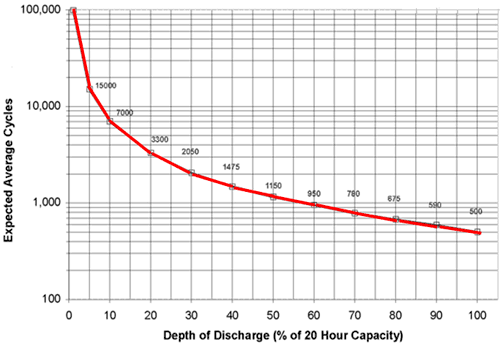
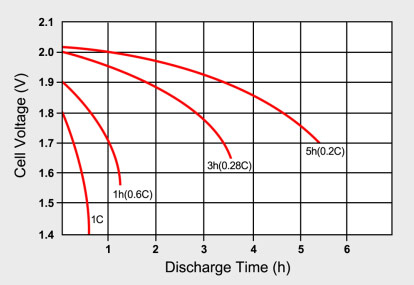
| Not necessarily! We don't know how deep the battery is being discharged. But we can make a guess. 4 * 365 = 1400 cycles. http://www.mpoweruk.com/images/dod.gif According to that chart (which is an approximation of course) 1400 cycles corresponds to about a 40% depth of discharge. Which isn't terribly shallow. The other variable is the discharge rate, and the higher it is relative to battery capacity the worse the efficiency and also the propensity to fail early. A lot of times doubling the pack size can extend the pack life by more than two because the increased efficiency (the internal resistance is lower) reduces the depth of discharge by more than half. http://batteryuniversity.com/_img/content/crate1.jpg Of course it feels totally ridiculous to only use 20% of the nameplate capacity of the system, and much worse than using 40% which you can sort-of rationalize as "half" but if it decreases your dollars per joule, it might be worth it. EDIT: I should also mention that if you're constantly charging and discharging and you don't mind a little energy loss you should look at nickel-iron batteries. They're not terribly efficient nor are they cheap in absolute terms but they're basically bulletproof. http://en.wikipedia.org/wiki/Nickel%E2%80%93iron_battery http://ironedison.com/ |
Thank you very much for the 2nd link. I was unaware any company was still manufacturing them. The last time I looked, the last company I could find that made them stopped a few years prior. I'm glad someone is making them still/again and marketing for an appropriate use.
The one odd thing is the price... for something as low-tech (relatively speaking) as an Edison cell, I'd expect them to be much cheaper. Must be the lack of competition.