Hacker News new | ask | show | jobs
by headShrinker 4137 days ago
Also many municipalities don't allow battery 'grid-tie' with the option of 'off the grid' living. For example, Connecticut has laws which don't allow houses to have batteries that would allow a house to be self sustaining and have a connection to the grid. This is because if you have batteries which cause a back flow during a power outage to the power station, an electrical worker could get shocked down the road.

The fact that lithium batteries aren't the greenest combined with the fact that you can't even live 'off the grid' in a grid tied system is a big uphill for these batteries.

15 comments

The same issue exists with grid connected solar panels. My solar panels are designed to stop working whenever there is a power outage. This is a legally mandated requirement here and is very annoying when it happens on a beautiful sunny day.

A solar panel installer told me that if I add a battery backup to my installation, then at least it'll still charge the batteries during a power outage.

This is the dumbest mandate I have ever heard of. Part of the installation of such power systems should have a mandate that in order for an off-grid power system to be connected to your box, your breaker to the grid must be off before you can enable your off-grid system. Why isn't there a mandate for this?

It seems like the mandate was written entirely to protect the power company's profits hiding behind a thin veil of trying to protect their technicians.

If the electrical utilities cared at all about the customer they'd mandate something that allows customers to do what they want, safely.

What good is charging batteries during the power outage when you can't use them during a power outage? You can't have power connected during the power outage for fear of "electrocuting the technicians" - so what's the point in spending all this money on solar panels if the only time you can use them is while the grid is up... and you have cheap (comparatively) grid fed electricity? What's the purpose in having batteries if not to use them when the grid is down?

In the US, rural electrification was largely complete 75 years ago. Urban electrification infrastructure dates back even longer. In all that time, intensity of use has increased.

There's a lot of bailing wire and duct tape...or overhead power lines and wood poles if you prefer...in the grid. It's grown based on small decisions over many years. People won't put up with six years of service interruptions while big chunks are rebuilt and debugged...nor will they be happy to underwrite the cost of doing so.

It's BS as you rightfully detected but that doesn't stop the State cheerleaders above from giving us 1001 reasons why this is bad and we must protect the lives of electrical workers, firefighters, and even the lofty goal of protecting the hand-wavy "public commons" itself!

Yeah, it's not the power company's fault for endangering the lives of their workers, it's our fault, you and I regular Joes, for daring to want electricity in case the power company can't supply us with any. How dare you?

This doesn't make any sense. There are almost certainly provisions in the law for backup generators to be connected to the service panel with a transfer switch, either manual or automatic. The idea is that when the generator is powering the house, the powerline service is completely disconnected, and vice versa. This is standard stuff, part of every electrical code I've ever heard of.

If a state legislature doesn't allow backup power to be supplied to a home or business with an NEC-compliant transfer switch, there should be some kind of judicial recourse. I'd spend some quality time with an attorney before taking "No" for an answer.

Agreed
Either your sarcasm tags are missing or you're just simply dead wrong.

I set up a fairly beefy solar/wind powered system in an off-grid configurations specifically not to have to deal with the red tape, installation and insurance requirements of being 'on grid' and I don't regret that but all of those requirements, inspections and gear made perfect sense from an electrical point of view and from a safety point of view.

There are some ways around that limitation. The reason it exists in the first place is so that the power company can safely power down their lines without installations such as yours feeding power back into the lines that are supposedly safe. This on the off chance that you'll end up electrocuting a line-man, which makes good sense.

Of course, since your puny little solar installation is incapable of powering a substantial portion of the grid this usually only really becomes a problem when the section that is islanded is small enough.

Some electrical codes allow you to resume powering your own circuit if you physically lock-out your connection during such an outage, and re-configure your inverter to non-grid connected mode.

You will also require a battery in such a case since the stabilizing properties of the grid (it's a very large load and acts as a huge flywheel or capacitor with basically endless capacity from the point of view of your installation).

And of course when the grid outage has been dealt with and you wish to feed power back into the grid again (or consume when the sun is down) you're going to have to undo all of this.

When I built a solar / wind power installation in Canada I decided that the net metering laws and price of power produced by renewables was so low that I scrapped the whole grid connectivity portion and invested the surplus into a much larger battery.

It felt pretty good to have power when the island was down which happened many times every year.

"you're going to have to undo all of this"

Why can't "all of this" be packaged into one idiot-proof box with connections to the grid, your off-grid system, and your house?

You mean like a generator transfer switch?

http://www.generac.com/all-products/transfer-switches/home-b...

That's a device that you probably don't want to use with your solar installation since it will not handle the grid-present resynchronization at the end of a power outage correctly which could cause your renewable energy system to be re-connected to the grid at 180 degrees out of phase worst case when grid power is restored. The result will be a big bill for a large number of power FETs or IGBTs depending on the tech used in your inverter.

So you can't just add an automatic transfer switch to retro-fit this to an existing inverter, but there are plenty of inverters where an option for an external module can be purchased or where an automatic transfer switch is built into the inverter itself:

http://ww3.wholesalesolar.com/newsletter/MAGNUM-AC-COUPLED-L...

These inverters will first synchronize with the grid before they connect.

Depending on local variations in electrical code it can be. But check with a licensed installer familiar with your local code.
Yes it's not such a problem when it's just my 5 KW system. However here in Perth, Western Australia there are a lot of sunny days, so domestic rooftop solar systems are very commonplace now.

In my case there's some significant financial incentives to stay connected to the grid (I actually get a cheque from my power company for most of the year). That'll change in another 6 years time when this higher buyback rate expires, so I'll be looking very closely at whether I want to remain grid connected at that point.

That's allowed in Connecticut:

http://cga.ct.gov/2011/rpt/2011-R-0390.htm

$300,000 liability policy requirement right at the end there.

There's also similar rules for installed generators, it's not clear to me how they would treat a big battery.

That may be the reason why the law was made, but that situation simply does not exist in reality. Any 'off-grid enabled' battery system that's worth anything at all would isolate the house from the grid when it kicks on, else all manner of bad things could happen, including having your battery drained on somebody else's load or the aforementioned electrical worker zappage. It's also trivially easy to accomplish said isolation.
Such regulations provide several types of protection to the public commons.

Another group of people who are protected are firefighters. In a typical residential installation the power meter also serves as the service disconnect. Response protocols include pulling the meter before many other life saving and property preserving operations. Live equipment and conductors operating from a second source downstream of the meter are a serious hazard to fire fighting personnel.

Solar panels are a particular hazard because the sun doesn't have a disconnect, many firefighting operations involve working on the roof, and fire burns upward. A collapsed roof may bring a tangle of live electrical parts down into the building and create a hazard that persists long after the fire has been suppressed.

In addition, miscellaneous loads applied to a grid can bring it down. In the Northeast US, much of the infrastructure is old and therefore less robustly engineered than elsewhere.

Am I missing something?

When you trip the breaker, the power is still on as far as the box in your house - unless it's shut off by the power company, it's just off inside the house. When you have alternative energy sources that include batteries, the same thing applies. The power from your batteries still runs through your box/breaker (via an inverter), and onward into the house. If you shut the box off, the power is off inside the house, regardless of where the power is coming from.

What's the difference?

In a typical US installation, the connection between the utility service and the dwelling service is made at the meter box. The meter forms the physical connection. When it is pulled, utility service is cut.

Secondary sources of electrical power such as solar panels, batteries, etc are connected downstream of the meter, i.e. connected to the load side from the perspective of the utility provider. Pulling the meter disconnects utility service but does not disconnect the secondary sources of electrical power. The dwelling therefore remains energized [and that's the point of installing such systems].

The difficulty in deenergizing the system presents a hazard. Finding and identifying the various disconnects takes time and is subject to error: who knows what was done for convenience or through poor planning or plain old stupidity.

Even if there is a disconnect for a grid of solar panels this only deenergizes the load side of the grid. Panels exposed to sunlight remain energized. Similarly lead acid batteries maintain an electrical potential when disconnected from the load side.

That you might not be there when you need to go to island mode or that you might not even be aware that the grid is down because you and a bunch of neighbours are capable of sourcing enough power that your 'off grid' detection mechanism fails.

There are solutions for this, it costs a little bit of money and depending on local regulations it may or may not be allowed.

So yes, you can override this and if you mechanically disconnect from the grid then you are typically allowed to operate your installation in island mode. But if you get caught backfeeding the grid when the grid is down then you will more than likely lose your hookup.

Most cheap/light inverters need an external power source to sync to and will automatically shut down if the grid is not available for synchronization purposes, which makes them compliant with the demands of the utilities. If you want to go to island mode you'll need a system that is considerably more expensive (batteries, load based inverter rather than generation capacity based) than one that can't.

There is no "detection" system. You are the detection system. There is no way of enabling your off-grid connection without shutting off the on-grid system. The interlock switch physically prevents you from switching on the trip for your off-grid system while your on-grid system trip switch is on https://www.youtube.com/watch?v=GbtRxcb-cmA

When the grid goes down, your power goes down. You then have to go trip the switch in your box to shut off the power between the grid and your house. Only then can you switch on the trip for off-grid power bringing the power back up in your house.

I guess you could have some kind of a relay where on-grid power would flow right through, but if on-grid power goes off, the relay redirects the circuit to your off-grid power - I think this is the basic principle behind the automatic transfer switch. Being on vacation or "not detecting a power failure" isn't really an option because as long as there's power, the power would flow into your electrical box from the grid. As soon as the power goes out, the relay that connects the circuit from the grid to your power box would flip to your off-grid circuit. The two circuits aren't connected but your household power can run from either one or the other.

I guess if you're wanting to sell power back to the grid, or supplement your power needs, that's different, but if it's a grid vs. off-grid situation, there isn't a problem.

And last but not least: when disconnected solar panels are 'open circuit' and the voltages will rise very rapidly. You can arc-weld with two fully illuminated 48V panels in parallel.
It's also not a theoretical concern for disconnected panels either; my late father was consultant in a lawsuit where a small mechanical design flaw in the solar panel connector boxes combined with rough installation procedures caused farms all across France to go up in flames.

It's also not that strange considering the farms would often have 20+ panels generating multiple kVs worth of electricity. Afterwards he refused to put any panels on our home without having a proper micro-inverter installed.

that is an interesting fact! wonder if there is a simple solution like a chemical blinder, that could be integrated into something sort of like a "EPO" button, making the panel inert in terms of voltage when hit? Just like the fire rescue folks can pull a breaker or service disconnect for traditional mains?
A properly wired transfer switch fully cures that risk.
A couple of my architect friends -- and they are good competent architects who spend the proper portion of their fees to hire competent consulting engineers -- designed an emergency services center a few years ago. The hurricane came - the project was in Florida - the utility cut grid power per protocol and the automatic transfer switch didn't flip to onsite power. Neither did the backup automatic switch.

The person trained to operate the manual switch was on a scheduled vacation (hurricane season in the US is six months it ain't reasonable to prohibit vacations). It took over an hour to get the system back online. Now keep in mind that all of this was with emergency services grade equipment trained professional staff and regular inspections and testing. And everybody wasn't away on vacation by policy.

Proper wiring is a necessary, but not sufficient condition. Power grid failures are many sigma events.

> The person

And there's the problem.

The HIL was the backup to the backup.

[HIL]: https://en.wikipedia.org/wiki/Human-in-the-loop

And even though the solution is right there, power line worker remains the ninth deadliest job in America.

http://www.businessinsider.com/most-dangerous-jobs-in-americ...

On trip through Minnesota, I watched a helicopter ferry guys up onto the towers to work (they dangled from the helicopter and then transferred over to the tower: http://www.capx2020.com/ ). They were building the type of infrastructure the news says America doesn't know how to build anymore.

I wonder if energized lines are the big problem.

Workers can safely work on live high voltage lines, if they're wearing a Faraday cage "hot suit" and not grounded: http://youtu.be/LIjC7DjoVe8
That video is awesome. I've seen a version with much better quality that really gets my acrophobia going... ;-)
(It's likely there are many -other- hazards to power line working, beyond presence or absence of transfer switches at on-site generators.)
If you are a lineman, you are three times more likely to die from electrocution than from a fall.

(They die from electrocution at 35x the normal population rate, while the death from falls is 5x the normal population rate.)

http://www.ncbi.nlm.nih.gov/pmc/articles/PMC1568699/pdf/envh...

That's just fatalities, ignoring the other dangers like getting your arms blown off.

True, but bewary of automated transfer switches. I have seen DC's fail due to ATS's not doing their job. This can be pretty dangerous for a lineman/fire rescue if your particular ATS fails to switch...
For people who are more interested in these topics, you'll want to investigate "anti-islanding", UL-1741, and IEEE-1547.

http://en.wikipedia.org/wiki/Islanding

http://en.wikipedia.org/wiki/IEEE_1547

https://www.google.com/?gws_rd=ssl#q=ul1741+pdf

...if you wanted to power your house from a battery-fed inverter you'd have to install an automatic transfer switch, just like if you had a back-up generator.

http://en.wikipedia.org/wiki/Transfer_switch

http://powerequipment.honda.com/generators/connecting-a-gene...

> because if you have batteries which cause a back flow during a power outage to the power station, an electrical worker could get shocked

What is the difference between Battery backup and a wind turbine/solar? Somehow you are allowed to have solar and pump back to the grid, but not battery, geee wonder why that is.

This is an issue even without battery storage. Solar and wind generation that is set up to feed excess back to the grid already has to have a way for the utilities to shut it off. This is why you have to have your setup vetted by the utility if you are feeding the grid.
Then that electrical worker would have to take precations (like disconnect the system), no? Sounds like it's just something that can be held in account. Plus the battery could not flow back to the grid in case of power outage (but instead power the own house first)
Any reasonable grid company should not only not prohibit this, but welcome it and pay for energy people feed back into it. I can call mine any day and have a bi-directional meter put in so I can charge for it, should I ever choose to install solar panels.
In some states, it is required by law that the power company pay for home generated electricity that is fed back into the grid.
Why is this not an issue if you have solar cells or wind mill or whatever?
I'm not an electrician, but that sort of thing seems trivial to prevent? Surely there are ways to stop the current from passing through the cables where the outage happens, or somewhere near it?
> This is because if you have batteries which cause a back flow during a power outage to the power station, an electrical worker could get shocked down the road.

Surely there is some safe way of preventing this?

There is. The same issue is present with home generators, and most cities require they be installed by a licensed electrician who will ensure it doesn't power the grid in an outage.
I would think so, and I would hope they would implement it. Especially considering the benefits to society of having people who are more prepared and self-sufficient, I would hope that safety would be only one of the reasons they wouldn't rely on people obeying some regulation for their worker's safety.
Living in CT, is my gas generator considered a battery?
>This is because if you have batteries which cause a back flow during a power outage to the power station, an electrical worker could get shocked down the road.

If I were an electrical worked I'd treat a power line like it was live regardless of whether there is a power outage or not.

>you can't even live 'off the grid' in a grid tied system

I can't find any references for your stated claim about Connecticut, however it seems deeply illogical given that a generator (which surely aren't banned), solar panels, wind, etc, all have the potential of feeding energy back to the grid in an outage. Which is why there are regulations and home inspections and all of that, to ensure that the appropriate safeties and switches are in place. Simply banning one of many possible mechanisms of generating power would be very short sighted.

Many regions that offer feed-in time-of-day tariffs are rightly trying to figure out how to accommodate battery systems, where some users are trying to game the system by charging a big battery array during low cost hours, and then "selling" it back to the grid during peak hours (at inflated, subsidized prices).

EDIT: As a reply to msandford, given that I can't reply lower -- the reason they have this limit is that the tariff price paid to home solar/wind generators is way above the bulk, "wholesale" price of power. It was created as an incentive to encourage green energy. So when you feed back their own power to them, it does them no favor given that now they're paying 2x+ what they would pay on the normal power market for power, and simply undermines the entire incentive program.

> where some users are trying to game the system by charging a big battery array during low cost hours, and then "selling" it back to the grid during peak hours (at inflated, subsidized prices).

The idea that a utility wants a heads-I-win-tails-you-lose kind of situation is annoying at best and downright infuriating at worst. If they're willing to sell power for $X now and willing to buy it later for $Y, what does it matter the method? I mean, there are people working on grid-scale storage batteries to do precisely that because utilities desperately NEED additional peak capacity when it's a hot day and everyone's A/C is on in the late afternoon. Why would it be OK for the UTILITY to utilize grid storage, but not an INDIVIDUAL?

http://en.wikipedia.org/wiki/Grid_energy_storage

  If they're willing to sell power for $X now and willing to buy 
  it later for $Y, what does it matter the method?
In the UK, to encourage adoption of residential solar panels there is a scheme of "feed in tariffs" where you can generate renewable energy and receive a guaranteed, above-market-rate price for it. The goal of this is to reduce carbon emissions.

For example, you can buy residential electricity for 15p/kWh [1] but sell energy from your small hydro installation for 19p/kWh [2].

Obviously, the goal of reducing carbon emissions would not be achieved if people simply charged batteries at 15p/kWh and sold it back at 19p/kWh!

Of course, this issue only arises because feed in tariffs are subsidised.

[1] https://www.gov.uk/government/uploads/system/uploads/attachm... [2] http://www.fitariffs.co.uk/eligible/levels/

Honestly, let them! They'll go bankrupt soon enough. And they'll achieve peak shaving in the process.

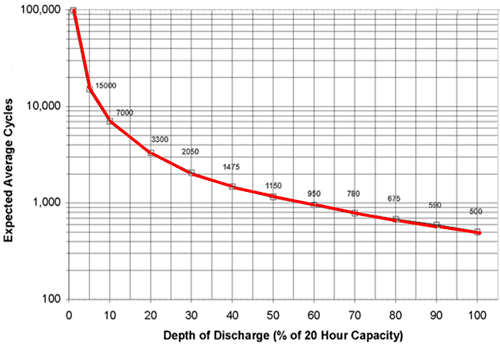
Lead acid batteries cost about $100/kWh of nameplate capacity, more like $200/kWh of usable storage. At a 50% depth of discharge you're going to get about 1000 cycles out of the battery.

http://www.mpoweruk.com/images/dod.gif

So assuming 100% charge, discharge, charger and inverter efficiency (reality is more like 60% through that whole cycle) a person stands to make about $0.06 per kWh per cycle (in the UK anyhow) and they can only get 1000 cycles.

$0.06 * 1000 = $60 per kWh per battery lifetime

That's only 1/3 of the cost of the batteries, completely neglecting the capital cost of the charger and inverter and the time spent to set the whole thing up. Further, once you take the realizable efficiencies into account, it's more like $40 not $60 so they're losing money even faster.

This is a problem that -- at least for now -- LITERALLY solves itself.

And they'll achieve peak shaving in the process.

Peak shaving is if you powered your own home off of your battery pack during peak times. The whole issue is that gamers -- who are essentially ruining "the commons" and pissing in the drinking well -- are instead abusing a system.

Again, no home battery pack is helping the power company. The rates are hugely subsidized to encourage green energy. The people who abuse it simply ruin it for everyone else.

You're right of course that it's not peak shaving, which is about shedding load. That was incorrect of me to state.

But it is peak generation, which is just as valuable.

> Again, no home battery pack is helping the power company.

Please re-read my comment where I detail the economics of pulling power off the grid at low price and selling it back at high price is actually net-negative for the individuals doing so. From this we can assume that it's net-positive for the utility company because they're basically getting "free money" from the people who aren't good enough at math to see that what they're doing is economically wasteful.

> The people who abuse it simply ruin it for everyone else.

The people who "abuse" it are paying $0.20/kWh of cost to make $0.06/kWh of revenue. That's REVENUE, not PROFIT. This is a losing strategy, it loses $0.14/kWh, at least according to the math I did.

It's entirely possible that my analysis is wrong for some reason, but rather than just stating "they're ruining it for everyone!" maybe you could rebut my reasoning or something? Just stating something as a fact doesn't make it so.

The idea that some people fetishize disruption and heads-you-loose, tails-I-win situations baffles me. The utility has expenses beyond the cost of power generation. They don't exist to provide a subsidy to cool upstarts. They provide critical infrastructure for those cool upstarts and everyone else.

There are certainly a lot of perverse incentives and inefficiencies in the current model. Even so, its either ignorant, childish, or intellectually dishonest to act like it is outrageous that a utility has a simplified pricing model that doesn't accommodate the outliers among the outliers (residential customers with large solar and battery installations), or that their overall pricing allows margin for cost recovery and profit on power they deliver, whatever the source.