Hacker News new | ask | show | jobs
by sixQuarks 4165 days ago
I'm optimistic about satellite internet done right, but I'm worried the speeds and lag are going to make it a bit frustrating compared to fiber. In 5 years (when this will be completed), I think virtual reality will be penetrating the masses. Can satellite internet handle virtual meetings, virtual online gaming, etc without major lagging?
6 comments

These are going to be LEO satellites (no higher than a few hundred km), instead of GEO satellites, which would make the lower bound of the latency pretty low (comparable to cable or DSL).
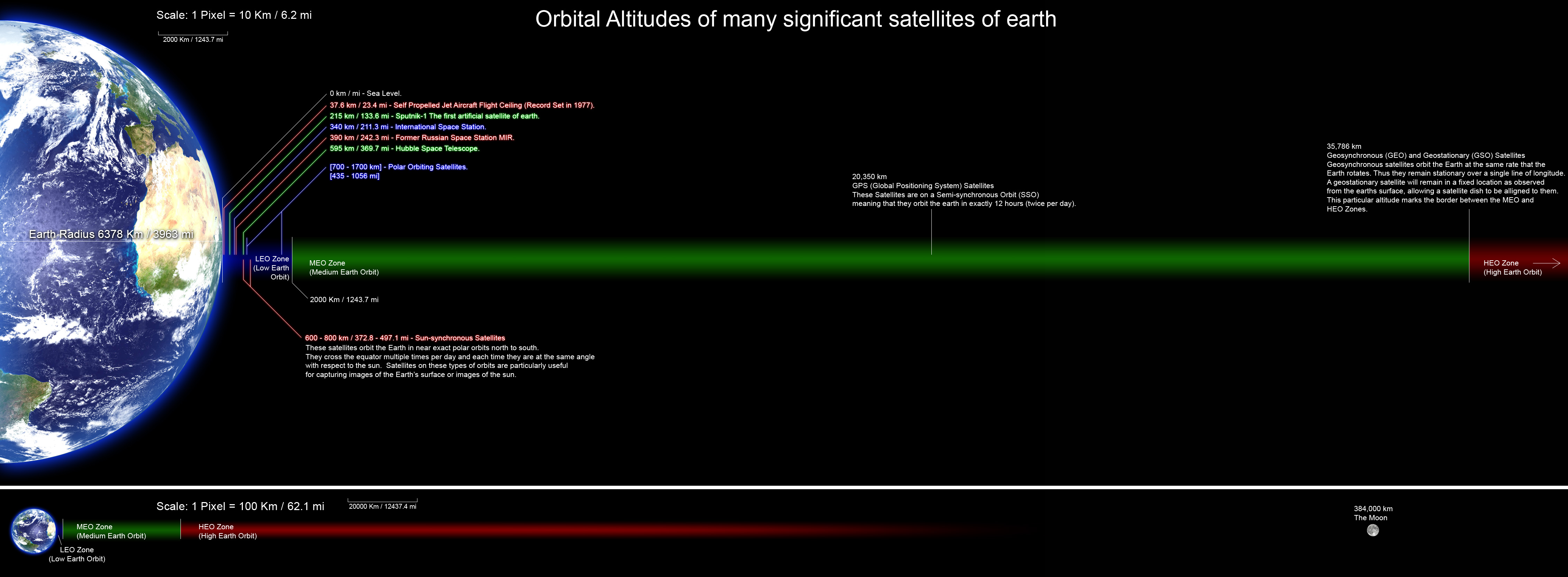
This helped me visualize how close LEO satellites are, as well as how far away others are (e.g. GPS).

http://upload.wikimedia.org/wikipedia/commons/8/82/Orbitalal...

Cool! Quick back-of-the-napkin indicates that the RTT for LEO satellites (at the upper bound) would be only ~4.7% of the RTT for GEO satellites. I'm sure there's much more to the story that I'm missing, but an LEO satellite should have a latency of around 11.75ms. In 2012, average US latency to Google was ~50-60ms [1]. Would bandwidth be the limiting factor?

[1] https://www.igvita.com/2012/07/19/latency-the-new-web-perfor...

The alternative to the market served by satellite Internet isn't fiber, it's nothing (or in some cases, cell towers). To address your point: The satellite network would almost certainly be in LEO. There's no fundamental reason why LEO satellites should have high latency. They're only a few hundred kilometers out, so round trip times are measured in single digit milliseconds. GEO sats have latency (and bandwidth) issues due to their distance from the surface.
I suspect the initial use case is low bandwidth protocols (email, IM, notifications etc) that don't mind high latency rather than "high" bandwidth stuff (browsing, streaming video etc).
It's certainly better than the alternative in some places, which is zero internet. Look at how widespread "dumb phone" use is throughout Africa. Some incredible and empowering things can happen when unprivileged folks are given what we might consider outdated technologies.
There's probably no reason this can't act as another competitor to fixed broadband in the US market, bypassing one of the major issues holding back greater competition in that market. Especially if SpaceX can get the launches down to a cheap enough point. And it should certainly be capable of acting as a competitor to 4G LTE and the next generation.

How much data could these push in theory?

I recall some notes from one of interviews with Musk that mentioned a "a plan for poorer countries and a plan for those stuck with Comcast". Not sure if Musk said this personally though, I haven't watched the interview itself yet.
What I'm wondering is how are they going to offer it to the people. Pay per minute? Pay for what you use?
No technological innovation can change basic physics. There will always be propagation delay in satellite networks.
Low Earth orbit is 1.3 light-milliseconds away from earth. My home router is 30-100 packet-milliseconds away from my laptop.
... But there's dramatically less when you put the satellites much closer to earth, as they're planning to do here. These are LEO satellites, not the far-away geostationary stuff you see with older communication satellites.
In fact, if they enable satellite to satellite communication (like e.g. Iridium) and get full worldwide coverage, there's no reason why they couldn't in theory delivery much shorter roundtrip times than what we get between many locations over wired networks, given how much traffic takes huge detours today for various reasons. E.g. lots of European traffic to parts of Asia still goes the "long way around" via the US because it's a far better served route thanks to massive amount of undersea capacity going in/out of the US to pretty much everywhere, while the land routes to parts of Asia are fraught with problems.

Being able to ignore political boundaries, war zones, problems with theft and vandalism and other concerns that often limit the placement of over-land long distance cables has a huge potential value in itself.