|
|
|
|
|
|
by jacobolus
4245 days ago
|
|
|
At-home 3d-printing uses shitty materials and has terrible precision. If you don’t want to go all the way up to making expensive metal tooling and doing injection molding, you can sill get much better results from CNCing some material and then using resin casting than using a 3d printer: http://lcamtuf.coredump.cx/gcnc/ |
|
|

How do you define "terrible precision"? Is there a fixed scale in which precision goes from "terrible" to "okay" to "very good" to "excellent"?
If I'm building a telescope mirror, I guess I just ask the manufacturer for "excellent" precision, and they know what to do?
How do you classify "better results"? It is the smoothness of the part, the strength, or the cost at 5, 50, or 100,000 units? Why do resin casting when I can do lost wax casting?
Can you tell me, which manufacturing method is the best?
Oh sorry, we haven't talked about what we're making yet. Seems any discussion of tools to fabricate things is senseless until we've established what we want to make.
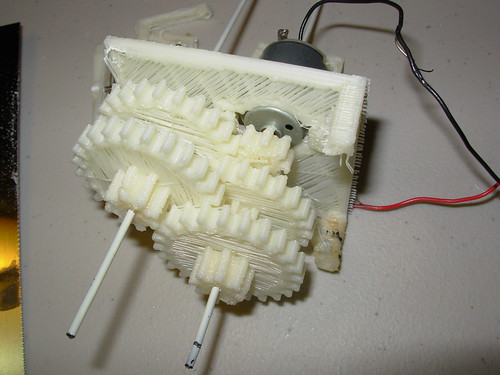
I'm designing a robot anyone can make at home. I mean actually, that is what I am doing as I type this comment. (well, I was designing it. It's printing now.). I want a robot that can be customized by the user. I want it to be as cheap as possible for someone who does not have access to anything more than basic electronics and a 3D printer. I want people to be able to design upgrades and test them.
Do you think I should design it so I can CNC molds that I use for resin casting? That is, after all, what you suggested.
But then, when I CNC something it takes a loooong time. First, I would design a part completely differently if I was going to CNC it versus print it. And if I was going to CNC a mold for casting, I would design it a third way still. If I am going to CNC a mold, I need to figure out where the parting line will be, and how all the molds will fit together. Some parts are impossible to cast, so I have to make sure not to design the part so as to be impossible to make with my chosen method.
Once I decide to CNC a mold, I need to source raw material that is as big as my part, but not so big that I waste a lot of material. I'll need some way to grab it in the CNC machine, so typically I choose material a little taller than my part. Ultimately it depends on how I specifically choose to make this part, and isn't strictly defined by the part's size or function.
To order raw material, if it was on short notice, I would need to go to the material store. In silicon valley across from the Fry's off Brokaw there is a place called Campbell Metal. Campbell metal is a large warehouse full of people and metals. The metals are sorted by size, shape, and length, and the people who work there tend to those materials - taking orders from the front office and cutting short pieces out of long bars. The cost of my material includes the cost of living of those people and the cost of the overhead for the large warehouse all that material is in.
Once that material is on order, I would need to program the machine to make the part. That involves figuring out the steps in order that I will use to take that raw block of material and turn it into my part. Simple parts may have 2 or fewer steps. Most have at least 3. Each one is a separate program. Once I've manually defined the toolpaths to use to make the CNC machine hollow out a block of steel or aluminum, including choosing how to send the tool into the metal, how fast to spin it, how quickly to move it, what depth and width of the tool should make a cut, I can begin to set up the machine to cut the first step. This involves taking all the right tools from the shelf, out of hundreds of possible tools, and loading them into one of the 24 tool pockets on our machine.
The machine, a HAAS VF-2SS, cost my employer around $90k. They sell a couple million dollars a year in custom made tools, so they could afford to pay this off over 5 years. I was pretty lucky to get my hands on that every day.
I could go on about the casting (get a scale, mix up material by weight, cast it), but I hope you see my point.
There is no "best" technique for "makin stuff", because every part is different. When I designed a waterproof housing that was sent 3km underwater to deal with the Deepwater Horizon oil spill, it was made from super thick aluminum with steel reinforcement. But when I designed the power button for our custom android tablet, which included software I wrote to help lift a nuclear cooling tower, I used dinky Delrin plastic for the part. There is no one best material either.
3D printed parts have certain properties. 3D printers have some limits. But what they lack in quality they often make up for in simplicity. If I had decided to print the part above instead of cast it, I'd have just made sure the thing was full and then hit "print". When I need to change something about the design, like I did this morning, I repeat that process. Iteration is a million times easier with 3D printers, which means designers can spend more time refining their parts.
For the robot I am designing, anyone with a 3D printer and the most basic of electronics can build a robot. I know where 3D printers are strong and where they are weak, so I design my parts to take that into account. They are chunky, and I leave a lot of room for the wide tolerance of home printers, but the parts work.
My 3D printer, when poorly adjusted like it is now, can hold maybe 0.040" of tolerance on a part. When I worked at the machine shop, my day to day realm was within 0.005" tolerance. On a critical part like a bearing seat, we'd add another zero to that. But there are guys making semiconductors with moving parts like DLP chips that would laugh at those tolerances. Even the guys cutting gears on their worst day would have bested my best try, because our basic $90k CNC machines had laughable quality compared to the "real" stuff.
Everything is relative. Even hand carved bricks can build a pyramid - with the right designer.