Hacker News new | ask | show | jobs
by primelens 4306 days ago
Most contemporary art needs to be illuminated by some mumbo-jumbo narrative about what it "means" before one can appreciate it. I get the fact that one of the things that makes art great is that it pushes the envelope on accepted norms - stretches the bounds of tradition. To have mere skill and craftsmanship and no individual vision does not make great art. But for me, the reverse should also hold - you can't have a total lack of coherence or skill and just get by on a pretension of "edginess." Unfortunately that is all that seems to matter in contemporary institutionalized art.

I am repeatedly surprised by how contemporary early modern art (a.k.a. renaissance art) -- both literature and the visual arts -- seem to me at time and how they can combine truly radical innovations with an unwavering commitment to basic skills. Write that searing tragedy about the frailty and absurdity of the human condition ... but make sure you absolutely master your iambic pentameter first!

1 comments

I'm surprised by this repeated statement that modern art doesn't hold skill. Most of the artists I know have enjoyed a very good education in the underlying skills, but then chose to break the rules.

Is there a lot of pretense trying to sell art? Yes, absolutely - but it never lasts. Good contemporary art is exactly what you ask for. A solid foundation of skills used to completely abandon any conventional display of these skills.

Let's get concrete; do you have examples? Particularly painting. I went to the Pinakothek der Moderne a few months ago and was really struck that, whereas in most "modern art" galleries I can find paintings I like, in one that restricts itself to post-1920 there was really nothing thought-provoking, nothing beautiful, nothing that even seemed like an expression of skill. There were interesting works in other media, but it really seems like painting has fallen by the wayside.
If you're seriously judging all post-1920s art, or painting ... take a step back. There's plenty of art out there, more everyday. A short search on Google helped me discover this one, for instance: http://fineartamerica.com/featured/arc-de-triomphe-leonid-af... Not to mention all the examples presented in this huffington article. There's plenty of skill in painting, the question perhaps remains, and has for some time -- if you have new tools, like computers, photoshop and photography, does that change the skill or quality of a painting or other artwork? Does it devalue it? Place greater emphasis on it? Perhaps what's sad is that universities are required to produce fine art in the first place, now that we've so many new models to follow for education...
I'm judging the paintings in that particular gallery, and more widely the academic and gallery culture - of course there are beautiful paintings being made every day, by people with or without artistic education.

If you can recommend a gallery of pictures like that I'll add it to my visit list. It looks like Afremov went to a technical university, which is in line with the sibling thread where te_chris is arguing that (grossly oversimplifying) polytechnics give a better-rounded art education than academic universities.

Sadly, I don't know art galleries. That was Google, after all. All I can say is, every visit to the Art Gallery of Ontario, near my place, nets me 95% "not my thing" to 5% "wow". All it takes is one "wow" each trip and it's worthwhile. The same is probably true of many art galleries, hence why people then try to collect the art they like, forming their own gallery. I wonder how the concept of galleries will change as VR technology takes off? Right now reproductions are two dimensional and cannot be interacted with in their original space. But what happens if we "fix that"? ;-)
I've had a similar 95/5 (I'd like to say more like 80/20) reaction to a lot of galleries, but most modern galleries I've been to (the Tate, or the one in the Centre Pompidou) include some late-19th at least early-20th century stuff. And until recently I'd have been a big defender of the value of these over older collections.

I was struck because the Pinakothek is the first I've been to that makes a three-way-split - the Alte Pinakothek for pre-19th century stuff, the Neue Pinakothek for, I don't know the terminology, but the time in the middle, and then the really contemporary works in the Pinakothek der Moderne. And I absolutely loved the Neue Pinakothek - loads of really beautiful paintings, with a variety of styles but almost all of them being the kind of representational/skilled work the article's talking about (or your link). Really recommend it if you're ever in Munich. And then I walked across the road to the Pinakothek der Moderne, looking forward to a real treat, and I was just really struck by how bad it all seemed, how much worse every painting was than any of the ones I'd just been looking at.

Van Gogh did pretty decent :) Assuming you meant 20th century modern art, here's a short list.

Skill: Dali. In terms of being "thought-provoking", I consider much of his stuff tripe, made to pander to mass tastes, but he most certainly had skills.

Skill & thought-provoking: Picasso. I don't - again, personal taste - find beauty in his works, but they sure make you think.

Skill & beautiful: Kandinsky, and Miro. It's too abstract for me to really consider it thought-provoking, but the pure beauty of it, to me, is almost mathematical in nature.

All three: I'd probably go with Magritte. YMMV.

If you want to go postmodern, it's getting difficult - not because it doesn't exist, but because I'm not that well-versed. Marcel Duchamp's painting are certainly there. "Nude Descending a Staircase" is, to me, an amazing painting.

Based on your preferences, I'd suspect classical realism would appeal more to you - try Parrish, or Jacob Collins. (I find them boring, but as always, the eye of the beholder is what counts)

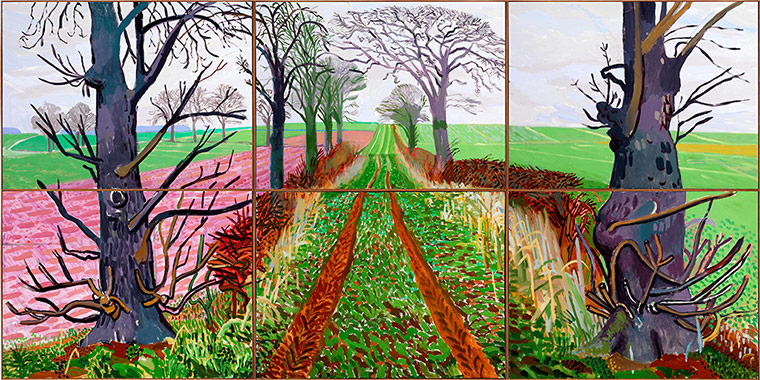
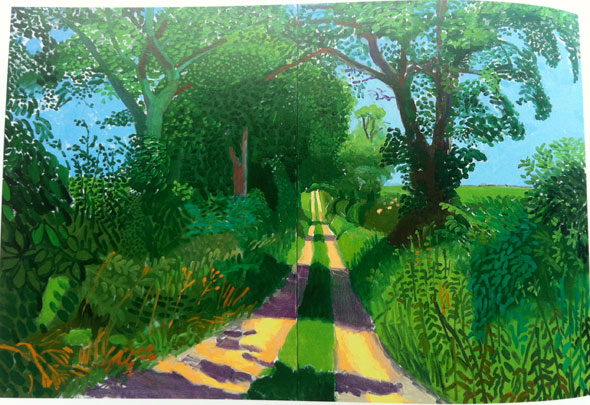
I visited the David Hockney gallery in Salts Mill recently, and came away a big fan. His works done in Yorkshire are beautiful (to my eye) even from a superficial level. I'd say there is skill in each of his paintings, but to clear any doubt, his Bigger Trees Near Warter (http://britishartresearch.files.wordpress.com/2011/01/bigger...), which is 12 x 4 meters large and painted en-plein-air, are undisputedly the product of real talent and technique.

Some examples of Hockney's Yorkshire work that appeal to me:

- http://thebikeshow.net/wp-content/uploads/2012/04/david-hock... - http://static.guim.co.uk/sys-images/Guardian/Pix/pictures/20... - http://colourliving.co.uk/wp-content/uploads/2012/02/blog-pe... - http://www.patternpeople.com/wp-content/uploads/2012/06/davi... - http://www.lalouver.com/html/gallery-history-images/large/da... - http://ainhoainsardinya.altervista.org/wp-content/uploads/20...

I could be off base here, but perhaps Hockney is the exception that proves the rule. I've been led to understand that his position is currently pretty unpopular in contemporary art discourse, and that he is viewed as a bit of a reactionary.

I however find him and his work really inteesting in the context of this discussion though. Particularly for his detective work and reverse engineering of the use of optics by the old masters.

http://www.amazon.com/exec/obidos/ASIN/0670030260/davidhockn...