|
|
|
|
|
|
by Bikanta
4340 days ago
|
|
|
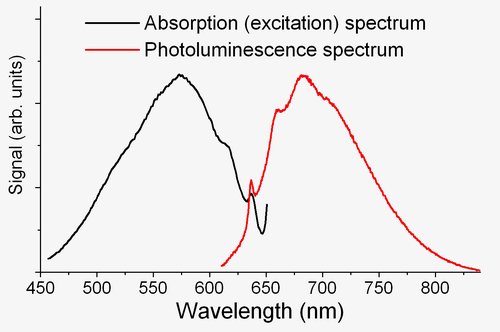
I'm happy to answer these technical questions. It's nice to share that info as that is what makes them so valuable. The fluorescence comes from nitrogen-vacancy centers. Here is a link showing the excitation and emissions spectrum. http://upload.wikimedia.org/wikipedia/commons/8/85/NVple.JPG The Stokes shift, as you can see is very large. The quantum yield is 1 and they don't blink. We are initially focusing on stabilized nanodiamonds with various chemical groups put on the surface to have them ready for further conjugation. Email us at info@bikanta.com and I can have a further conversation with you if you would like. |
|
|
Continuing with the human studies thought, are these particles seeing RES uptake? I assume, based on the high QY, that these the emission centers for these particles are protected by a thick shell and/or corona. General handwaving from the FDA was that they were as concerned with particles persisting as with elemental toxicity. Is there a predicted degradation pathway for these particles?
Can these particles be made with a hydrodynamic radius, including corona, <8nm? Is it possible to dope them to get better NIR emission?
Unrelated to technical stuff: I thought that a YC thing was that you had to move to San Diego for a few months. That doesn't seem all that conducive to wet lab work, in fact, it seems like a non-starter. Is that still a requirement for the bio-related startups? If so, how how disruptive is it?
Thanks for the answers!