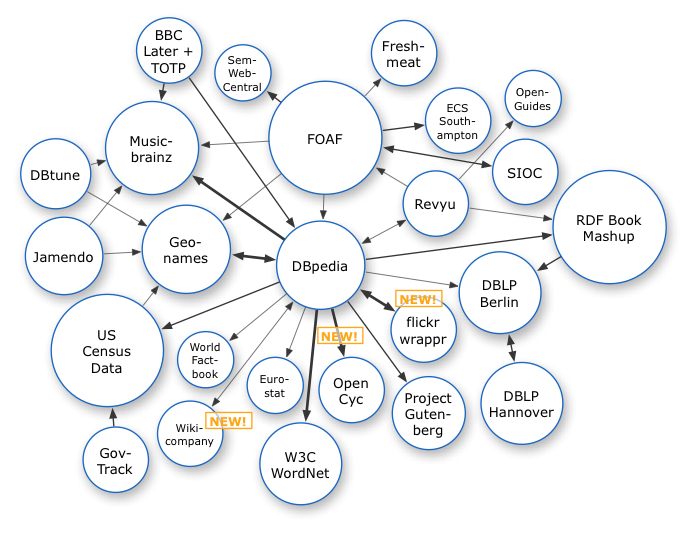
| I am not surprised by your results. However, the system is more robust than your experience would indicate. OpenCyc is a subset of ResearchCyc, which itself is a subset of (Full)Cyc. OpenCyc is primarily used for mapping between ontologies. It contains 239k concepts from ResearchCyc, but only the basic rules for definitional relationships between them. These relationships include part/whole, disjointness, etc. You mention DBPedia as being superior for your purpose, but I would counter that the two are complementary. There is a mapping between DBPedia and OpenCyc within the Linking Open Data cloud. In fact, it was one of the first ontologies contributed to the W3C's LOD initiative[1][2]. The concepts in OpenCyc are rigorously organized from most general (e.g. Thing) to more specific (e.g. board game). Each concept may have specific instances (e.g. Yahtzee, Trivial Pursuit, Scrabble, etc.) These primitives all live within a custom Lisp, where they may be reasoned over. DBPedia's structure arises naturally from user activity. It is organized primarily by Wikipedia's category system and includes individual pages. Unlike Wikipedia, the Cyc project does not aim to contain every instance of a concept. The relationships between concepts are what matter. Once one knows that something belongs to a given Cyc concept, one can leverage the system's knowledge to reason about it. OpenCyc's reasoning capability is limited by a lack of assertions (facts and rules) -- ResearchCyc's is not. ResearchCyc contains over 5 million assertions not present in OpenCyc. (Things like: water is wet, a dog is a mammal, mammals have hair, etc.) It also contains Natural Language tools not present in OpenCyc: parsers, taggers and more. With these tools, one can go from natural language to a formal logic representation. Or, given a formal representation generate natural language. These capabilities exist today in real world applications[3][4]. [1] http://lod-cloud.net [2] http://lod-cloud.net/versions/2007-10-08/lod-cloud.png [3] http://videolectures.net/coinplanetdataschool2011_witbrock_c... [4] http://videolectures.net/coinactivess2010_witbrock_lkc/ |