Hacker News new | ask | show | jobs
by dasil003 4387 days ago
I don't think it's amusing in the least. Have you looked around recently at people's diet and health? It's not just fast food, but convenience foods in general are huge business, and it's people largely bought into the marketing simply because they offer ever increasing taste and convenience. There are huge margins to be made by processing the same mono-culture grains into ever more refined and perfected addictive foodstuffs. Even government policy is shaped by this profit motive because who else is lobbying on farm policy?

Food policy an America is a perfect example of where capitalism fails to take into account externalities, in this case the externality is health and wellbeing which has always been recognized as of paramount importance, but nevertheless remains difficult to quantify in economic terms due to the inherent complexities involved. Unless we stop and think critically about it, we are doomed to sacrifice our health to a huge money-making apparatus in exchange for a bit of well-engineered flavor.

The status quo which most of of us have known for our entire lives is what necessitates a movement. Perhaps I'm taking your comment in the wrong spirit, but I think it's something that needs to be taken seriously by everyone living in industrialized countries.

1 comments

Spoken truly like someone who has no idea what they are talking about.

At present industrial countries spend between 9-11% of their annual income on foodstuffs and less than 5% of their time gathering said foodstuffs - the lowest in time/money expenditure for food in the history of the world.[1]

If we die slightly earlier due to a possible rise in cardiovascular disease then it was a small price to pay for saving years in productive time.

Also, fast food firms are an easy target but when pressed for an answer, the team at Freakonomics made a pretty good case that a McDonalds hamburger is possibly the greatest foodstuff when balanced between cost, speed, safety and bountifulness of nutrients.[2]

The real problem with convenience food is not the nutritional content (which is perfectly adequate and superior to most diets across a historical timeline)is the unsustainable agricultural and water scarcity burden it places on the planet.

[1]http://www.npr.org/blogs/money/2012/06/08/154568945/what-ame... [2]http://www.marketplace.org/topics/sustainability/freakonomic...

I don't have time to refute this kind of wrong-headed thinking in detail. Suffice it to say that I'm not just talking about fast food per se, I'm talking about the entire way that modern industrially prepared foodstuffs are processed, the huge proportion of grain that goes into it, and the way flavors are extracted and re-added while completely separating them from the nutritional value that said flavors would normally signal to our organism. Spraying on vitamins is not the same as eating a fresh vegetable or animal meat that is known to contain those vitamins.

Simply put, we are in the nutritional dark ages right now. You exemplify my point perfectly by looking at the issue through an economic lens, and ignoring the difficult to pin down issues like the explosion of obesity and diabetes. Now you claim that I have no idea what I'm talking about, and I claim the same about you, but mark my words in 100 years people will look back on the diet of today with the same horror that they look back on bloodletting as medical practice.

You do have time to correct my thinking because you attempted to correct it.

Mark your words?

You talk about being in the nutritional dark ages then mention eating fresh animal meat

No evidence exists anywhere that human beings should consume meat. Our digestive tracts are 4X longer than any other animal that consumes meat (which leads to rotting flesh in our body (not ideal)) and in repeated tests the sight and smell of fresh meat fails to incite child salivary glands but fresh fruit and vegetables does.

Unlike actual carnivorous animals which are equipped with the teeth, claws and digestive means to eat meat. Young offspring naturally hunt other prey and salivate at the prospect of flesh/organs.

To paraphrase yourself - mark my words, we will look back on the human consumption of meat with the same horror that considered bloodletting as a medical practice.

Disclaimer - I eat meat despite the huge risks to my wellbeing.

Test - Leave a toddler in a playpen with a rabbit; trust me he won't attempt to fucking eat it. He has not been social conditioned to see the consumption of meat as normal.

Leave an omnivorous or carnivorous animal in a locked environment with the same rabbit. You will need a new rabbit.

You just went off on a rant about something I didn't say and I didn't mean. Try again, none of this is relevant to what I said.
It's completely relevant. You are discriminating against fast food without any attempt to apply your arbitrary reasoning to other foodstuffs you consider "wholesome" or "good".
It's not relevant because I did not say what you said I said. You are putting words in my mouth and you are being intellectually dishonest about it. I am done with this conversation.
A surprising comment! I thought it was clear with all the obesity, diabetes and definitive rise in cardiovascular disease that there must be something fundamentally wrong with our food, one way or another.

Imagine that: people eat until their arteries clog, literally stopping the flow of blood so they die.

Oh but the branded, and yes, overpriced food-product was oh so satisfactory for the senses, the sugar, the fat, the flavoring, all carefully designed to overwhelm instincts and to create little addictions.

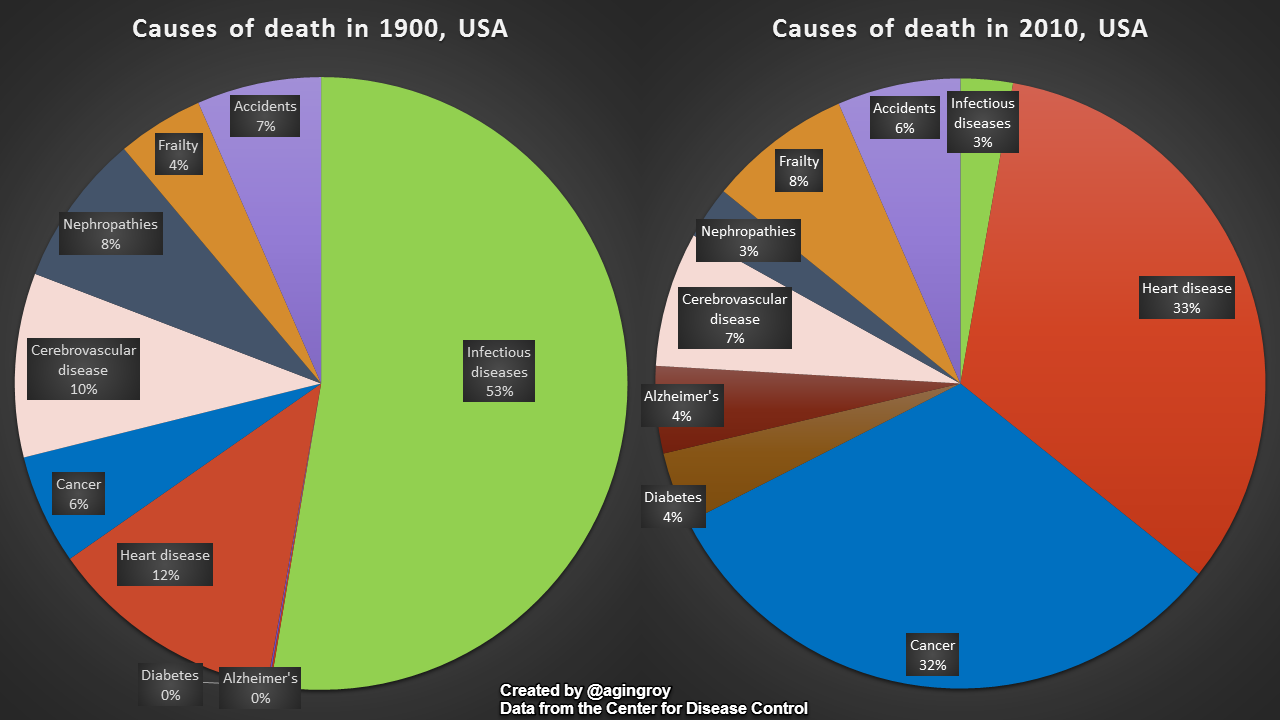
To be fair, we are also out-living the other stuff that used to kill us, namely infectious diseases. We now have the luxury of dying from heart disease and dementia. That's not so say that there is no room for improvement...
That's true for certain things - maybe people didn't really recognize dementia as such back then, when old and frail people died from some infection before other problems could manifest.

On the other hand, heart diseases are an area where things got significantly worse for no good reason.

We can be safe from common infections (thanks to hygiene) and also not all suffer from heart diseases (by not eating junk), there's no trade-off here.

How many old and frail people do you think were cutting around prior to the 18th Century?

I would wager not many.

Humans have to die from something at some point. If you have compelling evidence that fast food reduces your life feel free to post it.

A number of journals have begun to dispute that obesity even causes the conditions we currently associate with it.

Ah, this is the infographic I was looking for:

https://i.imgur.com/vuegm5x.png

My point is not that people were doing better then. My point is we could do better given what we know and what we have.

The simple fact that we are debating nutrition on such a basic level ("is something loosely defined as fast food bad?"), shows how fucked we are in that regard.

(Similarly, nutritional concepts, whatever their merits and benefits, that come with a name, be it "atkins" or "paleo", also resemble a pre-scientific worldview based on superstition and vague knowledge. Think "We're building this bridge according to the teachings of Prof. Dr.-Ing. Whatshisname.")

There's more to food than nutrition. The process of growing, preparing, and eating food has been a major source of social connection and "quality time," which is in my opinion the most significant value of slow food for well-being. You can get the nutrition you need with a pittance today in terms of economics, but as a society I think we've failed to fill the social gap that was left open by our liberation from the work of eating well. I'm not saying that the gap has to be filled by food (there are probably even better things we could do), just that the slow food movement is using it that way. Filling it with productive work as you describe certainly has economic value, but I think the cost in terms of happiness for some of us kills the reward.
> There's more to food than nutrition. The process of growing, preparing, and eating food has been a major source of social connection and "quality time," which is in my opinion the most significant value of slow food for well-being.

Have you ever been involved in the process of growing food? A workday on the farm is substantially longer than any office job, the only way to talk to people is to scream because they're at least thirty meters away from you most of the time. At the end of it you're drained and people who have been doing it all their lives get to live the last years of their lives with terrible back pains and having to rely on the young folks for, um, growing food, because it turns out doing manual labour for twelve hours a day isn't so easy when you're eighty. There's anything but quality time in that.

Edit: It also turns out that, with foodstuffs having to be so cheap, this kind of work was also very badly paid, which meant that except for people who owned huge amounts of land (and generally didn't work all, or more commonly any of it), people who had to do this were, if not dirt poor, in any case poor enough not to be able to afford too much. It's the fact that we lost all this chance to have "quality time" that allows us to heartily debate such matters through silicon stuff that shoves charge carriers through really thin glass tubes.

I own a farm, and work on it every day with my family, so yes, I do have personal experience with it. It turns out that working together on something you value seems to build relationships, at least in our case.
How big a family and how big a farm? My grandparents used to have one, too. As they grew old and the family either shrank or less of it became available for regular fieldwork, it simply became unsustainable for them. They kept a small-ish garden that provides them with most of the fruits and vegetables they eat fresh, some livestock, and rented the rest of the land.
Family of four, twenty acres. I custom graze cattle and raise ducks and fruit and nut trees, and keep a large garden.
Not all vegetables must be produced in the way you describe. In my tiny, poorly-weeded backyard, we've got herbs, beans, peas, 6 kinds of weird lettuce, arugula, tomatoes, strawberries, gooseberries, and more onions than reasonable. Right, it doesn't feed us entirely most days, but we don't have to buy many veggies. I don't get paid to tend it. The time out there is probably good for my mind, given all the research showing green space as effective as pharmaceuticals in combating ADD/ADHD in children.

If we all had our little gardens the food landscape of America would change wildly. Japan's got tiny little gardens tucked into every corner. It's a different model of production.

> Right, it doesn't feed us entirely most days, but we don't have to buy many veggies.

This is in the context where, as ZenPro stated above:

> industrial countries spend between 9-11% of their annual income on foodstuffs and less than 5% of their time gathering said foodstuffs - the lowest in time/money expenditure for food in the history of the world.[1]

Things would change radically if you had to feed off it entirely most days. Having a small garden is great, both as a hobby and through the healthy food you get from it, but glorifying the times when you spent "quality time" working your ass off in the field is a bit far fetched...

Growing food was a major source of social connection in the same way uranium mines were.

Preparing food was a major source of such "quality time" as peeling, flaying, cooking and serving food for a large family. Quality time, indeed.

It's all well and good if you want to have the social connection while fiddling with your food. However nowadays you don't have to if you don't want to. I for one would not like to spend a lot of my waking non-eating time preparing my food.
Averaging expenditures across the whole population is very misleading. Do you take the average of incomes in the US, and assume everyone in the country must be doing pretty good? Outliers like silicon valley tech workers might spend 9-11% of their income on food, but there are plenty of people spending a much larger portion than that, but their paychecks still aren't enough to buy comparable nutrition as those people who really only have to spend 9-11% of their cushy paychecks.

Have you tried to buy nutritious food on food assistance? Better hope a church or food pantry (if you car-less wastes of space have one nearby) can help make up the difference, or just go back to eating those big macs and fries because you're just too stupid to eat healthy (only costs 11% you numskulls, get off your lazy asses!)