|
|
|
|
|
|
by heterogenic
4446 days ago
|
|
|
Not necessarily. You're assuming that the factors which drive women out of engineering do so independent of ability. I would hypothesize that this is false, that the most interested and passionate women are least likely to be nudged out. Google should be comparing its ratio to that of their potential pool, which is presumably skewed high. If that's true, they should be expecting to get closer to 50%. (Not exactly 50, but better than the holistic ratio at least.). Also, they can look at their specific source pools to get a less hypothetical target. Berkeley is ~50/50, for example. (http://www.wired.com/2014/02/berkeley-women/). But retroactively |
|
|
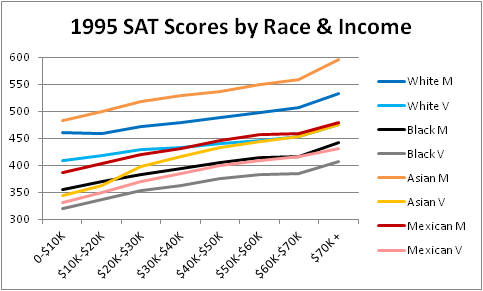
Citation required.
And if women are less interested overall in CS and/or have less ability on non-verbal tasks overall then you would expect that the RHS tail of the distribution of women would be lower than the RHS tail of the distribution of men. This is just basic statistics.
The same applies with African Americans. Blacks in the US have far lower IQs than whites - this is not in dispute though there is a certain amount of dispute about the reason, with some people attributing it to environment. As such the normal distribution will ensure that a much lower percentage of blacks will be at the high end of the scale (135IQ+) where google gets their recruits.
So the fact that google is close to the averages suggests they are already making a lot of effort to bring in women (and non-asian) minorities. Asians are highly over-represented at google versus their fraction of the population.