| "The air conditioning knob is a different shape and size from the stereo's volume knob, and located in a different place (ideally)." You've nailed it sir. Shape coding[1]. If it's good enough for F-14 fighter pilots, it's good enough for my Toyota Camry. I echo the sentiment of others. The OPs heart is in the right place here. Mimicking sight free displays on a touch screen is laughably terrible. Take this picture [2] from OPs post. Why are the media buttons ellipsoids? They're just smaller targets to hit compared to squares! In academia, we've been researching this problem, eyes-free mobile interaction, for a very long time. Particularly in the context of interaction while walking. There are numerous approaches (e.g., Flower menus [3], utilizing pressure [4], utilizing motion [5], the list goes on). The big takeaway is that it seems like more successful systems result from the multimodal approach. OP, you've done some good work here, but consider incorporating other sensors. Voice? A camera for in-air gesture recognition? A biometric sensor that gives reasonable defaults automatically based on learned use of the driver? Touch is only one part of the problem if we move away from shape coding, and we will very likely need to utilize multimodal input if we hope for success... ...or, you know, we could just stick to that whole buttons and knobs thing. ----- [1] http://en.wikipedia.org/wiki/Alphonse_Chapanis [2] http://matthaeuskrenn.com/new-car-ui/images/statusquo.jpg [3] http://www.youtube.com/watch?v=QRSASiEBw5k [4] http://www.mobilevce.com/newsite/sites/default/files/infosto... [5] http://katrinwolf.info/wp-content/uploads/2013/05/MobileHCI2... |
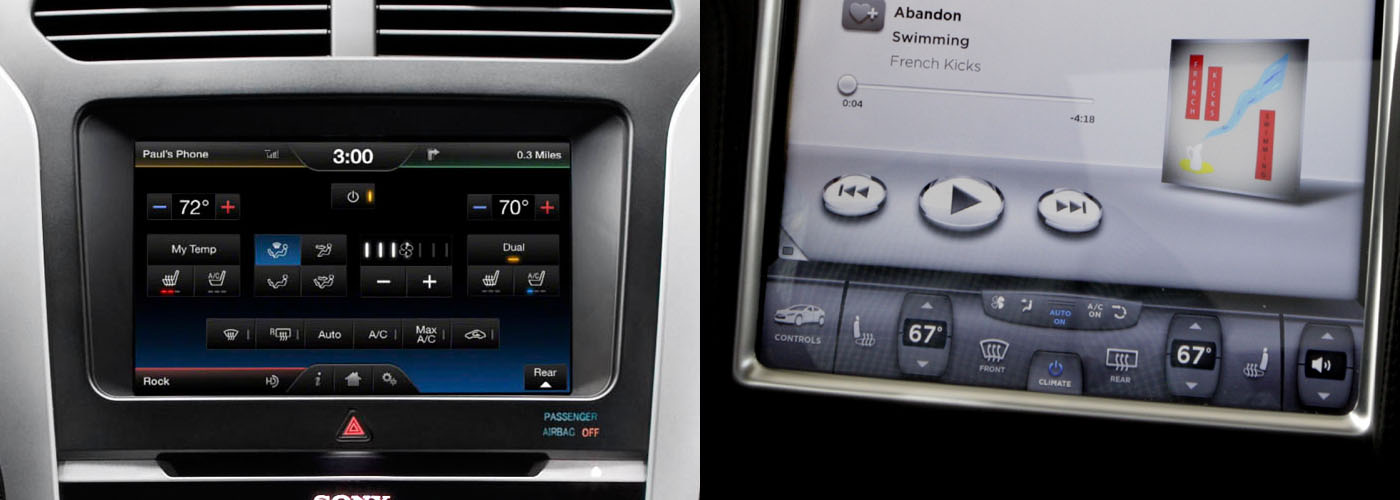

In this case, I'm simply trying to make a point that touch screens can be more control panels with buttons and sliders on them.