Hacker News new | ask | show | jobs
by rayiner 4506 days ago
There's a really simple explanatory mechanism, which is that even if an AirBnB host is bound by the same anti-discrimination provisions of the Civil Rights Act as a Hyatt, which is probably true, holding individual service providers accountable at that level is basically impossible. And to the extent that the "sharing economy" involves more individuals rather than businesses that can be sued, you will see more discrimination.

This issue also strikes to the heart of some of the libertarian ethos around the sharing economy generally and Uber/AirBnB in particular. People are really racist.[1] Just getting the racism to the levels experienced by Andrew's friend experienced involved a century of the federal government beating the states over the head with troops, court orders, etc. The elimination of overt racial discrimination in private businesses is actually a wonderful example of concerted government action addressing a problem that according to free market theories shouldn't even have existed in the first place.

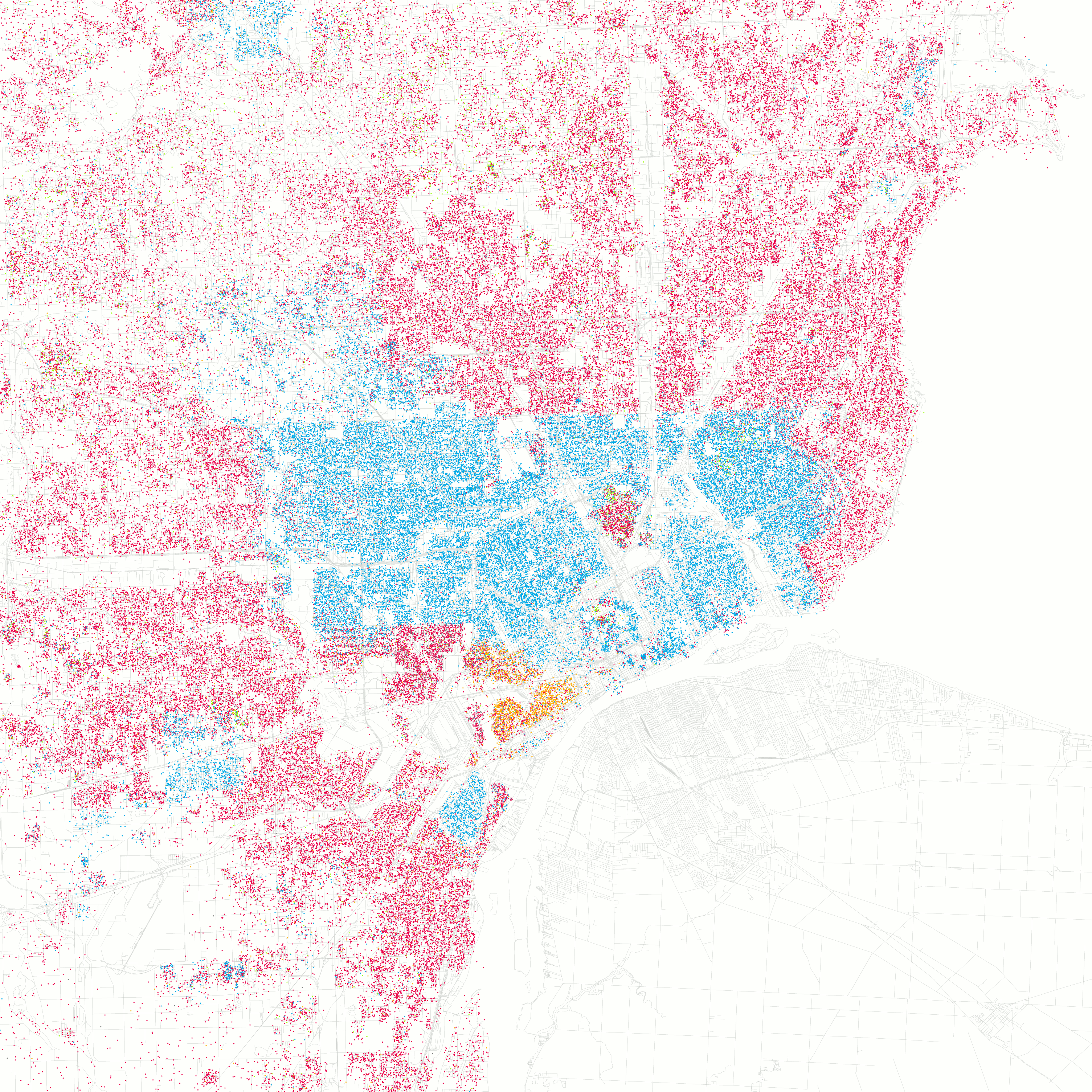
[1] I think Americans are much less racist than almost anyone else. I'm Bengali by ethnicity, and my observation is that people on the subcontinent are racist enough to make a south Georgia redneck blush. But even then sometimes I look around at maps like this: http://upload.wikimedia.org/wikipedia/commons/f/f1/Racial_Di... (race map of Detroit with black areas in blue and white areas in red), and think we'd still have legal segregation if the courts hadn't forced it down peoples' throats.

5 comments

Impossible? That's nonsense. They could ask users for a standard race descriptor that is never shared with the hosts, and if the hosts seem to predominantly reject certain races of people, the marketplace like AirBnB could kick them out. It's actually pretty simple. It all depends on how eager the marketplaces are to solve this particular problem.
A nice aspect of this is that it could work better than the system being replaced (tracking gets automated and centralized.)
> I think Americans are much less racist than almost anyone else. I'm Bengali by ethnicity, and my observation is that people on the subcontinent are racist enough to make a south Georgia redneck blush.

Not really, it's just in the rest of the world being openly racist is just fine, in the US (and Canada) you have to pick when you can be openly racist and pretend otherwise the rest of the time.

> think we'd still have legal segregation if the courts hadn't forced it down peoples' throats.

We would.

A bit uncharitable. As a minority myself I do think Americans are a lot less racist than almost anyone else, by virtue of the fact that they're aware it exists.

Call it white guilt if you must (though it's really a misnomer), but the fact that Americans are aware of their own racism makes the situation much, much more tolerable than in other places.

Sure, covert racism is still a problem (a big one at that), but at least there is awareness and a substantial degree of introspection. Both of these are absent in more racially homogenous countries, where not only is racism overt, but there is so little public consciousness of it that extreme racism is accepted as a matter of course.

In the US the words "oh good, you're not dating a black girl" will be outright rejected as racist, or at least give people pause and cause discomfort. I've personally experienced the exact same statement tossed around in another country as if it was the most natural thing to say in the world.

Again, it depends on who they're talking to. My father-in-law won't talk much to the black propane truck driver when they deliver, he'll be out there making sure he got all he's charged for, but will complain endlessly about the nigger in the white house when it's the white driver. If you're white he'll tell you straight out that black people are incapable of advanced (like math) thought like a good white person, that's why they're all lazy and poor. He'll also tell you he's not racist.

Because you're white, he assumes you agree with him. In a lot of the US, 'thank god you're not dating a black girl' will only cause discomfort if they think they're in mixed company, not because they think it's wrong. Once the person who they don't know about leaves, so does any discomfort about saying what they really mean.

He doesn't say that shit to me anymore not because it's wrong, but because he's figured out I don't agree with him and look at him like the idiot he is.

> "will only cause discomfort if they think they're in mixed company, not because they think it's wrong"

Yes, and that's a crucial difference. It will give them pause, or cause discomfort, because they know what they've just said is controversial. They know what they've just said is considered inflammatory, even if they themselves don't believe so.

This is, sadly, still a pretty leap beyond racially homogenous countries where all of the above is said without any awareness, because they're not even aware that disagreement exists on their point.

Your father in law no longer says these things to you because he knows you're on the other side. In many countries there is no other side, or the "other side" is so infinitesimally small that it's not in anyone train of thought while they spew their racist crap.

The mere presence of the "other side" gives hope that we might one day be further along than we are now.

You are exaggerating to some point and I am happy to provide some facts and scientific theory. I will address only one part of your argument. You argue that segregation in Detroit means people are more racist and only government regulation keeps them in check.

However, Thomas Schelling, an authoritative economist with published papers in peer-reviewed journals coined a model of segregation, that was named after him.

Shelling segregation model showed that a preference that one's neighbors be of the same color, or even a preference for a mixture "up to some limit", could lead to total segregation, thus arguing that motives, malicious or not, were indistinguishable as to explaining the phenomenon of complete local separation of distinct groups.

That means that segregation may occur even with communities that consist mostly of non-racist individuals or individual with very low level of racism.

Racism is a big problem, but emotional, visceral approach to it doesn't help anyone.

Btw, I learned about this model in Coursera Model Thinking mooc. Highly recommended, very interesting for anyone who is interested in deeper knowledge about the world.

>a preference that one's neighbors be of the same color, or even a preference for a mixture "up to some limit"

A common term for that is racism. Are you saying that segregation can spring from racism? I'm not sure that anyone was confused about that.

Literally the next line is qualifying and clarifying the previous statement:

"That means that segregation may occur even with communities that consist mostly of non-racist individuals or individual with very low level of racism."

I'm not sure that anyone could be confused about that if they aren't emotionally invested in the discussion. And I am not interested in debating things on emotional grounds.

If you reallywant more information on Shelling segregation model, it can be found here: http://www.youtube.com/watch?v=dFl3Cfw12bo. This is a 10 minute lecture from Coursera mooc.

> Literally the next line is qualifying and clarifying the previous statement

Exactly. What I'm reading here is that "a preference that one's neighbors be of the same color, or even a preference for a mixture 'up to some limit'" is not racism, but can lead to total segregation. I can't see where you're reading something different.

It would have been more interesting for you to clarify that for me, rather than psychologically diagnosing me over the internet.

Is merely having a preference for the race of one's neighbors considered racism in this model, or are those people counted as the non-racist portion of the "communities that consist mostly of non-racist individuals"?

What's a "low level of racism"? Is that what racial preferences are categorized as?

Schelling may be clear about some of these things, but you're not. If I'm getting it wrong, it's because you're doing him a disservice, not because of whatever you're projecting onto me.

-----

edit: You weren't doing him a disservice, and my interpretation was not wrong. The model is of groups with different preferences of racial balance, and shows that segregation can happen even when only a minority prefer total segregation. The point: in his model, all actors maintain racial preferences, and a 1:1 ratio is considered the opposite of segregation.

-----

from posts responding to the study on metafilter:

"not that this isn't interesting, but it doesn't take away the 'racist' part - it's not an 'inevitable result of mathematics' unless everyone starts out with a desire for a minimum racial representation. Why would they desire that? Do you seek a neighborhood where 'at least two of my neighbors have brown hair'? Or 'at least two of my neighbors are left-handed'?"

http://www.metafilter.com/52878/Dr-Schellings-neighborhood#1...

or

"It only works when people have a desire to stick to 'their own kind', so racial segregation would only happen if people viewed being around other members of their race as a positive, rather then a neutral.

"You don't see people segregated by hair color, or blood type, or any other genetic trait even when those traits have more effect on the genome? So why would skin color be different, unless there was an underlying sense of 'otherness' caused by skin color.

"Without that underlying sense of otherness, no amount of mathematical mumbo jumbo would cause segregation.

"(by the way, his mathematical models are very naïve, he's basically talking about simple thermodynamics applied to society. If we add 'heat' to cause things to re-randomize slightly and continuously that 'heat' can over come the 'desire' and keep things un-segregated, even if there were a slight desire to keep things segregated)"

http://www.metafilter.com/52878/Dr-Schellings-neighborhood#1...

"The elimination of overt racial discrimination in private businesses is actually a wonderful example of concerted government action addressing a problem that according to free market theories shouldn't even have existed in the first place."

Just to clarify Milton Friedman (A champion of free market economics) readily acknowledges racism. His argument is more along the lines of "in the long term racist businesses will lose business to more accepting and diverse ones."

I like Friedman, but this is one of his more hand-wavey arguments. It ignores the fact that discrimination might be a positive marketing characteristic for a business. If the customers are themselves racist, a business might lose a lot more revenue by serving minority customers than it gains from those customers. Indeed, even if all the business owners are not racist, as long as most of the customers are, they face a collective action problem. The first business to serve minority customers would quickly lose most of its customers to the competing businesses. And that seems to be precisely what was happening in the U.S. until Congress broke the cycle by making such discrimination illegal.
Do you think that many Americans (outside of the hardcore) are racist enough to literally boycott a business that doesn't refuse to do business with blacks?
I think in 1950, enough Americans were racist enough that many they'd simply head to a different neighborhood restaurant if a particular business had an appreciable number of black patrons. Maybe that's generous: in the 1950's the majority of Americans in many states were racist enough to try and ban interracial marriage...

Without the federal crackdown on discrimination in the 1950's and 1960's, housing, employment, public places, education, marriage, etc, would have remained segregated. In the background of that segregation, how long do you think it would have taken to get from "typical American circa 1950" to "typical American circa 2014?" Laws create social norms, and laws banning discrimination allowed a couple of generations of Americans to grow up in an at least somewhat integrated world, which led to the America of today where you can see people boycotting a business for serving blacks as something difficult to believe.

Even the kindest reading of that sort of ideology is saying that rather than solve the problem now, we'll let it solve itself really, really slowly.

It's sort of cute in the abstract, but it ignores the reality of people suffering now.

Individuals don't care about the long term, they care about their personal experience while they are alive.

Just another point against Friendman and his "understanding" of the world.

Right, Lenin or Stalin made everyone equal really fast, what's wrong with you Obama?
This is why you're silly. Because a post critical of Milton Friedman launches you into Leninist/Stalinist diatribe. There are more than 2 sides to an issue.
Yeah, like from Red to Pink is all yours, and I take the truth.
> His argument is more along the lines of "in the long term racist businesses will lose business to more accepting and diverse ones."

This assumes that the business differential exists and is large enough to matter.

I generally point out the lack of non-smoking bars/nightclubs before all the anti-smoking laws went on the books. Everybody agreed that non-smoking venues were a good thing, but non-smoking bars/nightclubs simply did not exist because the business differential was too high (smokers were so much more profitable than non-smokers that even though non-smokers outnumbered them nothing would cater to the non-smokers).

In the case of AirBnB, how much profit will someone give up by not serving <ethnic group>? Not much since most of these places are just getting a little bit of profit for renting out extra space.

Free markets should only reduce irrational discrimination based on race. If discrimination helps your business, it is rational, and will continue.

For example, if 5% of blue people trash your house, and you can't distinguish the 5% from the 95% easily, it may be rational/profitable to discriminate against blue people.

I wonder if you could reasonably sue someone in small claims court for racial discrimination. I've never heard of such a case, but it seems like it's more or less what we're looking for -- a way to bring suit for a penalty that's meaningful in amount to an AirBnB host, without you having to invest tens of thousands of dollars into a sprawling lawsuit.