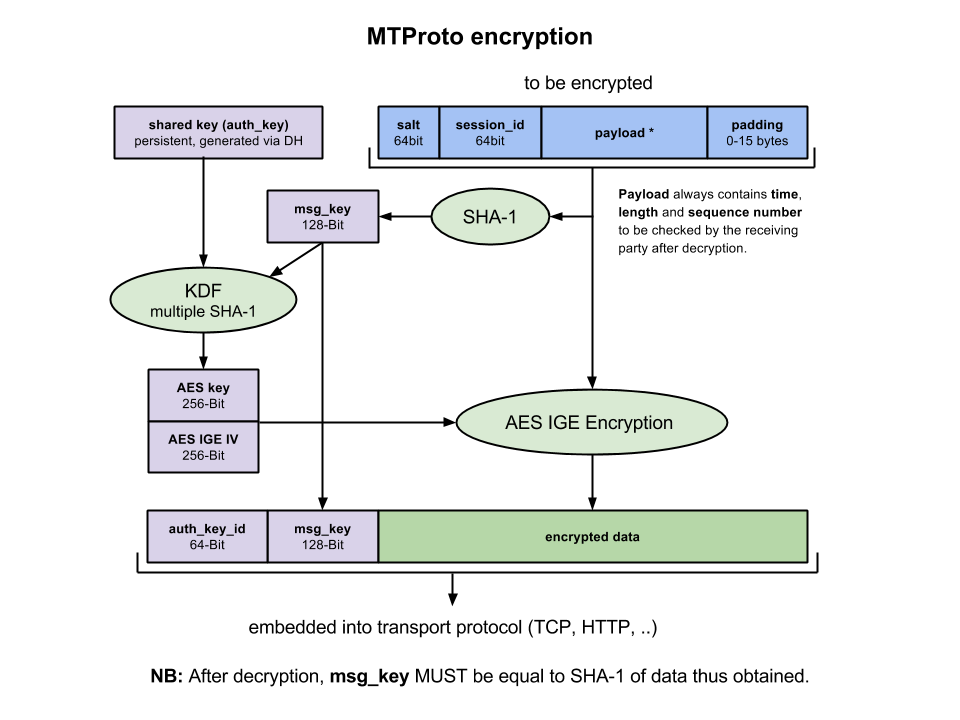
| > 2. And what problems with IGE are you aware of? Any known attack? As far as we know, it is the ubiquitous CBC that has had issues. And by the way, Kerberos had to abandon PCBC - not IGE. IGE was the first attempt at an "authenticating encryption mode," originally for Kerberos. It was a failed attempt (it does not provide integrity protection), and had to be removed. That was the beginning of a 20 year quest for an authenticating encryption mode that works, which recently culminated in modes like OCB and GCM. I don't see any integrity protection documented anywhere in your protocol spec, so if you're relying on IGE, it's broken. What's more, any "problems" with CBC (I assume you're referring to padding oracle attacks) are not specific to CBC, and are endemic to IGE as well. > The team behind Telegram, led by Nikolai Durov, consists of six ACM champions, half of them Ph.Ds in math. It took them about two years to roll out the current version of MTProto. Names and degrees may indeed not mean as much in some fields as they do in others, but this protocol is the result of thougtful and prolonged work of professionals. I don't think their academic credentials or the amount of time they spent on this are the important metrics. If you're trying to suggest that they're thoughtful, the best metric for demonstrating that would be something like a proof for the (honestly naive-looking) KDF they made up. In essence, the protocol seems to reflect many choices that anyone familiar with the field can immediately identify as suggesting a lack of understanding. It could be that these are simply brilliant moves that we non-ACM champions are too primitive to understand, but if that's true, you need to justify them with proofs in order to support them. Otherwise we're going to interpret them for how they appear. > Thank you for the offer to join in the project you represent. However, we feel that what we are doing is going in a somewhat different direction and has its own potential. Could you describe how your projects objectives are inconsistent with a protocol ratchet like Axolotol or the full TextSecure protocol? |
https://groups.google.com/forum/#!topic/sci.crypt/4bkzm_n7UG...
Long story short: you get integrity protection from IGE by relying on the fact that a bit error anywhere in the stream will irrevocably corrupt the rest of the stream, so you create an authentication code by sticking an all-zeroes block or (like I think Telegram does) a message digest to the end of the stream.
But it's possible with carefully chosen errors to first corrupt an IGE stream and then recover it, so that the remainder of the message after the corruption (including the "MAC" tag) will remain intact.
IGE is an extremely weird, and, at this point I'll venture: bad choice for a 2013-2014 cryptosystem.