Hacker News new | ask | show | jobs
by contingencies 4725 days ago
Sanskrit isn't verbose. I haven't seen any English translation...

Sure! Long multi-phoneme words with all the tense built in... the wordcount will be low. I meant semantically verbose, roughly: "average minimum unit of well-formed expressible information". In this facet, I found Sanskrit far worse than even Latin.

1 comments

I recently noticed similar diffrence between Polish and English. Usually Polish text is shorter in written form (less words, and often less letters), but English text is shorter when spoken (less syllables). Polish has also a little more redundancy because word endings must agree.

It almost seems like Polish was optimized for reading/writing and correctness, and English for talking and speed.

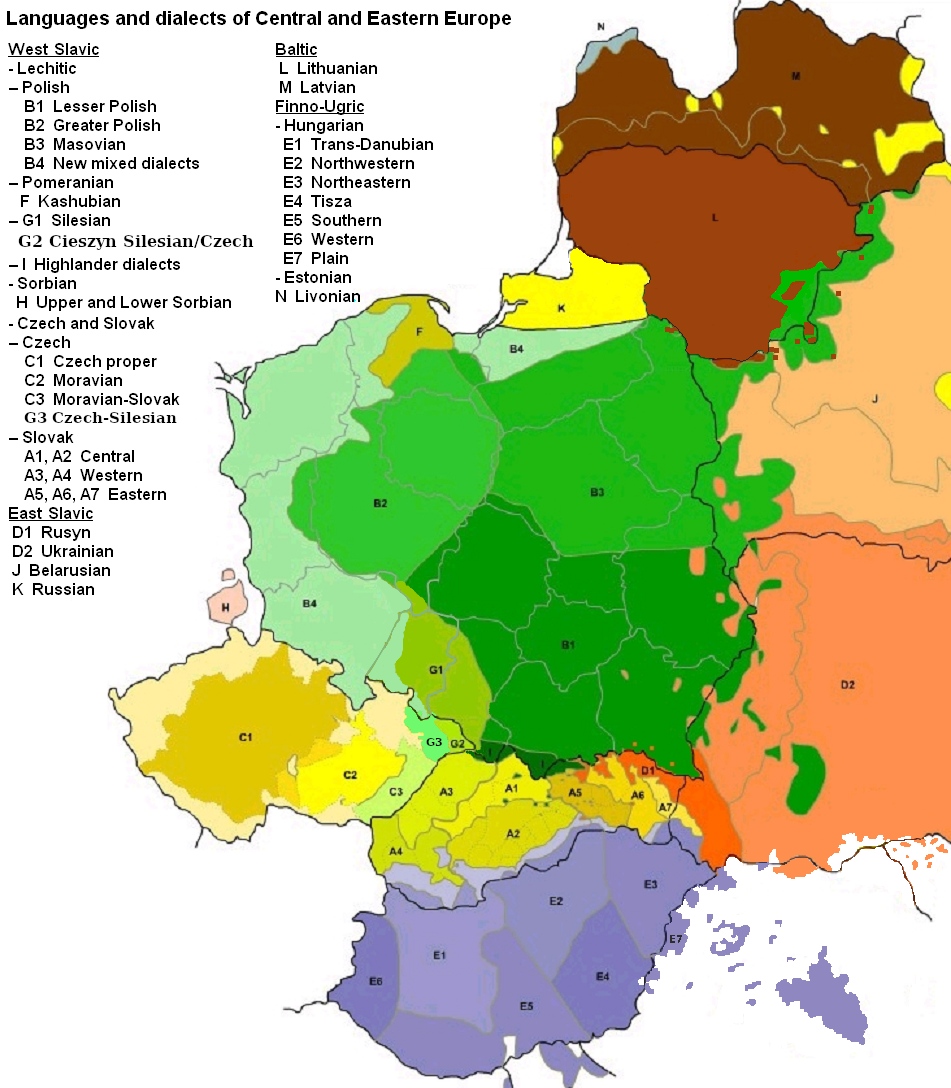
It's late here so I'm not going to research this before responding. It is my impression from some previous reading that the closest European language to Sanskrit is German, with certain words such as luft (Lufthansa, Luftwaffe, etc.) being directly traceable to a common ancestor. With all of the Prussian-style border-shifting in the Germano-Polic region over time (the German History museum in Berlin is absolutely amazing illustrating it with maps!), I wonder if perhaps Polish shares some of that - for wont of a more informed phrase - 'old school Indo-European' quality? The answer is probably on Wikipedia, which also distinguishes betwen many types of Polish: https://upload.wikimedia.org/wikipedia/commons/1/15/Language...
Strange, I think Polish share much more with Sanskrit than German. Not that it makes it somehow better or worse, just my opinion.

For example we have flexion system working smilary to that in sanskrit (you glue up pre and postfixes to the word to change the tense, mark the gender of the actor (mandatory), or depending on the case of the noun). German has sth similar only in a few places (past tense), and in concatenating nouns together. Most of the time word order and "keywords" decides on the tense, like in English. Polish have 7 cases (1 rarely used), sanskrit has 8 (1 rarely used), German has 4 IIRC.

Polish only recently (a few centuries ago) lost dual plurality that exists in sanskrit, and we still have relicts of that in many places, like proverbs, names for body parts, the way nouns change with numerals, etc.

And these all things aren't specific to Polish - almost all Slavic languages share them. I've also heard Lithuanians say their language are even more similar to sanskrit.