Hacker News new | ask | show | jobs
Ask HN: How to get back into mathematics?
9 points by chaosinorder 4792 days ago
So, here is the situation. I got a degree in literature a few years ago. Not enjoying work now (I work full-time). I used to like making sites when I was a kid (just simple JavaScript, PHP, etc., stuff). So I will be taking some programming courses. However, there is some math requirements. I only did up to grade 11 math, if memory serves. I never really liked it and have not done it in about 15 years.

Now that I'm much older, I have another perspective and really want to understand mathematics and do well in it. Basically, I'm willing to put the effort because I've somehow grown to appreciate it and hold mathematicians in high regard.

Question: shall I get a good algebra book (study on my own) and take a math placement test? Or shall I take the pre-req math courses at college and work my way up?

If I go the book route, what are some good algebra books/sites?

Thanks for any feedback I may get in advance.

6 comments

Information theory is a really cool, really practical form of math / computer science. I highly suggest reading up on it (I'm using this book to get through the basic ideas: http://www.amazon.com/Introduction-Information-Theory-Symbol...).

Basically it has to do with measuring entropy / uncertainty in a message, and I'm finding it has applications almost everywhere, from file compression to image editing to highway design to just the way I talk and communicate information. Fun stuff!

Will add it to the list. Thanks!
Since you consider yourself an older learner, how about trying your hand at "Intro to Mathematical Proof" or "Intro to Problem Solving" books? Velleman's "How to Prove it" and Polya's "How to Solve It" seem like good places to start (after you finish reviewing high school math) and will help you develop a deeper appreciation for the subject.

If I may ask, why the sudden interest in math? I have some experience with the subject and, if you want, willing to give some more advice.

I'm 30 years old, and focused on a liberal arts degree, but since I was a kid I've always done basic PHP and JavaScript stuff.

The CS courses I'm interested in taking, such as C/C++ have a math requirement. But I don't just want to do it because they're required. I now have a genuine interest in math maybe because of my life experiences, finding what type of person I am, etc. I have very few friends in the liberal arts, because I'm not really like them. Kinda complicated to explain all of it.

My personality meshes better with people in the sciences. This goes for work-related stuff, as well. It took me 10 years to figure that out after graduating high school. Even though I excelled in all of my classes (graduated in top 5%), I think I was living in my own little world with regard to liberal arts.

I feel like I can never get to fully appreciate mathematics, but at least I will try my best to do what I can when taking the math pre-reqs for CS.

I'm open to receiving any feedback/advice -- the people around me usually find these types of discussions boring, though :)

Email is in the profile. Thanks!

I would recommend some MOOC's for a good, pressure-free re-introduction. Udacity has an algebra class. I assume it's really good. The Norvig course I took there was excellent. Also check out Coursera.

https://www.udacity.com/courses

https://www.coursera.org/courses

If your interest is math for programming, you want an introductory course or book on 'discrete mathematics', which should be enough math for you to take an algorithms and data structures class. That will position you to do some real programming.

Beware of trying to learn everything. For adults that is probably impossible due to time constraints. Standard subjects like trigonometry and calculus will have less utility for programming than discrete math.

Focus on algebra and discrete math. Then, if you want more, probability and statistics. That will give you the biggest bang for the buck.

This is what people have told me when I inquired about this in person.

Thanks for confirming it. And, of course, all of us already know about MOOCs, but knowing someone has taken a course there and it was good, is a decent indication for a beginner like myself.

Your advice also seems to get to the nitty-gritty -- to the point! So this is good! Thanks!

I'm a strong believer in getting some basics under your belt, and then following a course. Don't read haphazardly, have a specific curriculum to follow so there's an over-arching arc to your learning.

Without knowing more about what you can already do I can't recommend anything, but actually taking courses is a way to give you structure. The fact that you're asking here shows that you haven't taken control of your own learning, so getting a pre-prepared course or two under your belt seems a good way to start. Then re-assess.

YMWV

Thanks. You're right I haven't taken control of my own learning, which can really be summed up in the question: where do I start?

Part of the problem is I don't even know what I can already do, because I haven't done math in a long time. So part of all this is really my being a little scared of it still.

I will look for algebra resources online and see how I do and use that to see if I need to go further back, stay on that algebra track, or try higher-up math.

In the end, I really am partial to taking a course, because of the structure, as you say. So I just want to see what math I should start at, instead of throwing away money.

Thanks!

I have the same problem to some extent. I'm developing a web site that shows the connections between topics, and is intended to help structure such courses, but finding where to start, and where to go, and what's connected, is difficult.

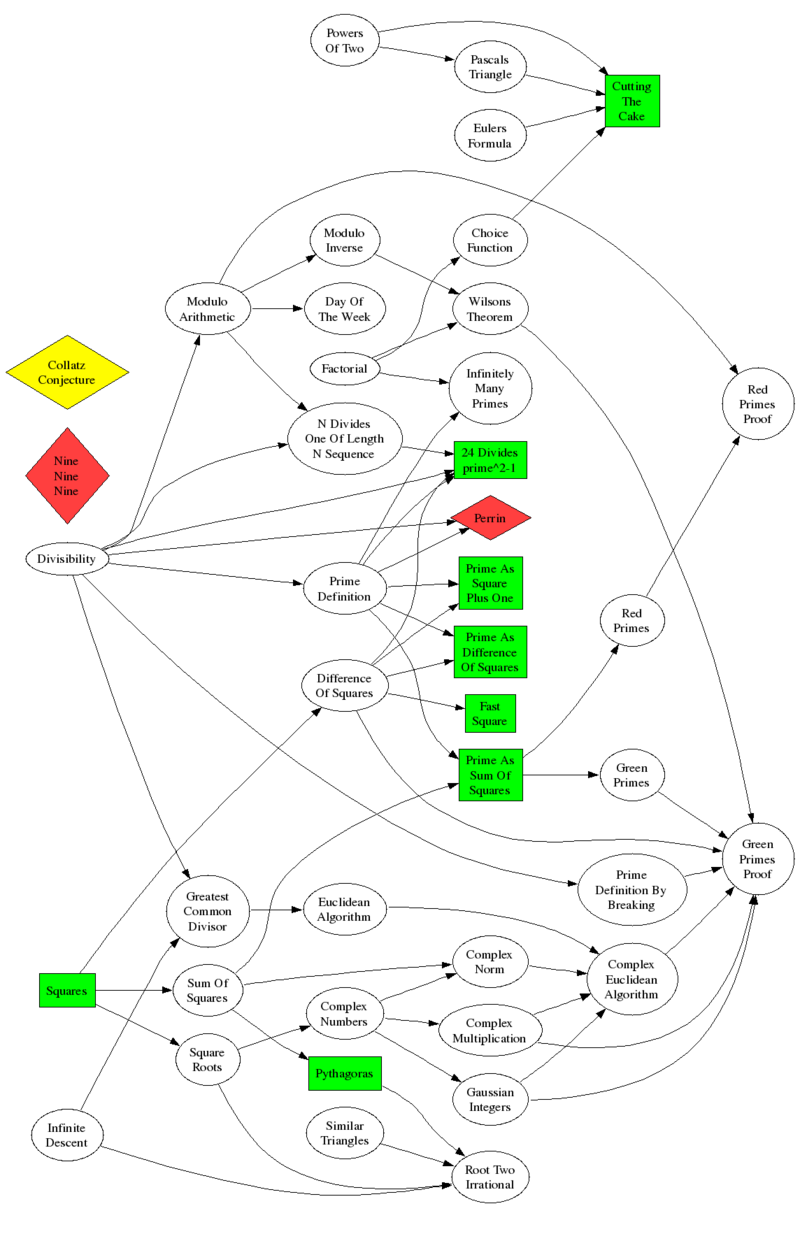
It comes down to what you want to end up with. If you know that, and can prevent yourself from getting discouraged, draw a DAG of the topics you think you need. For example, do you want to understand why primes of the form 4k+1 are always the sum of two squares (which I call "Green Primes")? Here's a net of interconnected ideas:

http://www.solipsys.co.uk/new/images/PatternsFailProofsPreva...

These are things you need to understand to get to that proof.

Then pick another. Maybe we can help each other. Are you interested in just getting to USA High School graduate math? Or do you want to understand proofs?

Consider emailing me. My response time is slow, but I will answer.

I had never heard of a Directed Acylcic Graph before. Let me read up on it and will try to do it. What you say makes sense, though.

I want to be able to take advanced CS courses and fulfil the math requirements. However, I am certain I am far from being prepared to take those math courses required to take anything above first-year CS courses.

I know this is going to sound lazy, but a quick Google search indicates it is recommended CS people know how to write proofs. So I guess the answer is yes. However, we are getting into extremely foreign territory for me.

And yes, I am in California. I don't really know how I can be of any help to you, to be honest, though.

What are the math requirements for advance CS courses? If you can find a concrete list of topics, then I can help you find the prerequisites. You will be helping me by finding topics I need on my site, and the connections between them. I'll help you by giving overviews of topics, and answering specific questions (usually with pointers to reading).
I will email you tonight (my time).
Honestly the best thing you can do is go to www.khanacademy.org and finish all the math videos he did and all the math exercises on their. You will be a math professional or close to it lol
There are some resources listed here, most of them should be free on the web:

http://www.kidslikemine.com/2013/05/03/math-resources/

(That's my site, if it matters, and aimed more at kids, though math resources go as high as calculus.)

I used to be a math geek, though not nearly on Colin's level. I don't necessarily agree that you need a course. Different strokes for different folks. That's not a math thing. That's a human diversity thing. Only you can determine whether a course or self study (or some other option) will work best for you.

Now that I'm older, I can appreciate educational material directed at children. So, I'm not opposed to taking those courses -- I do not feel above it by any means. Who knows -- it may work as a catapult!

I will try out your site, for sure. Thank you! :)