|
|
|
|
|
|
by oillio
4914 days ago
|
|
|
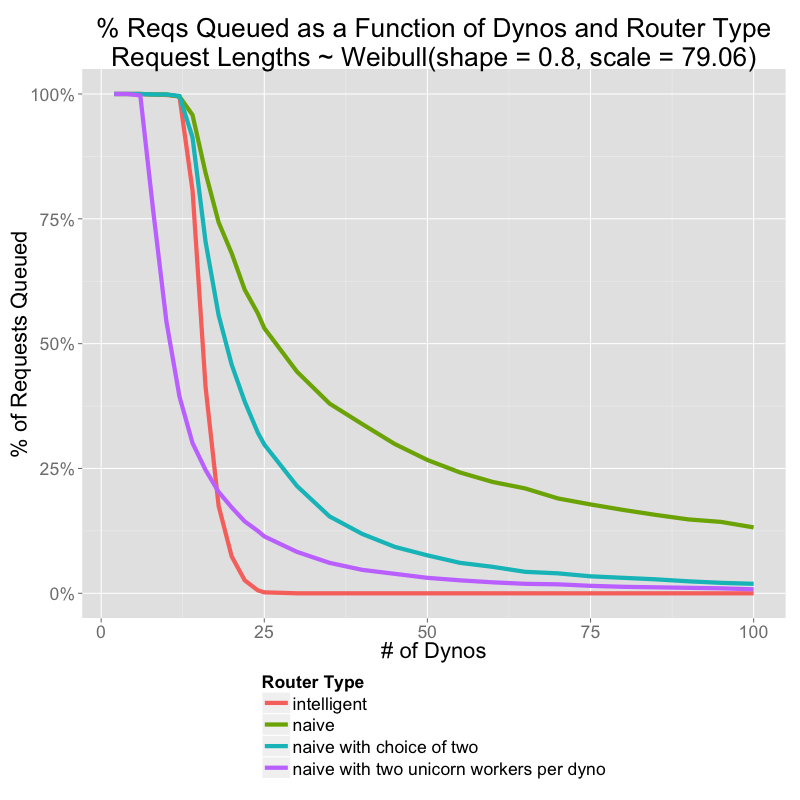
A simple intelligent router may have 2^n performance, but I cannot imagine there are not other solutions that would bring performance closer to linear. I am not a queue theory expert, but I know they are out there. This is a well studied area of CS. This is not only a problem for non-concurrent applications. It will become a problem as dyno usage increases for any application. The major factors will be the standard deviation of your response times and the number of responses you can handle per dyno. The issue just manifests first in applications that can only handle one request per dyno. Check out this graph released by rapgenius:
http://s3.amazonaws.com/rapgenius/1360871196_routerstyles_fa... The purple line is a multi-threaded application.
No matter how concurrent your framework, it is still possible to overload the resources of a single dyno. When that happens, the router will continue to stack requests up in the queue. |
|
|