| If anyone's interested in the accuracy, this is very 'visualisation grade' software. Its a bit of a pet peeve of mine that people present these sims as being very physically accurate, when they contain major inaccuracies, some of which are very obvious and/or deliberate. This one has some serious physical limitations I wouldn't mind at all if it didn't say that this was a *physically accurate* black hole specifically, but this now falls under misleading science communication in a way that often gets hand waved away as if it doesn't matter, so we've got to clear some things up! 1. The accretion disk shouldn't be red, people just expect it because it looks cool. Black hole accretion disks are near universally hot enough to be blue. Interstellar did this too, and tried to handwave it away very unconvincingly 2. This is a non/low (?) spin black hole, which isn't super duper realistic 3. It ignores the position of the camera (which affects the lorentz shifting) 4. The doppler shifting isn't terribly accurate 5. It doesn't model the accretion disk temperature distribution or colour with any kind of accuracy. Usually you model accretion disks as a blackbody radiator, shift it by the doppler, and to display this convolve this against the human eye response (LMS), go to XYZ, then RGB, do a physical tonemapping step, before an sRGB conversion. This instead does none of that - no step of this is done with any physical accuracy. Its not even illustratively correct as we'll get into 6. The actual radiative transfer is very simplified compared to what you'd use for realsies, and isn't based on any real numbers, with very simplified equations. The opacity and emissivity of the disk is arbitrary, as is the size, and it does not correctly incorporate brightness or extinction, eg here https://github.com/aplavin/blackhole.plav.in/blob/2f004bfeca... is super simplified 7. The wrong equation is used for the doppler calculation. They use the I^3 variant, whereas the data you get out of a disk sample is *radiant flux* which is actually F_obs = F_emit / (z+1)^4. This is a very common mistake in image processing, which means that the doppler shift and observer brightness isn't correct. Surface brightness over here https://github.com/aplavin/blackhole.plav.in/blob/2f004bfeca... is *not* a spectral radiance but instead a radiant flux Stuff like the brightness -> colouring conversion is particularly inaccurate. Eg if you check out the source: https://github.com/aplavin/blackhole.plav.in/blob/2f004bfeca... It maps the pseudo brightness completely arbitrarily to colour. The resulting colour/brightness here then doesn't correspond to anything remotely physical. It also performs a *linear* mapping of a linear quantity (brightness) to sRGB (which is a nonlinear process!!), which means that it doesn't even retain any of the underlying physical characteristics of the brightness simulation, which itself is quite inaccurate. Its vibes all the way down This is all fine if you're doing visualisation, but this isn't an accurate simulation. I wish this was just called a visualisation of a black hole, but its being communicated as if this is super hard science with credentials and all |
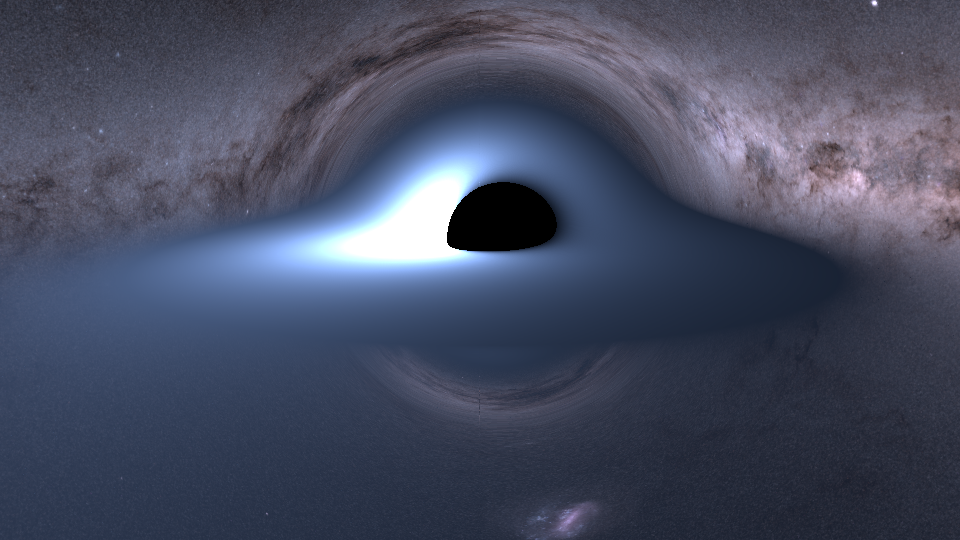
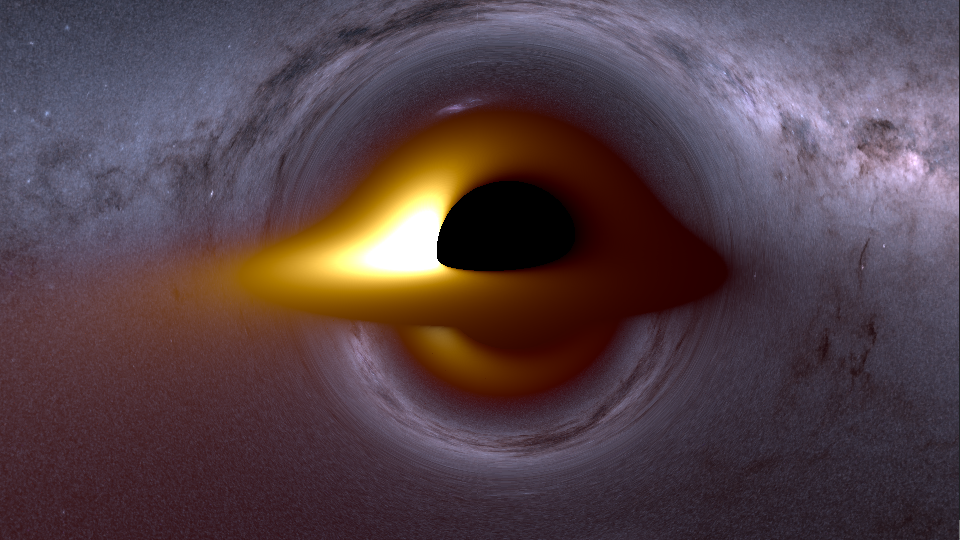
I thought "oooh this is interesting I wonder how they are going to do physically accurate on an end device" Recalling how the original particle sim was something like 100TB, took 2 weeks to generate and seemed to write in a way that killed disks. but that was >10 years ago, so what clever stuff has been done to model it locally.
Its been a long time since I've looked at black holes, but what I'm not understanding is why the stars surrounding the black hole are just points, and more over why the lines are straight to the centre of the hole. from memory the way light enters the hole appears non-linear and changes on view point.