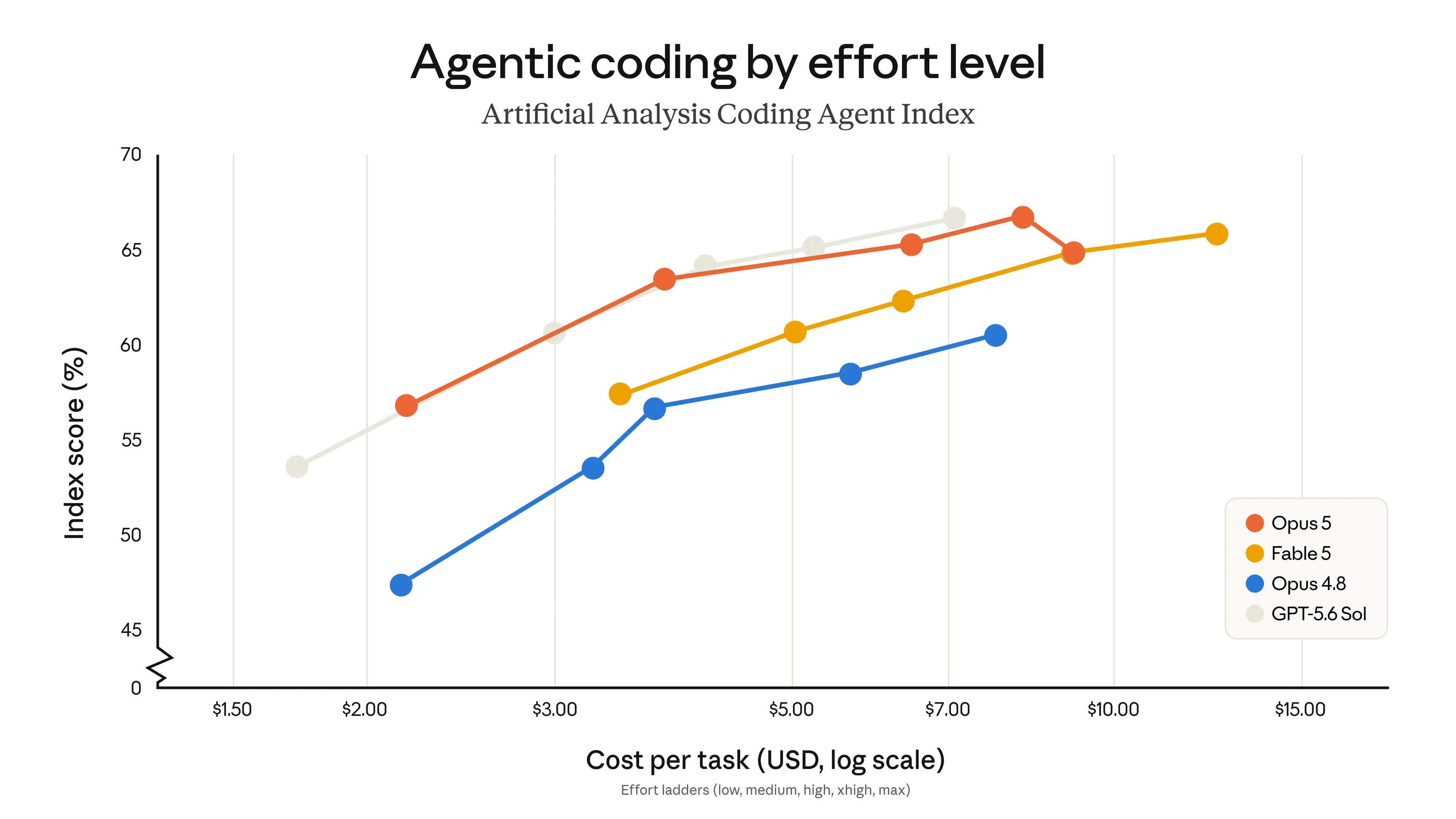
I like how they highlighted Opus 5 as the best for “Agentic Coding” even though the number is slightly lower than Fable. Close enough for marketing, I guess!
But better cost for the same performance. According to AA, Opus 5 _medium_ is as smart as Opus 4.8 _max_, at 1/3 the cost and twice the speed. And if you need a better response, you can turn it up to 11.
Opus 5 also downgrades. it's now Fable -> Opus 5 ; Opus 5 -> Opus 4.8.
Unclear why they want to nerf their own products with sometimes right classifiers. I guess the government ban might've been real and not coordinated marketing?
I don't understand why people believe this conspiracy theory of "oh the government ban was just marketing". That claim feels so incredibly ridiculous to me. It cost Anthropic a ton of money and reputation, and worst of all: it absolutely killed their competitive advantage. They were 1-2 months ahead of OpenAI, but trump conveniently gave OpenAI the time they needed to catch up and push 5.6 out the door without having to lose their subscriber base to the competitor.
Hopefully it's not like old Opus, where it was actually more expensive than Fable cause it thought for half an hour, got it wrong, and then thought until you ran out of credits trying to come up with a correction, while Fable just went for it and did it in one go, getting it right the first time without thinking more than a few seconds.
Got an endless list of stuff done with Fable, Opus 4.8 was like a flailing braindead idiot in comparison. Maybe this one is a bit better if it's distilled.
Recent releases have said something to the effect (paraphrasing here):
"Use <less expensive or older model> for everyday tasks and <other non-critical stuff>. Use <more expensive or recent model> for complex coding tasks, refactoring large code bases, etc.".
Then, the next model/release emerges and the previous "best for complex" gets demoted to "everyday".
Obviously, it's all relative. But, it does beg the question: was the previous model really good for complex coding tasks or no? I mean, how is it now suddenly only good for the "easy" stuff?
I'm sure the marketeers would love for the public's assessment of complex versus easy to conveniently shift per their release cycles; or for the public to simply forget their prior marketing.
I think you're being overly cynical here. First, I don't see any claim that is the world's best model for agentic coding. Second, it is absolutely the best model in terms of coding performance vs. dollar, and it's raw performance seems very close to the frontier.
How are you supporting the claim that GPT 5.6 is "far more token efficient" than Opus 5? Tokens equal, output is cheaper for Opus 5 ($25/1M) than GPT-5.6-Sol ($30/1M), and it seems to outperform slightly on agentic coding benchmarks.
It would still be the best model per dollar if the score was 2% lower instead of 0.1% lower. Would it be ok to still give it the highlight color then?
How big of a lie is too big? Especially when no lie needed to be told at all: many including myself would have noticed the tiny 0.1% deficit and been suitably impressed by the Opus 5 result.
I’ll admit this is a small deception by today’s standards. I’m one of those who believes in truth for truth’s sake.
Using the most expensive model for all of your agentic coding work hasn’t been good practice for a long time. Not unless you have infinite money to spend.
Fable is typically used for key planning, architecting, and review tasks.
I think this is a case where you don’t understand the use case, not that the marketing department is making mistakes.