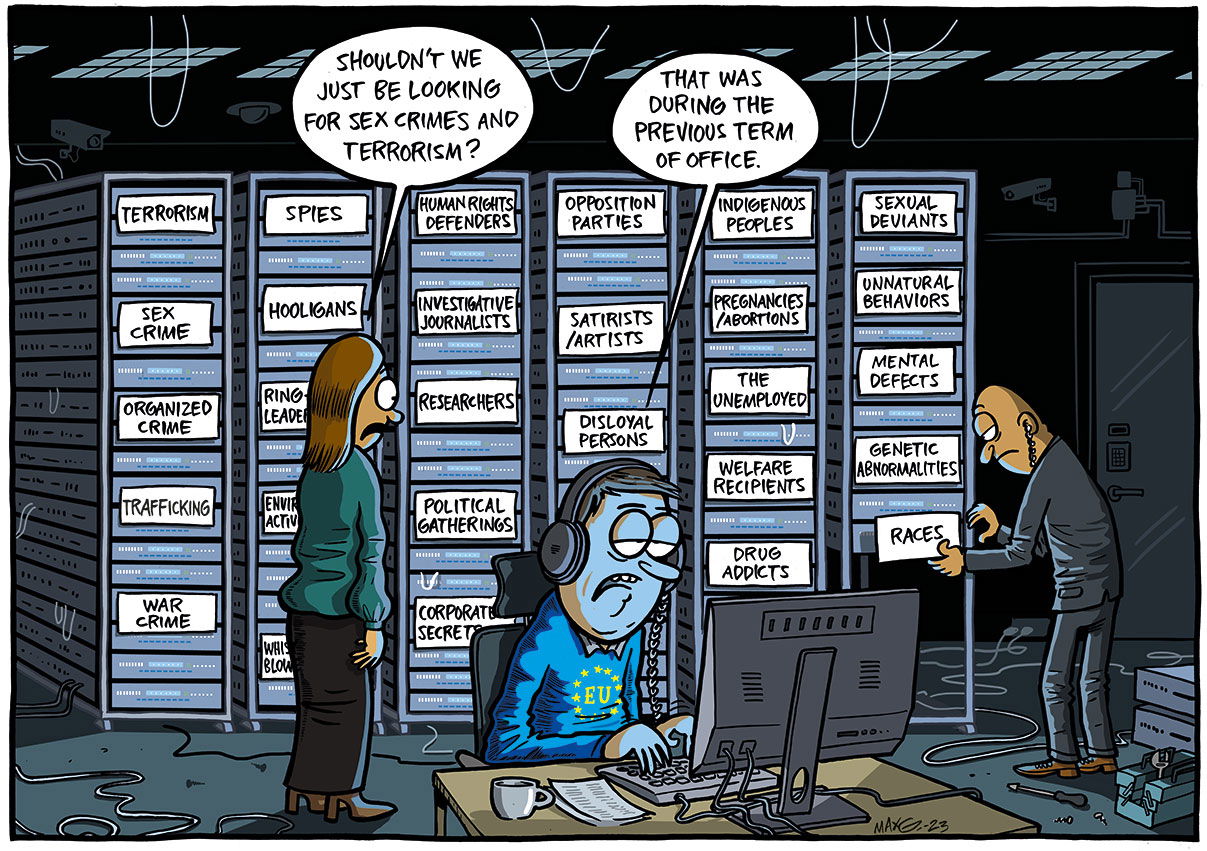
The Internet Watch Foundation, an organisation funded by almost all of big tech, is already at work pushing for client side scanning next [1], for the children, of course.
Why stop there? This system can easily be used to target welfare recipients, immigrants, LGBT+ people, black/brown/indigenous people, pretty much any disfavored group of choice!
You're just one election away from "that was during the previous term of office"
Kind of surprised they don't just pitch it as a way to root out Russian propaganda and right-wing extremism. Public opinion would shift overnight. They'd practically demand it!
Actually, what are the partisan leanings of the parties actually actively pushing this, since you’ve brought it up?
Despite being fairly left-leaning I wouldn’t automatically blame the right for this particular type of invasive nonsense… is this a centrist spawned nuisance, or something?
>Aren’t stupidity, shortsightedness, and corruption universal human “values”, well-spread all across the political spectrum?
We ostracize and marginalize people for doing all sorts of bad shit that is endemic to humanity because minimizing and eliminating those people's ability to affect society improves society.
The fact that people feel entitled to peddle flimsy "for the children" justifications for obvious enabling of authoritarian government (or any other social ill) is the problem. Those people should be as well received as someone who says we need to re-subjugate blacks because 13/50 or whatever. Nobody makes the excuse "cut them some slack tribalism/racism is a universal human value"
If we treated peddlers of the former the way we treat the latter we'd have a lot less of this problem.
>Kind of surprised they don't just pitch it as a way to root out Russian propaganda and right-wing extremism. Public opinion would shift overnight. They'd practically demand it!
Because the masses are already pretty damn sick of exactly the demographics and groups that that marketing would garner support from.
> an organisation funded by almost all of big tech
Agreed, and this sucks, but what should be done about this? Some NGO called "We Stop Bad Guys" approaches your company with its hand out. You have two choices:
1. kick down some money, get great headlines
2. don't, and then have it known that you don't support stopping Bad Guys -- then maybe write ten thousand never-to-be-read words about how your position is actually quite principled
How is it rational? What's going to stop a different We Stop Really Bad Guys NGO from showing up next. Corporations are perfectly capable of not getting involved when they don't want to.
I feel like if people wanted to counter this push, the more effective route would be addressing the "for the children" motivations seriously rather than fully dismissing them. You could cut the legs out of this effort by capturing the part of the population that does have an honest desire to protect children by offering an alternative that actually protects children. Instead, that concern is treated as 100% disingenuous which pushes many normal people to the side of wanting to enact these controls. This is a political problem, you need to solve it with politics.
I know a number of people who have gone down this route, including Senators. For example, here's Senator Wyden's proposal to add $5 billion in mandatory funding to investigate and target sexual abusers [1]. The problem with these efforts is that they're expensive: fighting child exploitation requires enormous amounts of funding.
Guess what doesn't require billions of dollars? Mandatory scanning paid for by tech companies, followed by dumping the billions of hits they produce [2] on overworked police and clearinghouses that mostly ignore them.
Then fund the initiative by taxing those same tech companies. "This problem is hard or expensive to address" does not assuage the desire to fix the problem.
There are countless reasons to be against these chat controls, but it's easy for a layperson to understand how they would address their specific concerns. The only way to effectively counter that is providing an alternative that does a better job.
> Then fund the initiative by taxing those same tech companies.
The politicians needed to change tax laws are owned by the tech companies. This is why its a hard problem. The tech companies set the rules now. Getting politicians elected that aren't owned by tech companies is also hard because tech companies effectively control all the information.
If this is your belief, the only reasonable conclusion is that time spent on fighting these chat control initiatives is wasted because it's all downstream of the power of the tech oligarchy. That's the battle you should be fighting rather than trying to play whack-a-mole on individual proposals like this.
> You could cut the legs out of this effort by capturing the part of the population that does have an honest desire to protect children by offering an alternative that actually protects children.
There are many, many things we can do that actually protect children -- and we generally already do them. That's the nature of the problem. After you do all of the things that are reasonable and cost effective, it solves 90% of the problem, 95% of the problem, 99% of the problem, but never 100% of the problem.
So you can't give them something that does that. The thing they're proposing doesn't even do that. Nothing does. And then disingenuous opportunists keep proposing the thing that should never be done because they know it lets them paint you as the bad guy for having to tell them no again and again.
What you need instead is to identify and strip power and resources from the people who keep proposing it.
>There are many, many things we can do that actually protect children -- and we generally already do them. That's the nature of the problem. After you do all of the things that are reasonable and cost effective, it solves 90% of the problem, 95% of the problem, 99% of the problem, but never 100% of the problem.
Genuinely, how do you expect someone concerned about child sex trafficking to receive this? "Oh, good point, I guess we can't do anything more to protect children because it isn't 'cost-effective'." Do you think that will be a common response?
>And then disingenuous opportunists keep proposing the thing that should never be done because they know it lets them paint you as the bad guy for having to tell them no again and again.
I'm not even disagreeing with this point, I'm simply saying your response can't just be "no, they are the bad guy". That is not a winning political message. That's why the democratic socialist faction of the Democratic Party in the US is growing in popularity. You can't just call your opponent bad especially when your opponent is promising to address people's concerns, you need to actually engage with people about their concerns and offer solutions.
Child sex trafficking is primarily a law enforcement problem. You actually need someone to solve the case, visit and arrest the perpetrator.
Mass surveillance doesn't actually solve the problem because of how rare it is. Your signal is 99.99% noise in the first year and 100% noise in the second year after people get caught on the scanned platforms and switch to unscanned platforms.
> Genuinely, how do you expect someone concerned about child sex trafficking to receive this? "Oh, good point, I guess we can't do anything more to protect children because it isn't 'cost-effective'." Do you think that will be a common response?
I'm taking it as a given that we shouldn't do things that aren't cost effective, because that's what "cost effective" means. There are things we could do that would cost six trillion dollars in order to save one life, and we're not going to do those things, because it would be patently unreasonable and cost dramatically more lives than that as a result of what those resources would have to be allocated from.
It's possible that there are cost effective things we could do that we're not currently doing, but those things tend to be uncontroversial, so when someone uncovers one it generally does actually get enacted and becomes the status quo. That's the issue: Name any given thing you suppose we should do instead of Chat Control. Enact it, as many of them already have been. Tomorrow they propose Chat Control again, so what now? Offering and even enacting an alternative hasn't satisfied them, they keep trying to pass it anyway.
> You can't just call your opponent bad especially when your opponent is promising to address people's concerns, you need to actually engage with people about their concerns and offer solutions.
What are you supposed to do when you've not only offered solutions but enacted and implemented them already and your opponent is a fear monger who will never be satisfied because they have an ulterior motive for their dangerous and ineffective proposal?
>I'm taking it as a given that we shouldn't do things that aren't cost effective, because that's what "cost effective" means. There are things we could do that would cost six trillion dollars in order to save one life, and we're not going to do those things, because it would be patently unreasonable and cost dramatically more lives than that as a result of what those resources would have to be allocated from.
The problem with describing it in terms of cost-effectiveness is that you now have to put a price on how much we can justify spending on child sex trafficking. What is that number? How much is too much to save a child? How can you possibly answer that in a satisfying way?
>It's possible that there are cost effective things we could do that we're not currently doing, but those things tend to be uncontroversial, so when someone uncovers one it generally does actually get enacted and becomes the status quo. That's the issue: Name any given thing you suppose we should do instead of Chat Control. Enact it, as many of them already have been. Tomorrow they propose Chat Control again, so what now? Offering and even enacting an alternative hasn't satisfied them, they keep trying to pass it anyway.
>What are you supposed to do when you've not only offered solutions but enacted and implemented them already and your opponent is a fear monger who will never be satisfied because they have an ulterior motive for their dangerous and ineffective proposal?
The proposal up-thread seems like a good place to start. If we believe that these tech companies have through their software and platforms made it easier to exploit children, that justifies taxing them to offset the negative externalities they create. We then take that money and use it to increase funding for investigation and enforcement. I have no idea if that will work, but it at least puts the people you view as the enemy on the defensive and gives you the chance to win some of their supporters back to your side. Because right now you're letting those fearmongers dictate the terms of this political debate and their persistence on this issue shows you aren't making any progress in changing that.
> The problem with describing it in terms of cost-effectiveness is that you now have to put a price on how much we can justify spending on child sex trafficking.
The problem with not doing this is that you in fact actually have to do it, or else what are you going to describe as the problem with the proposal that would spend six trillion dollars to save one life?
> If we believe that these tech companies have through their software and platforms made it easier to exploit children, that justifies taxing them to offset the negative externalities they create. We then take that money and use it to increase funding for investigation and enforcement.
The problem with that proposal is that it's foolish. Special-purpose taxes should only be used if you're specifically trying to discourage something (e.g. cigarettes) since a) they're inefficient because you need a wasteful new collections bureaucracy instead of using the existing already paid for apparatus for collecting general revenues (money should go to protecting kids, not tax bureaucrats) and b) you're then targeting a specific industry for a new disadvantage which will oppose it much more strongly than trying to get the same amount of money from the general fund.
The actual meat of that proposal is to increase funding for law enforcement to investigate child exploitation. But that's exactly the sort of thing where if it's cost effective to do that then it will have no meaningful opposition and then will either be enacted without controversy or already has been. At which point they immediately go back to trying to pass Chat Control.
> If we believe that these tech companies have through their software and platforms made it easier to exploit children, that justifies ...
Do we believe that? At least relative to the rest of the internet (ie not-big-tech)? Isn't singling out big tech in this manner just a talking point used by the disingenuous actors attempting to foist this on us?
What is even the supposed motivating ill here? What exactly do you mean by the phrasing "exploit children"? That's awfully vague for something we're supposed to be targeting.
> ... at least puts the people you view as the enemy on the defensive ...
It feels like you're ignoring the point you're responding to here. The pattern outlined was one of bad faith, where after each reasonable attempt the process merely repeats itself ad nauseam. So then in effect your suggestion is to follow the same strategy that hasn't worked in the past.
We aren't dealing with a good faith opponent who will back down when an alternative wins out. They will return with the same argument, and it will still hold sway with the same people, because the rate of the crimes in question will almost certainly never reach zero. At some point the political solution must be to attempt to educate those who are being taken advantage of by the bad actor. To refuse further accommodations when the other party is clearly acting under false pretenses.
It also seems like you're neglecting to address the relative expense. Chat control is cheap compared with Wyden's proposal.
I don't think I agree - "think of the children" is not primarily a rational argument, it's more an emotional and political lever that is used to frame anyone in opposition as being opposed to more child safety, which is very obviously a bad thing.
It creates a moral asymmetry where one group is "defending children" and another group is "defending an abstract concept", but group A wins out primarily due to millions of years of human evolution. It has very little (IMO) to do with the actual underlying concepts being debated.
>It creates a moral asymmetry where one group is "defending children" and another group is "defending an abstract concept", but group A wins out primarily due to millions of years of human evolution. It has very little (IMO) to do with the actual underlying concepts being debated.
You aren't actually engaging with why group A wins. Those "millions of years of human evolution" actually instilled in people a desire to protect children.
I am engaging with why group A wins: they win because the emotional prior is doing most of the work, not because the underlying argument necessarily has merit.
Of course, just like it instilled a desire to consume a lot of calorie-dense food. "Desire to protect the children" in this case is a knee-jerk reaction, or a thought terminating cliche.
For example, how many children will this actually protect? How many children will this harm? How many adults will be harmed by inevitable side-effects that arise? Those questions are not discussed or even considered.
Because those questions are meaningless to many people if you aren't offering any solution of your own to address their concerns. For the people who genuinely care about this issue, an obvious response you will get is "how many children are you willing to allow to be sex trafficked to preserve your privacy?"
You can't win a debate by claiming your concerns invalidate their concerns. You need to actually engage with them on the issue they care about.
Ok, but by this logic all freedom of citizens can be taken away, because it could lead to a single child being trafficked.
The end result is that even the children you're trying to protect are now under permanent surveillance of an authoritarian government where sex trafficking probably still happens, but the law permits the government to wrongfully ruin more people's lives than are saved by the claimed "noble" act.
Wait a minute. If the claim is that we're going to destroy privacy to protect children, asking first for proof that it will actually help children doesn't seem like an unreasonable request.
I can admit that your concern is perfectly valid, even share your concern, and still oppose your solution if your solution won't actually work. In fact, I would argue that I have a greater concern for the problem, because I care enough to worry about actually solving it, instead of just doing some ineffective measure that looks good.
That's at the level of reality, though. At the level of how this gets spun in media and politics, it doesn't often work that way. Performative action too often rules the day. Recognize it for what it is, though - performative. Asking if the solution actually works is a valid real-world response, even if it doesn't play politically.
>Like actually finding and arresting Eipstein clients?
Genuinely yes. It's a viable political strategy to respond to this with a redirection towards Epstein. "How can we waste time on these chat controls when there are obviously people guilty of the worst version of these crimes that go unpunished due to their money and connections? We need to focus on those criminals instead."
Once again, this is a political problem, it needs to be solved with politics.