Hacker News new | ask | show | jobs
by runjake 29 days ago
From a US perspective, just up until a decade ago, it was a sentiment that left-center perspective that people like Barack Obama and Bill Clinton had.

I was caught quite off-guard by this new "open borders" perspective. It doesn't seem sustainable at all.

2 comments

Who supports "open borders" and what do they support exactly?
Radiolab (the podcast) did a good series on border policy that was pretty informative.

IIRC, the US-Mexico border was never open, but it was quite porous. People would come to the US, work for a season to make some money, then go home.

Then once border security started to be tightened, leaving was too risky so people would stay leading to a huge increase in the number of undocumented people living in the US.

To expand on this. California has the majority of illegal migrants. A significant portion of them are "seasonal" fruit pickers where there exist some migrant farmer visas for them, but not nearly enough. Now should we have American citizens/PR holders doing these jobs? Maybe, but it's pretty hard to get Americans to do this back breaking work in the hot sun for a few weeks, travelling from farm to farm until all the fruit is picked. American fruit is really only as affordable (and available) as it is thanks to all this migrant seasonal labour.

I think there's probably some leftist argument against this system on account of how we're taking advantage of poor countries and something something workers rights, but I think removing the ability to leave, to go home is the worst of both worlds.

Strict borders have only existed for ~100 years, and many were drawn without much regard for the people living there, often constructed with intention of religious segregation, and to maintain europe's global superiority

They run counter to the notion of sovereignty and local agency which we value greatly in the US

The irrationality of strict country borders and heavy migration controls will emerge as a heavy global challenge due to economic and climate migration and aging populations

I don't think we have a good answer for what replaces them, but I don't believe there's enough evidence to state that hasty decisions made after WWI and WWII should forever govern global human freedoms - and we need a better approach than war to renegotiate some of this

Part of the reason this thread and this topic is so fraught is there are many people, like you, who are willingly and confidently lying about history. Strict borders have existed since ancient times. There are physical markers of them all over Europe that are more than 1000 years old. You can see other borders from space. This idea that only in the 20th century did this idea emerge is so wrong that it’s got the history completely and totally inverted. Why make stuff up like this?
How did they enforce strict borders in the distant past then?
“Look there’s an X, what is he doing here, get him!”
To add to this, there are numerous well known examples.

For example the Bible defined borders of "The Land of Israel" which are still fought over today: https://www.biblica.com/bible/?osis=niv:Ezekiel%2047:13%E2%8...

The "Eternal Treaty" between the Hittites and Egyptians defined spheres of influence and position of various cities

The Peace of Antalcidas defined the border between Greek and Persian influence and assigned various cities to different powers: https://en.wikipedia.org/wiki/Peace_of_Antalcidas#Effects

One of the biggest drivers of strict borders was tax collection: they defined who could collect tax from which subjects. This was a common source of conflict and so anywhere feudalism was practiced strong border definitions were strongly enforced.

It's possible the grandparent is talking more about the idea of limiting travel across those borders. That is a more defensible position but even then it was more about the the costs of enforcement.

Trade routes had very strong border enforcement because the borders were places taxes were collected for example, and there were limits on who could travel various routes.

For example Venice, Genoa and the Ottoman Empire jealously protected European end of trade routes linking to the spice road.

> Who supports "open borders"

It's a very prevalent idea among US immigration activists and left-leaning people.

> what do they support exactly

Generally speaking, that people can move anywhere, if they want to. This article/interview/book covers it in more depth:

https://www.nyclu.org/podcast/the-case-for-open-borders

* * *
The obvious solution to the problem of abuse of the asylum system (which is in fact a real problem) is to hire more immigration judges so that claims are processed in a timely manner. Apart from getting rid of the asylum process entirely, that's the only long term solution. It's something Joe Biden made progress on (though he did overstate his progress), and Donald Trump reversed.

It doesn't show up in the short term numbers because it is a long-term solution. But Americans aren't interested in long-term solutions.

I agree that that would be an improvement. I don't know that I would call it the solution.
Tell me, how do you, as an immigration judge, actually judge someone that says their life is at risk due to x,y, or z but you have no way of actually verifying that? Especially when they crossed quite a few countries to get here? I don't see how that's an actual solution to the problem.

One could easily argue that Trump made for more progress as far as the immigration courts being backed up by simply not having an almost completely open border like we did with Biden.

It’s shorthand for the policies of the Biden administration, who oversaw an unprecedented level of immigration.
Biden. His policies led to a huge increase in illegal immigration.

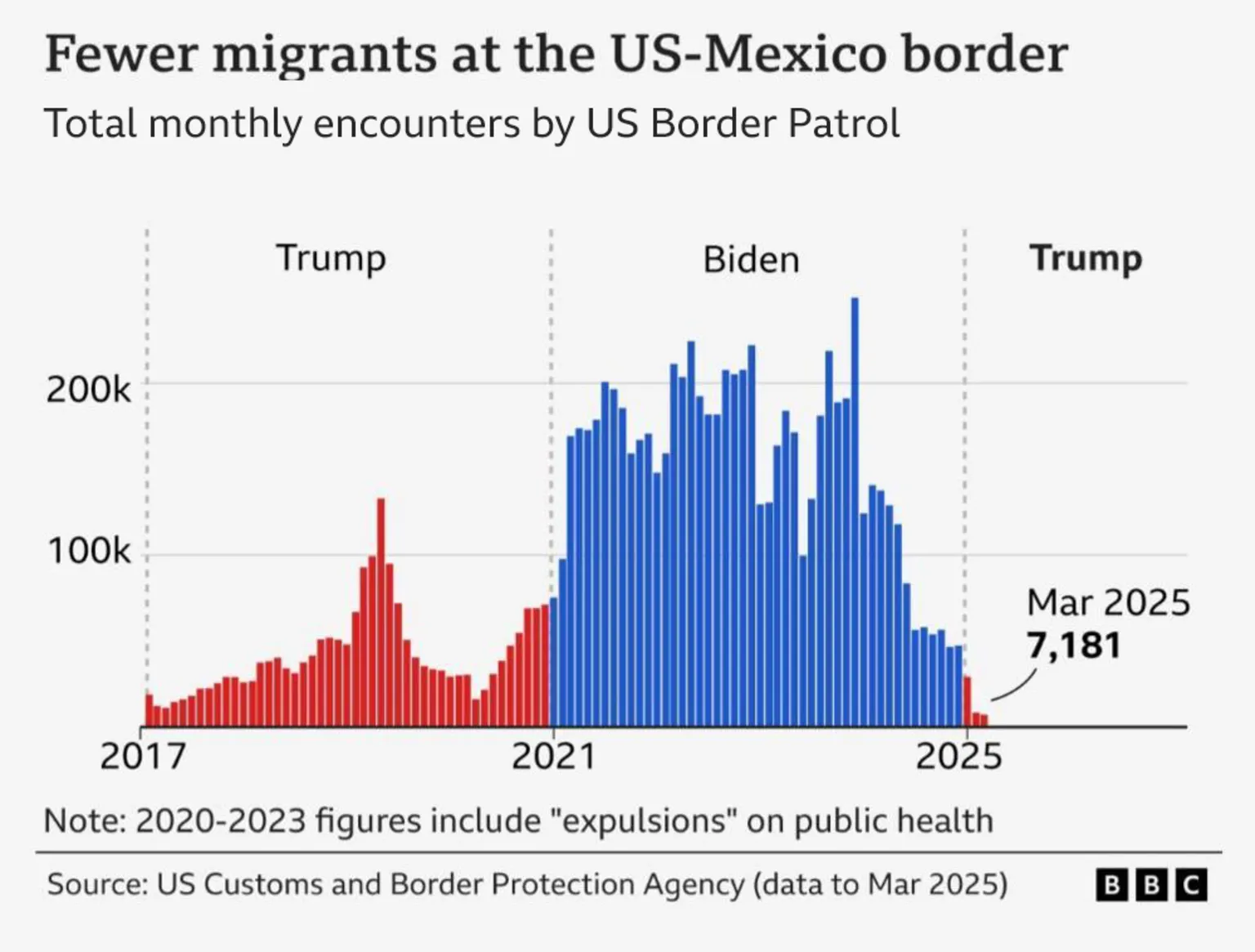
Look at the huge jump due to his policies: https://www.economist.com/content-assets/images/20240127_EPC...

The same was not true for Obama, who was actually much better than Bush.

Biden did not support "open borders", nor did he cause the immigration surges during his term. CATO of all places refutes both of these ideas:

- https://www.cato.org/blog/biden-didnt-cause-border-crisis-pa...

- https://www.cato.org/blog/biden-didnt-cause-border-crisis-pa...

- https://www.cato.org/blog/biden-didnt-cause-border-crisis-pa...

(Also, FWIW, those immigration surges were good things (for the US), and likely helped the US stick the "soft landing" instead of slipping into a post-covid recession)

Not better, just different? GP's chart includes two prior administrations for context; yours includes Trump 2, which also provides additional context (but excludes Bush and Obama).
What was the policy change though?
Biden: "Here's an app where you can make an appointment to illegally cross the border. Our system will be so backed up that you won't need to go to actual immigration court for years, and even then if we tell you to leave and you don't we probably won't go after you. You'll have plenty of time to make an anchor baby. Oh, I can't close the border without a bipartisan bill that essentially enshrines a certain level of illegal immigration. Can't be done."

Trump: "Border is closed. We're deporting people, starting with mostly those that have committed serious crimes."

> I can't close the border without a bipartisan bill that essentially enshrines a certain level of illegal immigration

How did it do that?

The mandatory trigger at 5,000 encounters/day (or 8,500 single-day) implied acceptance of very high volumes—potentially ~1.8+ million encounters/year—before full expulsion authority kicked in. That expulsion authority only lasted for 3 years. It also codified/expanded release authority for asylum seekers under certain "operational" conditions.

The main point is that Biden acted like his hands were tied and Trump showed that they clearly weren't, and that we already had the tools to effectively shut down illegal immigration (through the border, at least).

the graph actually makes it look like the jump was due to Trump's policies, since the spike started in his term. if anything the graph shows that Biden policies arrested it shortly after. I recall reading deportations were actually very high during Biden's term.
Biden, his party, and some Republicans worked for years on the toughest border legislation ever endorsed by a Democratic president. Trump demanded it be shot down so he'd still have an issue to campaign on.
Biden's executive actions resulted in the loosest de facto border in recent memory. That he later worked on some legislation that was ultimately ineffective isn't a great defense. He could have just directed the executive branch to be less lax the whole time!
> That he later worked on some legislation that was ultimately ineffective isn't a great defense.

The in-effectivity was due entirely and directly to Trump interfering in the matter. How can a president sign legislation that doesn't reach his desk because the party in control of the legislative body is in the pocket of a man who cares more about his career than the nation's well-being?

It doesn't matter. You don't get credit for things that don't happen, even if your political opponents were unhelpful.
The current Mayor of New York City and three candidates that just won congressional primaries in the city belong to a political party called Democratic Socialists of America (DSA). They will be joining two more DSA members in congress. This is the DSA's platform on immigration:

> Allow workers to freely migrate between countries to seek employment without restrictive immigration controls. Demilitarize the border, end all immigrant detention and deportations, immediate amnesty for all immigrants regardless of current immigration status, and provide access to jobs, labor rights, and social services to all immigrants.

https://platform.dsausa.org/foreign-policy/

In other words, give labor the same mobility as capital. Nothing inherently unreasonable about that.

Note they say “to seek employment” and “without restrictive border controls”, not “for any purpose” and “without border controls”. This does not mean they’re advocating to let in convicted murderers or people who just want to migrate for welfare benefits. Calling it “open borders” is an exaggeration in absolute terms, though it is for sure accurate as a relative comparison to what we have now.

Also, their political party, as such, is the Democrats. DSA is not a political party. But yeah they are members of DSA as well as being Democrats.

From the Wikipedia article:

> Markus Allard initiated heavy debate in 2025 by claiming that Sweden is "the land for/belongs to the Swedes"

> In a debate hosted by Studio3 with Liberal member of parliament Martin Melin, Allard asked: "why won't the Liberals push for deporting 100 000 social welfare-Somalis?" and in the same debate said that "Sweden belongs to the Swedes.

I don't think it's particularly hard to figure out what these are dog whistles for, and equating my vehement disagreement with it as being in favor of "open borders" is absurd.

It doesn't sound much of a dog whistle? More pretty plain spoken. I think Sweden had one of the lowest crime and high trust societies and then admitted a lot of Somali refugees and now has gang warfare and much rape from the guests. Not sure it's that ridiculous to suggest they go home?
I am confused. Are you using multiple HN accounts or something? I was not reply to the saghm account and your saghm account isn't even present up the thread.
No, this is my only HN account. I'm equally confused why you think that claiming that being in favor of "open borders" being a common perspective wouldn't generate reactions from the type of people holding the views that you mischaracterize as that.
> I'm equally confused why you think that claiming that being in favor of "open borders" being a common perspective wouldn't generate reactions from the type of people holding the views that you mischaracterize as that.

I'm having trouble grokking your statement, but "open borders" is not a pejorative. It's a belief that people, more or less, should be able to freely flow across borders and live where they like.

Again, I am speaking from a US perspective. It may carry different connotations in other countries. It's too prescriptive to apply the same immigration policies at a global level. There's too much nuance and geographical differences.