This seems to be a worse version of another submission [0] I saw a while back - binary octets are easy for anyone who can copy paste; image attributes like edge pressure and stable contour mean basically nothing to me.
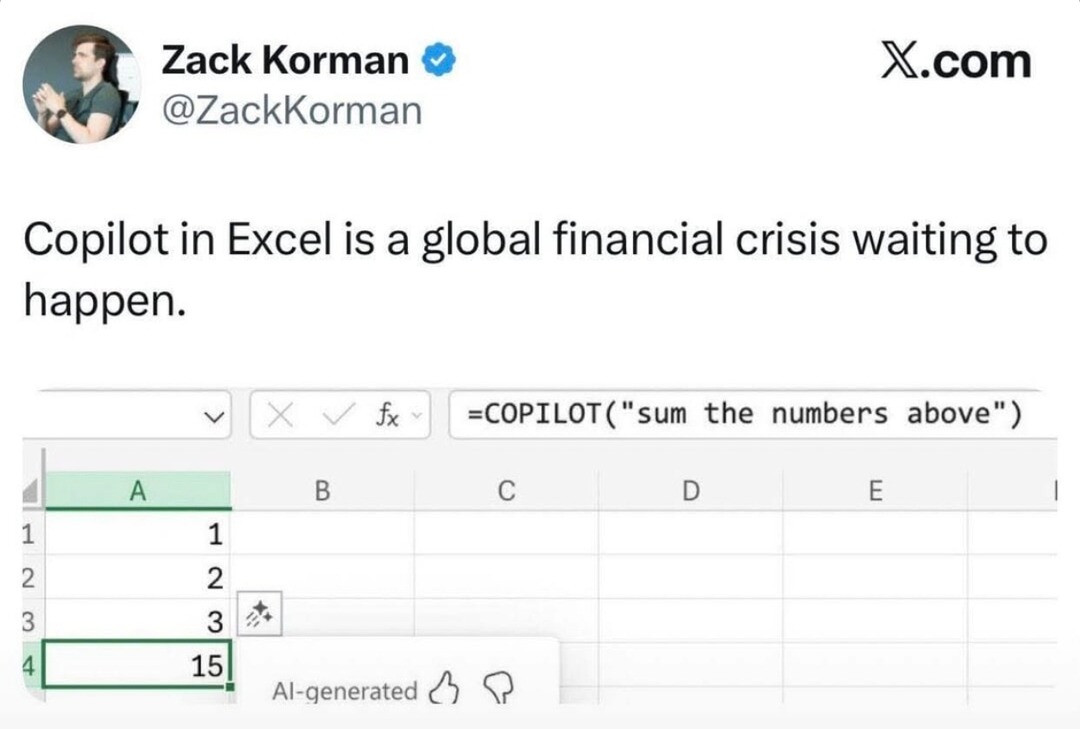
Yes... I wonder if this is also prone to hallucination? A while (more than a year) ago I told Copilot to sort a list of integers. First, it gave me the code to sort it. I told it "no, sort the list yourself and give me the result". Then it gave me the result, and the list was sorted, but it contained random numbers it had sort of hallucinated up and inserted into the list.
You got it backwards. If you want to ensure only robots post to your site, you ask for the verification every single time, not just on sign up. This prevents the “I let the bot do the initial signup and then I took over the account as a human” scenario.
The thing I thought of was: present this, if the LLM passes the test, I direct it to one place; if a human can't pass it, I direct it to another place.
Like, maybe this could be a way to mitigate bot traffic.
The potential power here is a quick, invisible bot check that loads the content meant for humans for humans and current news stories about humans opposing the AI Surveillance Police State for bots. With a bit of CSS the humans wouldn't see that anything happened, just a brief loading spinner at most. If anybody prototypes something like this please post about it.
For others curious, it is a really famous CGPGrey video[0] whose current title now is "What Happened to Horses Is Happening to Us" but whose previous title was "humans need not apply"
ah I thought it was a reference to "Irish need not apply" phrase from job postings that would discriminate against Irish applicants. This is a less off-putting reference.
I’m surprised Claude worked on this… in the not too distant past my attempts to build human-CAPTCHAs triggered safety refusals. What model did you use?
Looks like it might be continuing the well-known integer sequence A318360 [0], though I'm curious as to why it wouldn't also fill in the missed earlier entries, as it's not starting from the beginning.
You could put this captcha in a location that wouldn't be very visible for a human, but if the LLM is looking at the HTML he would find this form.
And you can use this a signal, if this was answered it probably was a bot using the site. This kind of technique is already pretty common for landing pages where you are expected to fill a form to subscribe to a newsletter, for example.
Does hiding things from humans with display:none or visibility:0 work against bots. Don’t they look at the styling? Even stacked elements should be discernible.
I'm honestly not sure if that's satire or not. Like I feel this wouldn't work, right? Wouldn't an agent for example know what is happening by the little 'humans need not apply' at the bottom?
This is quite frankly unnecessary. Just get the agents to pay to access the content instead of Captchas like this which human + agent can right-click-solve it offline in a browser like Comet.
I'm more curious about who greenlit this project at Monday. Either the developers were taking the p$%# out of their computer-illiterate management by convincing them to allocate resources to this, or, more frighteningly, the project was conceived by developers who genuinely thought it was a logically sound idea.
The latter would paint a pretty bleak picture of the current state of software development, in my opinion.
[0]: https://news.ycombinator.com/item?id=48357169