Hacker News new | ask | show | jobs
by xoa 3 hours ago
>And it raises the heat outside of buildings.

No it doesn't. Seriously, where does this meme even come from? It should be pretty obvious just from a solar insolation map that AC is just noise vs the sun. The energy usage is tiny vs vehicles or non-heat pump heating and only electric. What changes temperature overall is the balance of thermal retention by the atmosphere vs radiation into space, hence why net increases in GHG are so dangerous. And at the ground level similarly how heat is dumped to atmosphere. Greenery, whites, shade etc is good, asphalt, mass standard glass is bad (hence many cities being heat islands). Old, leaky units sure, we absolutely should work to reduce that. But it's astonishing how people claim AC makes the outdoors hotter so consistently.

3 comments

This simulation claims otherwise (though I agree it's hard to believe):

> A significant degradation of external thermal comfort can also be seen in the simulations, as heat released by AC systems warms the outside air (see figure 3). The temperature increases due to AC depend on the time of day and on the characteristics of the heat wave, mainly its intensity. On average, the duration spent under high heat stress conditions in the streets is increased by about 20 min per day because of AC.

https://iopscience.iop.org/article/10.1088/1748-9326/ab6a24#...

The way AC works is by transferring heat from one place (inside) to somewhere else (outside), and it takes energy to do this which produces even more heat, which is generally in the outside part of the AC system. This isn't something you can engineer away either, it's a result of the second law of thermodynamics.

Is that increase small compared to other things, like surfaces that absorb more solar radiation? Maybe. It depends on a lot of factors, but the amount it increases the heat of the outside is certainly non-zero.

The difference in ambient temperature due to air conditioning pumping heat outside is unmeasurably low. If all the power a city uses went to AC, it'd still be negligible compared with the sun irradiation on its surface.
Over the scale of an entire city, it might be negligable, I don't know, I haven't done the math. My guess would be it is measurable, but not a lot, probably less than a degree. But the GP said "no it doesn't" increase heat. I'm just saying that even if it is a very small amount, it does increase heat.

And if you stand near an AC unit, you can definitely feel heat coming from it.

You can reason it out (in a way that might make Fermi proud) pretty easily: a very large AC unit can be powered by a very small (relative) solar panel, where the solar panel is maybe 20% efficient. Thus, solar irradiation is substantially higher than AC power usage.
> No it doesn't.

Yes, it does. It may be small temperature increase but AC use increases outside temperatures. It is just physics.

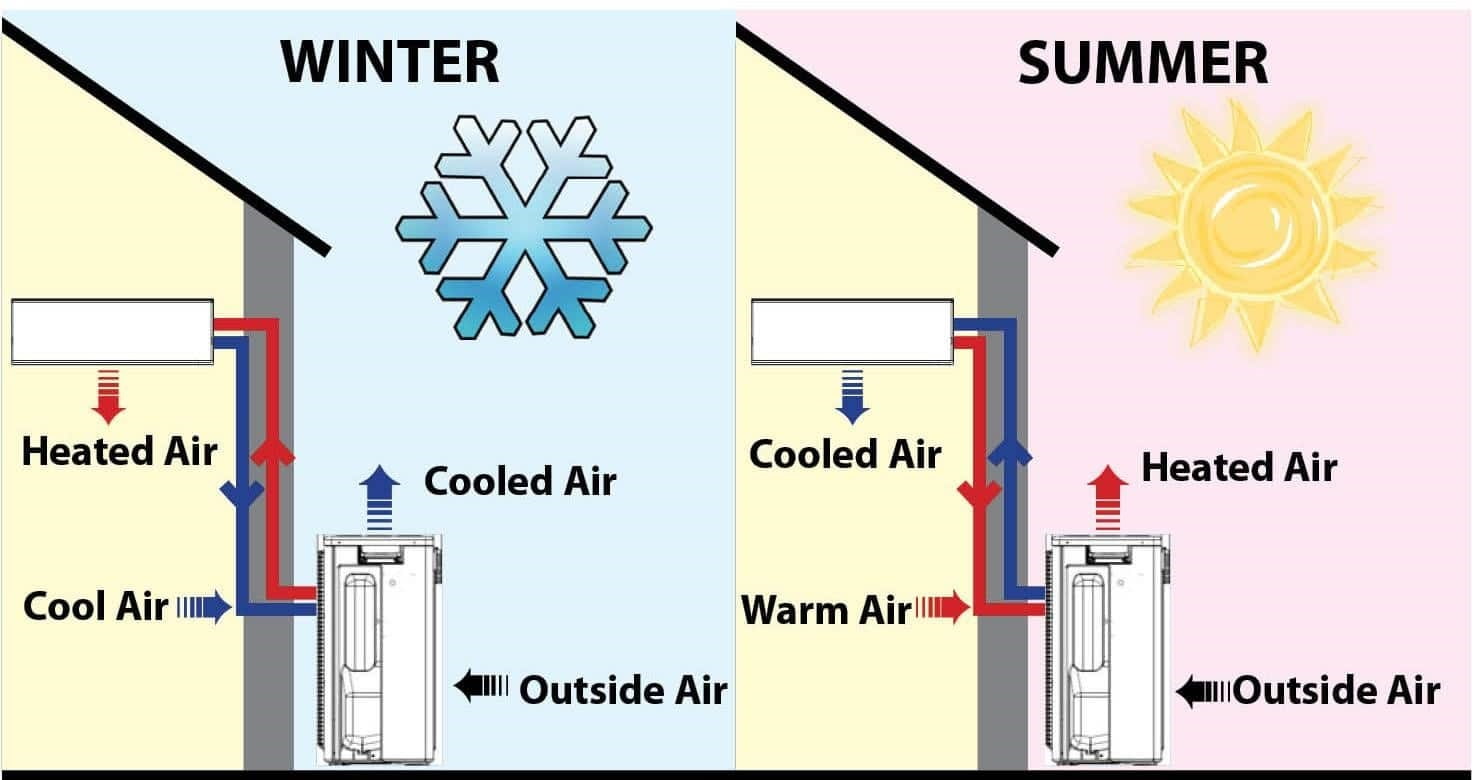
Here is a simple diagram: https://www.lozierheatingcooling.com/filesimages/heatPump.jp...

This effect is temporary. Otherwise one could run their AC once for a few minutes and then it'd be cold inside your home for the rest of the year until you turn up heating.

In reality equilibrium is restored quickly (and the thermal mass we're cooling/heating here is insignificant anyhow).

That heat goes out into the world, it doesn’t just disappear
The house being cooled by aircon is within the same world as everything else is.

This doesn't mean that there's zero heat added locally (as many seem fond of suggesting): The compressors and circulation blowers and fans don't run for free, and every Joule of electricity they consume is ultimately converted to a Joule of heat in a process that wouldn't occur in the absence of aircon. That's not zero.

But in very broad strokes, it's not very significant. It's somewhat akin to running a refrigerator inside of a kitchen.

With aircon, the refrigerator is the size a whole house. That certainly sounds huge, and it is huge. But that refrigerated building is inside of a room that is the size of the Earth's atmosphere, which is very obviously vast in ways that kitchens simply are not.

It doesn't really matter. Millions of homes with aircon don't mean much when the atmosphere is millions of times bigger than they are.

Eventually radiates out into space ;-) It doesn’t disappear, but we don’t need to care much about infrared passing Alpha Centauri.
Eventually yes, perhaps. But first heat gets trapped in Earth's atmosphere, because pollution and greenhouse gases make it hard for it to dissipate into space. It's called global warming, and no - it's not a hoax.
Except we have an lot of greenhouse gases that are really good at reflecting that infrared back down to earth.
The process of moving heat from your house outside also creates excess heat, because no AC system is completely efficient (and it can't be because of the second law of thermodynamics).
Give a chart with actual numbers on the increase in temperature versus the sun. Not a diagram from an elementary science textbook on how air conditioners work.
I’m not debating that the sun is stronger heating source. I’m just saying air-conditioning increases climate change because it uses fossil fuels and also the law of thermodynamics dictates that he will be created in this instance.
Air conditioners don't need to use fossil fuels. Solar power and AC work really well together because peak solar energy is exactly when you need AC the most.

No heat is created either, that would explicitly violate the first law of thermodynamics. An air conditioner powered by solar energy (or anything solar powered) ends up releasing the exact same amount of "excess" heat as the sunlight would have if it hadn't been absorbed by the panels.

They don't always overlap well -- certainly, not exactly. Thermal lag is a thing, and it is promoted by increases in both insulation and mass.

As an example of thermal lag: My present home doesn't have aircon upstairs. I've got a room with a west-facing window up there, and I just happen to chart temperatures in that room.

The daily temperature peaks in that room during the warmer months tend to happen at night -- sometimes, as late as midnight. The daily temperature minimums tend to happen around noon.

This suggests that solar power is least-useful for that particular room when solar availability is greatest. It doesn't overlap very well at all.

(I'm still looking into installing fairly modest solar rig, though, just to help offset my own baseload when I can and maybe make extended power outages more survivable.)

> An air conditioner powered by solar energy (or anything solar powered) ends up releasing the exact same amount of "excess" heat as the sunlight would have if it hadn't been absorbed by the panels.

Sure. But solar panels are intentionally designed to absorb a lot of energy. So if you are putting the panels over a dark surface, like asphalt, you'll probably have a net zero effect on heat. If you put them over something light colored, you are now converting more visible light that would have been reflected into space into heat. To be clear, that is still a lot better than burning fossil fuels, but it isn't completely free either.

You gotta take entropy into account too. Sunshine is high grade energy, infrared is low grade. Reflecting high grade energy is a huge waste. You could even (in theory) run a solar powered space-ir-dumper and end up with net cooling of earth.
> I’m just saying air-conditioning increases climate change because it uses fossil fuels

It would actually be a much better global warming mitigation strategy to install bidirectional heat pumps (A/C in the summer, heat in the winter) that runs on electricity (which is increasingly produced using renewables) and then get rid of fossil-fuel burning furnaces.

> it’s just physics

> provides diagram with zero evidence that AC meaningfully influences temperature

Clap, clap.

It does on my balcony where the fan pumps to, which has made doing any gardening difficult, but to the overall outside temperature it's just a drop in the ocean.
Sure. And each car is just a drop in the ocean of CO2. And each plane flight. And smoking one cigarette.

Humans have a really hard time understanding compounding risk. But there are billions of us. How many billions of drops can you handwave away?

8 billion people running a 2000 watt AC continuously for 8 hours a day = 5 trillion watts of heat. (Only the electricity consumed by the AC is turned into new heat. The heat from inside the house would have moved outside anyway, at the same rate, since it's an equilibrium)

The sun = 175 quadrillion watts of heat.

So I would say, the heat from running ACs is not significant. It's also additive with all the other existing forms of energy use we have. Unlike greenhouse gases, which are multiplicative.

It is worth noting that if the Air Conditioner is powered by electricity that came from solar panels, the net heat produced compared to letting the sun heat solar panel colored ground is exactly 0.

Air Conditioners do not produce a net heating effect unless you power them by burning fossil fuels.

Not net zero exactly, since it’s a flows and rates problem, not static equilibrium. So it could even be strongly positive effect or negative effect based on how quickly the heat gets radiated back into space depending on how the wavelengths interact with the surroundings and the atmosphere.

Our current cities and infrastructure are designed to be black heat sinks to soak up heat and hold onto it and ground level. But there is research into what would happen if we flipped that design around.

When you enact 0.1% changes through a population, that's still a 0.1% change.

"If we all do this little thing" thinking is utter nonsense. If all of human consumption or contribution to warming or what-have-you is 1000, applying a change that lowers that to 999 is not doing anything more than that.

This here is not even a 0.1% thing. You could probably get a better result by telling people to read ebooks rather than hardback. It's just absurd.