I moved from Indiana to Norway - Trondheim, which is about in the middle of the length of Norway. During the summer, I can read outside at night even though the sun technically goes down for about 4 hours in June. It never gets darker than twilight. A few clouds means you might just have sunset all night. The sun does get surprisingly hot and very warming if we happen to have a sunny day. Jacket in the shade, short sleeves in the sun even though it is 18C/65F.
The reason for this is that the sun is at a low angle, so it hits more of your body than it does when the sun is overhead - like you'd get in Australia. This also means that while you need some sunscreen during the day - from about 10 to 5 - it doesn't burn as much. It is less intense in that way - but it just feels different.
During December, days are 4 hours of very weak light.
> The reason for this is that the sun is at a low angle, so it hits more of your body than it does when the sun is overhead - like you'd get in Australia. This also means that while you need some sunscreen during the day - from about 10 to 5 - it doesn't burn as much.
Not sure if I parse this correctly - I'd imagine you need more sunscreen at "low angles" due to more severe and longer exposure? Low angle -> more body surface area exposed directly at near-right angle to Sun -> more direct absorption -> more sunscreen needed?
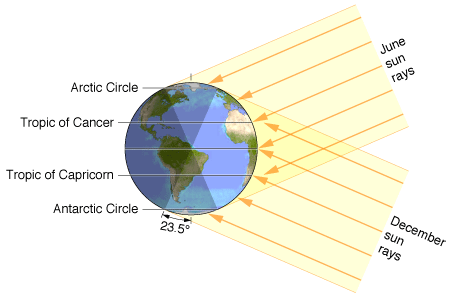
I’ve found the UV index forecasts to generally be a good metric, so try looking at those for various locations. The main factor here is that the lower the sun is from the horizon, the more its light will be absorbed by the atmosphere due to the longer path. The maximum altitude that the sun will ever reach is (90° – (latitude – 23.4°)), so at the 60°-ish of Scandinavia it’s rarely more than 50° in the sky. It’s a very noticeable difference even in the summer.
In my experience (born in southern Italy, pale-average, currently living in Sweden) it’s almost impossible for me to get sunburn in daily life in Sweden even without sunscreen. Definitely not so further south.
> it’s almost impossible for me to get sunburn in daily life in Sweden even without sunscreen.
Um most Swedes, even with not-super-pale skin get a sunburn every june. Just being outside in the sunshine for 2-3 hours without any protection and they turn "kräftröd" as they say.
Swedes have an almost comical compulsion to stay in the sun. Growing up in a hot place you get the opposite instinct.
Still, it’s known that your skin color is the main thing that matters, which is why Australians have the worst melanoma statistics. I guess mine tans fast enough to keep up with the seasons here.
This low angle situation must have been experienced by every adult I imagine, its just about being outside before dawn and feeling how sun's warming effect on the body is much stronger than few hours ago even though air temperature itself might have been higher before.
Since it hits body more perpendicular its not rocket science, I realized this around age 10 myself and I am not the brightest in the pack.
At the equator, the sun is highest at the equinoxes (March and September) and lowest at the solstices. Outside the tropics, the sun is highest at the summer solstice (June or December) and lowest at the winter solstice.
Exactly at the equator the sun is directly overhead (90 degrees) at a single time point (close to 12 on depending on where you are within the time zone) every single day
The only thing that varies over the year is the path it takes to get there. At the solstices (summer/winter) the path curvature is maximal while t the equinoxes (spring/fall) it is a straight line.
Yes, it's crazy to consider how far north Earth's entire land mass is skewed. Australia is basically the southernmost landmass (apart from Tierra del fuego), yet it is located squarely under the Tropic of Capricorn; at the same distance north of the equator (Tropic of Cancer), you've merely reached Mexico, the Sahara desert, and the Himalayas.
For non-Australians, that's burn as in "burst into flames", not "your skin goes red". Go to somewhere like Cairns and you can hear people crackling as they walk down the street.
Yes, because it's lower in the sky so more of the UV in it gets absorbed by the atmosphere before reaching the ground.
For example, in Florida in the summer, the sun is close to directly overhead at noon. In Scandinavia in the summer, the sun is only about halfway up the sky from the horizon at noon.
I moved from Indiana to Norway - Trondheim, which is about in the middle of the length of Norway. During the summer, I can read outside at night even though the sun technically goes down for about 4 hours in June. It never gets darker than twilight. A few clouds means you might just have sunset all night. The sun does get surprisingly hot and very warming if we happen to have a sunny day. Jacket in the shade, short sleeves in the sun even though it is 18C/65F.
The reason for this is that the sun is at a low angle, so it hits more of your body than it does when the sun is overhead - like you'd get in Australia. This also means that while you need some sunscreen during the day - from about 10 to 5 - it doesn't burn as much. It is less intense in that way - but it just feels different.
During December, days are 4 hours of very weak light.