Hacker News new | ask | show | jobs
by michaelmrose 2 days ago
This is basically a built in limit of X. The only exception is that monitors that support variable refresh rates may be able to offer this feature in multiple monitor configuration subject to software and hardware options.

I'm personally very dubious of the claim. This has basically never been supported because x treats all screens as one big screen unless you run multiple X screens which disallows moving Windows between screens which is a pretty big barrier to normal usage

3 comments

> unless you run multiple X screens which disallows moving Windows between screens which is a pretty big barrier to normal usage.

Is it? Or is it forgotten?

Around 1994 I had a Pentium 133 with 16MB. In it a Diamond Speedstar 24(Pro?) (Tseng ET 4k) Vesa Local Bus, some ISA Trident 8900, and an ISA Hercules, driving one 17", one 15", and the Hercules at something like 12" IIRC. One could choose in the BIOS which "GPU" ...err... frame buffer should have priority at boot, or rather which slot, so when you've chosen VLB it took that, and the others were a matter of the OS to initalize and drive way after boot.

At the time I compared 386BSD, NetBSD, SLS(Softlanding Systems), early Slackware and SuSE, and lo and behold, I could move windows across all of them on all of them!1!!

With proudly created custom modelines for all of them, even the Hercules, with different Hz & DPI for each screen.

Though it didn't really make sense, because X on the Hercules was very laggy and jerky, coz' 8-Bit ISA. Was more useful for syslogs and debugger.

Anyways, it worked, even if only as POC, to show off.

Now that wasn't Xorg, but XFree86, but still?

1994. Worky, worky!

IIRC that also applied to Accelerated-X, at least for the Tseng and Trident.

Didn't try the Hercules with X then.

In 1994 the only way to have multiple monitors was to run X with multiple X screens which did not allow moving windows freely between screens. In 1998 X11R6.4 brought xinerama and proper multi-head with many physical screens but only 1 X screen removing that complication.

May I submit that it is more likely that you are speaking of 1998 instead of 94 rather than this entire technology working differently.

> May I submit(suggest?) that it is more likely that you are speaking of 1998 instead of 94

No. I'm not pulling this out of thin air, or misremembering. It wasn't easy, and it wasn't in the manpages, or only some of it. It was rather involved, and didn't work on first try. Not only that X-thing, but also which TTY/VT was on which head for tailing syslogs, std-error, and whatnot else. But it worked. And with no X on the Hercules, just between the Trident and Tseng, even reasonably fast.

I remember exactly because I moved shortly after that. I also remember which relief Xinerama brought me, when it appeared :-)

Edit: I also remember frying the Hercules and the attached screen with both of them giving me the magic blue smoke, because I've overdriven them a little. But it didn't matter, because that was already abandoned cybertrash at the time, used, and collected just for fun :-)

> With proudly created custom modelines for all of them...

Yep. I remember that pride very clearly. I'm also so glad I never have to do that math ever again.

> SLS(Softlanding Systems)

I'd never heard of this one. If the claim that its slogan was "Gentle Touchdowns for DOS Bailouts" is true, then that's a really great pairing of distro name and slogan.

Come on...

Isn't that fun? https://nyanpasu64.gitlab.io/blog/crt-modeline-cvt-interlaci... :-)

TBH I've been mostly unimpressed with the early Linuxen. At the time they had almost nothing which NetBSD didn't have, and I knew that really well. Gentoo 'ricing' well.

But it was clear that there was momentum behind the Linux hype. It was on CD-Roms in magazines, in book stores. While *BSD wasn't known generally, just by some guys in Universities, or similar. Bad marketing. FUD because lawsuits, and whatnot else.

Such BSD, so sad...

> This has basically never been supported because x treats all screens as one big screen unless you run multiple X screens which disallows moving Windows between screens which is a pretty big barrier to normal usage

Hmm.

I'm not sure what windowing system you've been using over the past ~thirty years, but you seem to be unaware of both Xinerama (released in the late 1990s) and XRandR (version 1.2 [0] of which was released in like 2006). Maybe you've been using an X11 implementation provided by some proprietary *NIX for all of these years, but whatever you've been using, it has certainly been neither XFree86 or xorg.

> The only exception is that monitors that support variable refresh rates may be able to offer this feature in multiple monitor configuration subject to software and hardware options.

1) Monitors have been able to support multiple refresh rates for ages. This is a big part of why EDID and friends exists.

2) I note that VESA standardized Adaptive Sync in ~2009, and that VRR-supporting monitors were extremely uncommon in the consumer space until the introduction of GSync and the addition of Adaptive Sync to the DisplayPort standard... which both happened in ~2014. Add to that the fact that my secondary monitor does not support VRR, and it becomes very clear that VRR is not a prereq for driving multiple monitors at different refresh rates.

[0] IIRC, 1.2 is the version that gave it feature parity with Xinerama

Here:

amdgpu + x11 + xfwm4

  $ xrandr | grep -A1 ' connected' | sed 's/^/  /'
  eDP connected 1920x1200+0+240 (normal left inverted right x axis y axis) 286mm x 178mm
     1920x1200     60.03*+  40.02  
  --
  DisplayPort-0 connected primary 2560x1440+1920+0 (normal left inverted right x axis y axis) 597mm x 336mm
     2560x1440     59.95 + 200.00*  179.96   144.01   120.00  
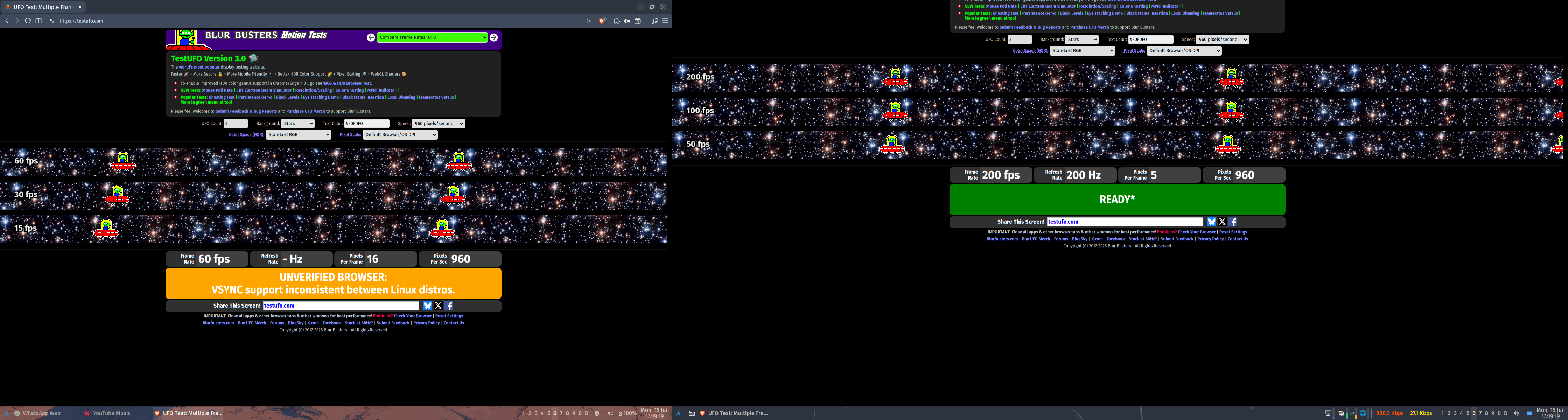
https://u.cubeupload.com/porridgewithraisins/img.png

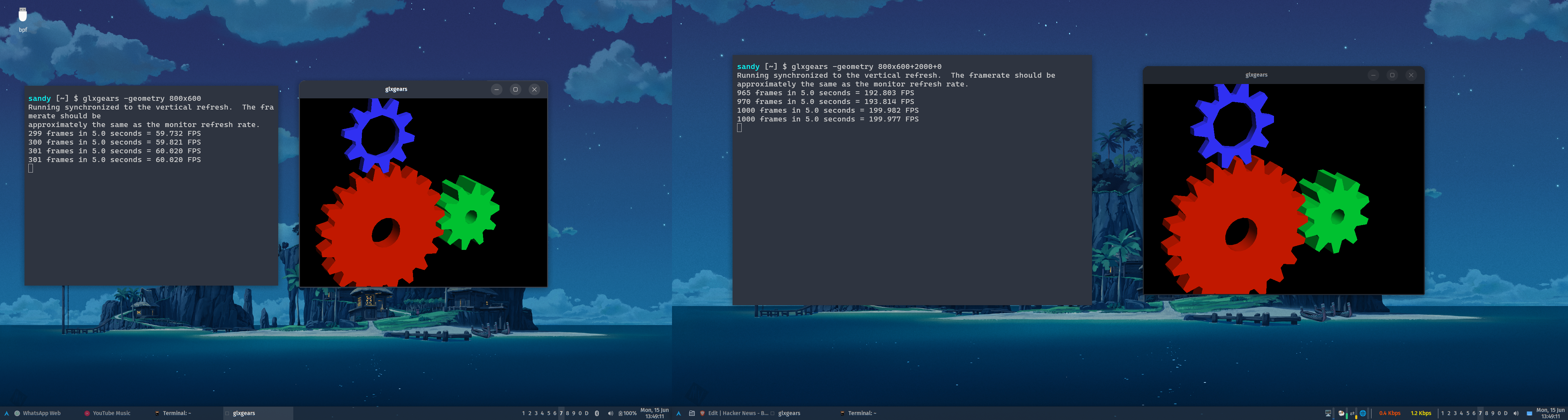
https://u.cubeupload.com/porridgewithraisins/img3.png