Hacker News new | ask | show | jobs
by ben_w 2 days ago
Bob is the marginal generator: the most expensive power plant that still has to run to satisfy demand in a given hour (or whatever the auction period is, I assume it's per hour).

Bob is not one single concrete thing, it's the abstract concept, anthropomorphised.

Germany's energy is expensive because the marginal generator is so expensive.

1 comments

The marginal generator is likely so expensive because solar was used to replace cost effective nuclear and coal plants.
No; nuclear and coal can't _really_ be used for peaking. They're too unresponsive. Peaker plants are pretty much always gas these days.
That's nonsense. Solar during overcast days is extremely and at night infinitely expensive by itself. You can't just take some average, you have to take expensive gas or battery backups into account when comparing to a stable energy source like nuclear or coal which doesn't need these backups.
> That's nonsense.

It's one of the industry standard metrics.

> Solar during overcast days is extremely and at night infinitely expensive by itself.

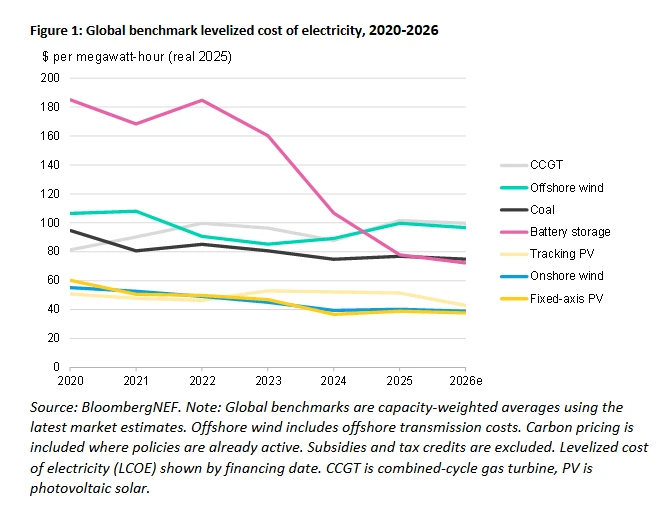
1. Note pink line's name: https://assets.bbhub.io/image/v1/resize?width=auto&type=webp...

(from article: https://about.bnef.com/insights/clean-energy/battery-storage...)

2. Literally everybody knows this. 2006 wants their memes back. Why do people bring this up without realising that demand is lower at night, with shops and factories being closed etc.? Even the duck curve thing is solved with just 1-2 hours of storage.

A quick DDG search says that other nearby countries with higher % of specifically solar (e.g. Luxembourg, Hungary, Netherlands), have lower consumer electricity prices than Germany, ergo solar itself isn't what's causing the high consumer prices in Germany.

And it's not like batteries are even expensive any more, at least not when bought in bulk.

> You can't just take some average,

Sure you can.

Consider a consumer with a constant demand (to make the maths easier, still works if not):

Option 1: use only the thing which works 24/7, but costs €1/kWh

Option 2: use the thing which works 50% of the time and while working costs €0.05/kWh, and the rest of the time go back to option 1.

Option 1 costs €24/day

Option 2 costs (50% * €1/kWh * 24h) + (50% * €0.05/kWh * 24h) = €12.6/day, or €0.525/kWh.

(PV is of course weirder than that, because it's shaped more like "Over the next 35 years it will emit X joules for your initial investment of Y money", so you're pre-paying for something, and also it's immune to any inflation, and there's a long side-discussion about financing here I'll skip as you seem to be refusing to accept even the fundamentals).

> stable energy source like nuclear or coal which doesn't need these backups.

They absolutely do need backups, their downtime is higher than you may expect.

This is, in fact, why even coal rich countries don't only use coal. Why nuclear-happy France doesn't only use nuclear. Etc.

Dismissing the cost benefits of renewables "because they need some kind of backup" is like dismissing the travel benefits of planes because the airspace around them gets closed every night, or like refusing to use a bike ever because sometimes you need to buy a new fridge and that won't fit on a bike trailer.

Or dismissing oil because of the two stupid wars currently going on, and how much they impact oil.