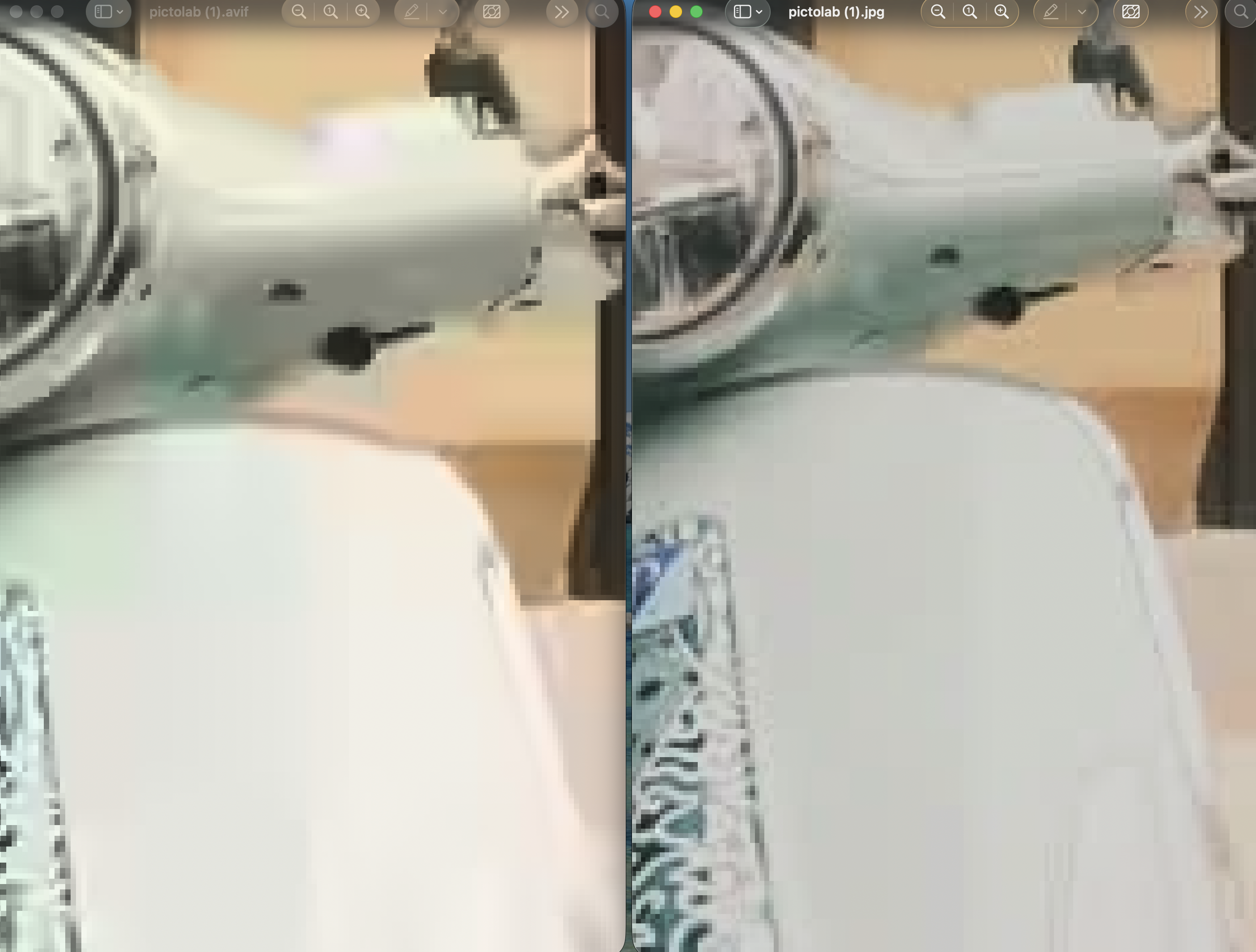
| > Hmm, I don't think so. I think at a fixed file size, chroma subsampling usually allows you to have fewer noticeable artifacts At low bpp, certainly. Though "certainly" is to be quantified since chroma is quite cheap in AV1, thanks to CfL. > Humans are so much more sensitive to luma that it doesn't make sense to treat it equally to chroma with respect to lossy compression The problem is that this is completely dependent on material. Sharp and/or bright red is too common a killer sample (cf https://gitlab.com/AOMediaCodec/SVT-AV1/-/work_items/2211). Make sense for video where you'll have a hard time seeing it, but for still pictures it's too problematic to apply indiscriminately unless you're encoding at potato quality anyway. > That said, if you don't like it, AVIF supports 4:4:4 just fine. I know, but libaom is basically a reference codec, SVT-AV1 is the only "real" one we got and it doesn't =( > In my tests, AVIF beats PNG easily for lossless compression of actual photographs You're right, I wrongly put photographs aside where AVIF certainly is better. It did "okay" in my tests (NB: ImageMagick doesn't do "lossless" RGB AVIF even with `-quality 100` unless you add `-define heic:chroma=444 -define heic:cicp=1/13/0/1`; you can verify with `magick compare -metric AE ref.png out.avif /dev/null`). > And for lossy, it's much smaller than jpeg At decent quality, is it that much better than jpegli (https://opensource.googleblog.com/2024/04/introducing-jpegli...) or even mozjpeg ? If we add FGS to the equation, AVIF has the potential to be much better, though. |