Hacker News new | ask | show | jobs
by plaidfuji 22 days ago
There may be additional major leaps forward, and there may not. I kind of struggle to imagine what the next step actually is. Certainly there will be improvements in performance (speed) and cost. But at a point you reach a barrier where the limiting factor is the specificity of the human prompt and our ability to manage all the code we’re generating.

Somewhat oversimplifying; writing software and building apps was a bottleneck - now it is not. What is the next bottleneck that LLMs can solve? Is there one? And is there enough publicly available data to solve it repeatably at scale? Or did we just automate stack overflow searches and now we’re stuck again?

Or is the endgame of this innovation cycle the complete removal of interaction with machines through code? Will we simply interact with machine coworkers purely through natural language? Can an LLM make PowerPoint slides and run a meeting? So far not seeing much progress on that.

3 comments

Judging from the fact that the Opus 4.5 inflection point was not really anticipated, and we still don’t really know what threshold was crossed that suddenly made agentic coding accessible to so many more people, I think it’s safe to say we don’t know what the thresholds will be until they’re crossed. The fact that we don’t know exactly what they’ll be isn’t a good reason to think there won’t be any more.
> The fact that we don’t know exactly what they’ll be isn’t a good reason to think there won’t be any more.

Nor is it a good reason to think there will be more.

We should expect to see the process slowing down first. Until then we should expect it to continue with pretty high likelihood.

https://substackcdn.com/image/fetch/$s_!_ZW2!,f_auto,q_auto:...

I think we have quite good reason to expect more. As I said, we already know (caveat with your level of irrational skepticism toward the overwhelming evidence) that the best existing models are better than the ones publicly available.
For what it's worth, at PyCon US this year I ran into a few people with access to Claude Mythos and they confirmed that it's notably better at writing code than public Claude Opus 4.7.
And there's a whole lot more evidence than that!
> caveat with your level of irrational skepticism toward the overwhelming evidence

If you can talk about my irrational skepticism (because I said that "we don't know the future", I suppose?), can I talk about your total lack of common sense?

Because the economy has been growing in the last decades does not mean that it will keep growing for the next decades. Because LLMs have been improving in the last few years does not mean that they will keep improving in the next few years. Maybe, maybe not, your guess is as good as mine. If you know the future, put your money where you mouth is and invest everything you own in LLM companies.

Your overwhelming evidence is about the past: it has been improving in the past.

I must have thought I wrote something that I didn't actually write in the previous comment — I can't figure out what "as I said" is supposed to be about.

In any case, maybe I was too subtle. I was talking about Mythos, a model that continues the trend, but which is not available to the public yet. The "overwhelming evidence" is the testimony of the people who have used it. The irrational skepticism was people who don't believe that testimony. In other words, we do know the future, because we know that model and others like it will come out soon.

Mythos is already here, you cannot use it for predictions just because you don't have access to it...

I just have an issue with all the people saying "I predicted this 10 years ago" (implying something like "you should listen to me, I make good predictions") while conveniently forgetting all the things they predicted wrongly, or the survivorship bias.

We don't know that AIs will continue improving at the pace they have, because we don't know the future. Some people will guess right, some won't. And those who guess right will be tempted to believe that they guessed right because they are more clever. All we can say is that it is possible that it improves, and it is possible that is stops improving.

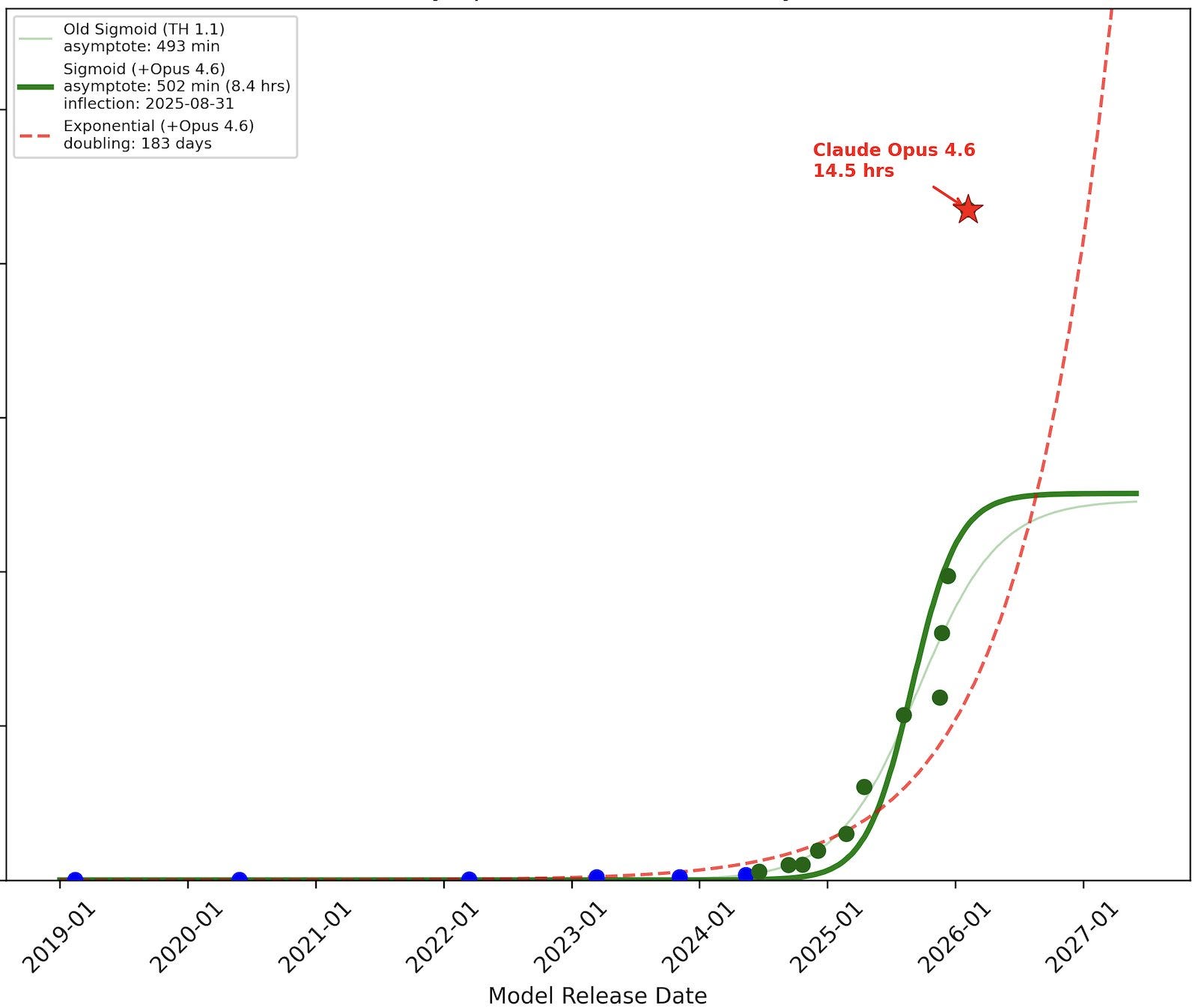
Based on how much money is chasing returns, and how steep the slope is, it's almost certain that we are still not at the end of this sigmoid cycle.

Sure, it might start to slow down, but even then we will likely see a doubling in the next 10-15 years.

https://substackcdn.com/image/fetch/$s_!_ZW2!,f_auto,q_auto:...

I am currently eating lunch. Meanwhile Claude is triaging and writing reproducers for 70+ tickets nobody has had time to look at. Next it will attempt to fix them. I have not read the tickets. I will not look at the code until there are review ready PRs and a code review bot have done the first pass.

In other words, most of the prompting will also go away.

Are you not concerned that you, too, will go away?
Feels like everyone should be on one hand. On the other hand it also feels like a massive recalibration of what companies can/should do. They spend massive amounts of money on AWS, Datadog, GitHub, CircleCi, et al. If it becomes easier to host/roll your own it's a big increase in the demand for engineers.

Ultimately software is everything these days and the economics make the demand insatiable. We've gone through many cycles of "X" but on computers/web/mobile. There's going to be a massive amount of "X" but with AI companies that will need engineers.

Or at least this is what I tell myself to sleep at night.

If I don't stay ahead of the curve, yes. But I can't stop that development. What I can do is leverage the technology enough to be more valuable than those who don't. By e.g. knowing how to set up processes like the above.

Ultimately, we'll need UBI or large scale cuts in working hours or similar if AI progresses to the point of mass unemployment - the alternative would be massive social unrest. In the meantime I expect to keep doing better than average.