If you ignore everything that happened in between 1903 and today, it might seem like we've never made any progress on this, but at least in the US wealth inequality was demonstrably not as much as an issue for some of the time in between. For a time in the 20th century, it was possible for someone solidly middle class in the US to be able to save up a bit of money and afford a down payment on a house within a decade of working. That's something we've lost to time now, and it's not because it's impossible to achieve or because of the bogeymen of DEI making the fruits of labor and technology too sparse to share with everyone, but because an increasingly large portion of the pie is going to an increasingly smaller set of people.
The delta between 1903 and today in this regard might be small, but the line between them isn't flat, and that makes it even more tragic and frustrating to have this questioned as if it's an impossible problem.
I do agree that the US handled the situation relatively well in the second half of the 20th century, plenty of such opportunities have been squantered badly.
But we cannot ignore that it was truly a unique opportunity:
- The US was the only intact industrial country left after WWII.
- With massive momentum from industrial deployment during the war.
- With a massive optimistic and hardened workforce coming home.
- With plenty of saved wartime income they didn't have a chance to spend due to rationing and shortages, a lot of it saved as wartime bonds just starting to deliver healthy yields.
- With the New Deal that resulted from the horrible Great Depression making sure they got to truly benefit from the fruits of their labour.
- And a wide-open global market to lend to and to sell to for rebuilding the world.
That is not something that can be replicated easily at any time, and if the US makes decisions expecting that that is the norm, there's a disaster coming (perhaps it's why it's a disaster now).
It was not only in the USA. Even in developing countries like Brasil, the post-war was an era of great material improvement for the worker class. Industrial employment was coveted, and blue collar work definitelly landed you in the middle class.
The biggest difference between the US and other countries was the scale. Proportionally more workers benefited, and they benefited more in the US in the post war, as the US was by far the more advanced industrial power.
But, removing the scaling factors, the history is the same. Home ownership was once in the realm of possbilities for most workers, at least industrial workers, and this is no longer the case, and now even most white-collar professions are having issues with that.
Yeah, that's basically the point I was making. The fact that it was this way before and is again now might lead someone to think that there's nothing we can do about it, but clearly there was something we did about it, and now we've lost it again.
It did absolutely change, a lot, it was one of the main themes of the 20th century: revolution. In the old sense of the word, turning the social order upside down.
It took many forms: capitalist social democracy, communism, fascism, feminism... Left or right, without making a value judgement, they were all revolutions seeking to empower the working masses.
Of course, when you get rid of kings, it's really really hard to make sure the vacuum is not filled by something even worse. Credit where credit's due, as a European, I do believe that the US is one of the few cases that was somewhat successful in not completely bungling this opportunity (although there's the detail of slave labour, and the conquest of natives...).
And after many-many horribly failed attempts, much of the world did end up in a relatively healthy state around the second half of the 20th century. Fukuyama's end of history and all.
Now we seem to be regressing again. Perhaps it's part of the eternal cycle and it was always coming. Perhaps it's not actually regressing all that much, and it just looks like it to our coddled selves, or we have become more ambitious on what we think is right. Perhaps people have found new loopholes (tech) on how to get ahead and dominate the rest of us, and we just need to catch up and get it under control again.
Perhaps that quote from 1903 is relevant now, but it doesn't mean that it was relevant the whole time since. Perhaps it was, I wasn't there.
There's been plenty of examples of workers seizing the means of production and establishing sustained non-capitalist organization (State or otherwise). We have any number of strategies to choose from: The PRC, Soviet Union, Syndicalized Spain (my favorite, seems the least likely to lead to police state), Vietnam, Cuba. The question thus isn't "how," but more specifically a couple other questions: "How do we prevent capitalist forces from liberalizing our movement (PRC, Soviet Union)," "How do we prevent fascists from killing us all (Syndicalized Spain)," "How do we prevent becoming a state-capitalist police state that halts the revolution (PRC, Soviet Union)"?
Can someone explain what it even means to seize the means of production?
Like if the means of production is land, and you are seizing land, sure that makes sense to me.
But most goods are not made by land alone but by machines and factories and transport systems and etc. If you seize those as preexisting entities, what happens after you seize them? If you as a group can operate and expand those things, can’t you just build them yourselves also, and if so there is a way to work within the existing framework to do that, which is to start a company. Is seizing the means of production not equivalent to starting a company and stealing things others have built for the company to get started with? Why is that a good thing?
Like I personally agree that wealth accumulation is bad if it has political power go along with it, and there are huge problems with our system and lots of debt formats should be made illegal, I just don’t get why anyone thinks “seize the means of production” is the answer and I feel like I might be confused about what that really means.
If a landlord owns 500 homes and tenants pay off the mortgage, maintain the place, and generate the income stream, who is really taking from whom?
"Seizing" kind of sounds like theft. If McDonald's employees at one shop in Pasadena Texas suddenly stopped sending money up the chain, isn't that theft of that particular McDonald's shop? I say no, because the theft has already occurred, but legally: faceless profiteers at wherever McDonald's is headquartered stole the land from the locals in Pasadena for the purpose of generating profits for people in NYC. Their labor and the surplus value of same is stolen to actualize and maintain those profits.
"But McDonald's provided the equipment, training, advertising!" Yes, and long after the value of that equipment, training, and advertising is "paid off" (the given franchise has achieved profitability), the headquarters will continue to steal surplus value from the local workers. Indefinitely.
Why don't Pasadena McDonald's employees just build/buy their own equipment, start their own burger shop, call it something other than McDonald's? Because society is designed to serve the needs of McDonald's shareholders, not Pasadena minimum wage McDonald's employees: they could never get together the kind of capital needed to do so. Get a loan, investment? Sure, now they're in the same situation: someone is extracting the surplus profit off their labor, and nobody's gonna go for a loan to a bunch of minimum wage Pasadenans without a very juicy potential profit margin.
Capitalism is structured around exclusion: capital, land, patents, credit, licenses, distribution networks, rent, and monopoly advantages are already controlled. The era of "just compete with McDonald's" is long dead.
> Is seizing the means of production not equivalent to starting a company and stealing things others have built for the company to get started with?
So to answer your original question, "seizing the means of production" doesn't mean "starting a company." Within the context of capitalism, you could do what I did and start a co-op, which is a worker-owned entity where profits are distributed equally, so no theft of surplus. However that's not a sustainable solution to the overall problem of capitalism because we will never have the kind of capital accumulation that allows much larger companies to start influencing governments or engage in lawfare. If AKQA decides to eat us, there's not much we can do to stop them. Also all institutions of capitalism are against us: nobody wants to give us loans or an investment, it's stupid hard to navigate bureaucracy, the very formation mechanisms are so much more complicated than when a business is a simple minority shareholder owned corp. On the other hand our members make way more than local rates (3x, sometimes more) and are much happier than AKQA folks, and our client outcomes are phenomenal, so idk, everyone should convert their business to a co-op.
Sorry, rambling. Seizing the means of production doesn't mean taking people's toothbrushes, it means abolishing the right of an owner class to control the productive infrastructure everyone depends on and extract profit from other people’s labor simply because their name is on a piece of paper.
Means of production: land, factories, warehouses, tools, machines, logistics networks, software infrastructure, housing, energy systems, water systems.
Seizing means transferring control away of the means of production from distant profiteers, to the people who actually build, operate, and maintain those means.
Incidentally this shifts priorities away from pure profit and usually to things that are better for the workers and users: compare the incentives and impacts of Linux versus those of Microsoft.
Seizing can look like: occupying, collectivizing, expropriating, squatting, unionizing, converting firms to worker control, building commons, abolishing intellectual property, refusing rent, creating parallel distribution systems, and making capitalist ownership unenforceable or irrelevant.
Too long, did read but replying to a granular supporting point at the beginning not to the whole idea. Which isn’t to say I dismiss the whole idea, this is just how my brain processes arguments. If an argument relies on a certain support, I like to check in on the supports and not just accept or refute the argument.
> If a landlord owns 500 homes and tenants pay off the mortgage
So I agree that this situation feels like a scam, and I think that feeling is based on human instinct and so it is in a way just objectively true (since unfairness is fundamentally defined by that instinct).
But, what is inducing this unfair situation?
Is it the part where someone owns the land and the building and someone else pays them to use it?
Or, is it the part where some third party gets to decide who can use its money, which is to say “who is in the club”, and people outside of that club pay both the third party and the people in the club for basic necessities, without which they will die. In essence they are held hostage and must pay their own ransom. And the reason that’s ostensibly fair under the current moral regime is that club membership is… itself determined by money.
Do we think that part might be the root cause of the unfair feeling in this situation?
Please do respond to my specific point here as I’m curious to engage and I’m not trying to nitpick you. If you just respond with a dismissal such as “the argument doesn’t rest on this point”, then I will conclude your overall argument is not sound (whether due to being insufficiently thought through or whether due to being fundamentally invalid, I don’t know, but I don’t feel it’s my responsibility to figure that out and I can just dismiss the claim until someone comes along with a more well structured argument).
What is inducing, or what is unfair? I understand that liberals (actual definition, not American) may feel that a good rigid analysis would determine that land ownership is fine so long as we can solve the boy's club problem of wealth concentration meaning a few landlords own most of the land, or that a small subset of people are financed such that they can own most things. That's what you mean, right?
So along these lines the idea is, we can keep doing private property (this is different than personal property - toothbrushes), so long as we solve the "unfair" imbalance that leads to coercive landlord relationships?
Sure, I'd rather live in that world than this one.
But, for once I get to wear the anarcho-communist hat, so I'm gonna give my full commie answer: no, private property isn't fair, natural, normal, or sane. It is the root cause of the wealth concentration, the boy's club, and the feeling of unfairness.
Capitalism's inevitable end stage is wealth concentration, because fundamental to capitalism is the idea that money == power, after all, the amount of capital you have determines the amount of resources you get to decide how to distribute. So eventually, you get enough to where you can make decisions about whether to put a plant in Pasadena or Deere, Texas, and whichever town gives you the more permissive legal situation is the town you choose. Lobbying, lawfare. The instruments of the State, no matter how well designed by moral liberals attempting to prevent club membership being determined by money, are chipped away by you and your friends. This is compounded by the fact that most people are happy with what they have and just want to get on with their lives, but the corporations are capitalistically unable to do that: they HAVE to constantly grow, or they're not delivering good shareholder value. Only so many directions to grow. So they overwhelm the energy of humans who just want to chill, get a mountain of small decisions passed that make their lives unfair.
The unfairness is around the exclusion. 500 property landlord isn't just due to money concentration - it could be inheritance (yes that's wealth concentration but only because we consider land to be wealth), cronyism, or domination (go look up how most of the land in Taiwan was acquired, or in the UK, and how that land never really left the families it was given to by actual military conquerors).
It's not fair that one person/entity can arbitrarily exclude access to what traditionally is the commons - we're talking about housing right now but I mean all commons, land, network infrastructure, water. It's not fair that they can charge rent to access those commons for all of forever, despite the fact that the only reason those commons have any value at all is the existence of the community that needs it. The relationship is inherently interconnected but for some reason the money moves one way and only one party gets to say how the resources are distributed, and it's not the party with the actual needs! Which in the real world leads to detached corporations and individuals making bad decisions about resource distribution because of their distance from the need or because they're trying to maximize profit, which leads to capitalist insanity like leaving fields fallow despite workers wanting to work and people needing food, but crop prices aren't high enough to justify planting, growing, and then selling the food in a market, so fuck yall, we chained up the commons due to changing marker conditions.
It's not fair that people have to justify their labor's value to capitalist markets instead of the needs of their community. It's not fair that access means of that labor can be shut off based on the whims of markets or, don't forget, a petty human (remember that dumb beach access gate thing in California a couple years back?). Wealth concentration is an inevitable symptom of this system and therefore not the core problem.
Even under less wealth concentrated private property, a landlord can still evict a tenant that doesn't want to be evicted. That's unfair.
The hard part seems to be for the workers to keep the means of production after they are taken. In all those examples, you end up with a leadership that owns everything nominally "on behalf of the people". If anything, democracy gets the closest to that ideal, a compromise with all it's flaws.
Well, it's rather patronising of of me to call that "the hard part", after all the terrible struggles workers have gone through to earn a seat at the table, but you know what I mean.
While this is certainly the more interesting question, the unfortunate reality is that the ideological complex of capital (even if weakening, and no longer effectively reproducing itself) is still strong enough that most in the West can't even imagine a better world (other than "less bad capitalism"), much less think about how to get there. Consequently messages like the above are of great value in moving more people towards a point where questions like yours become relevant.
Well, in that case, my "how" has always been along anarchistic lines: establishing parallel forms of resource distribution, establishing habits and communities of mutual aid, and in doing so, delegitimizing and rendering obsolete the State, capitalism, and systems of hierarchy.
Fun techcentric utopian speculation about this: Cory Doctorow's "Walkaway" and Ruthanna Emry's "A Half-Built Garden."
Essentially, can we leverage our current post-scarcity society to expropriate everything people need in a sustainable way that cuts capitalism and the State out of the loop? For example, why would people buy food if they can get it for free from farming syndicates or similar? (see: Global Village Construction Kit, Food Not Bombs, Food Not Lawns) Why would people buy medicine if they can print it for free from pirated recipes? (see: Four Thieves Vinegar Collective)
I see the Right to Repair and FOSS movements as a foundation to build upon for this. Anarchism (or at least, anti-capitalism) exists right under everyone's noses, in all the FOSS software installed on their computers. Existent example of people laboring without profit motive and contributing to the commons.
My personal life goal is to figure out how to capture that same energy to tackle the bottom layers of Maslow's hierarchy.
I really like the sound of that, but these proposals never acknowledge the monumental challenge of truly incentivizing people to help each other, beyond shallow niceties.
I'm not entirely cynical, people generally are very open to be generous with one another and collaborate for a common good, but up to a point.
Currently people spend the majority of their hours doing relatively hard work for the collective's benefit (kinda). Exactly because capitalism makes selfishness into selflessness (very kinda). Also people are relatively civilized to one another thanks to the considerable latent force of the state's monopoly on violence.
People will be nice to each other when it doesn't cost them much and/or when the opposite costs them dearly. But will they work as hard as now for each other just to be nice? Will they not harm each other when there are no significant consequences and something to gain?
A fair free market is far from a natural phenomenon, it needs to be protected and maintained by some external force. If you let things unfold naturally, what you get is kings, and many layers of dominating hierarchy underneath, exploiting the masses, which exactly what we had the whole time.
I suppose that the post-scarcity idea is that people neither need to work hard, nor have significant reasons to harm, if they have everything they want. Sure, let's talk if we ever get there, but until then we have other problems to deal with.
PS: Don't forget that people are able to do FOSS because they have well paid jobs that don't completely drain them of their energy. For others, getting the reputation and/or experience for a better job is the incentive. There's a very different social infrastructure making that work, FOSS doesn't sustain itself, not even close. But yes, it does prove that when people's needs are covered, some of them will do great things for everyone without much incentive, but usually not enough to cover everyone's wants.
I really like this comment, you are outlining exactly the sort of things that our society has convinced us are ground state truths, that are actually just capitalist norms enforced by the State.
I really think you'd enjoy Peter Gelderloos' "Anarchy Works," because you can keep asking "but what about..." and the book will keep giving you examples from history to answer that exact "what about?"
To your points:
First, people don't do hard work for the collective benefit, they do it for the benefit of the owners of capital, who allow just enough leftover profit for people to keep themselves alive and for very little else.
A lot of that hard work isn't for the good of society, it's bullshit work that maintains artificial scarcity and the systems of capital, like the entire beast of health insurance in the USA, military procurement, landlord administration, advertising, corporate compliance rituals, or predatory lending.
Second, capitalism doesn't turn selfishness into selflessness, it rewards and selects FOR selfishness, and punishes and selects AGAINST selflessness. Why publish FOSS under MIT, the most selfless choice, when a major tech company will then just take the library, make money off it, and give you nothing in return? Why contribute to FOSS deployed by a big tech company when that contributes directly to a big tech company's bottom line for nothing in return to you?
Capitalism doesn't create incentives through rewards, it redirects people's inherent incentives towards less socially useful or rewarding projects that instead serve the needs of capital and the state. I read a lot about motivation to understand it in myself better, and one thing that keeps coming up as core to motivation and happiness is finding it inherent to a given activity, achieved through improving at and mastering that activity, and then being recognized for that improvement and mastery. Then, potentially, introducing novelty by finding something else to improve at and maybe master. Basically, humans love work, especially when it's useful or they can become good at it. Capitalism creates structures around this to try to redirect that labor to things that are useful first and foremost to capital.
Third, yes, a free market paradoxically requires regulation to maintain or it tends towards wealth accumulation, monopoly, and then as exploitative a labor relationship it can get away with - slavery, if it can manage. The free market is thus impossible because under capitalism, capital is power, and capitalism is a system designed for the accumulation of capital. More capital means you can chip away at the rules, which means more capital, which means less rules for you, and so on, until you get situations like today, where billionaires can diddle our kids and there's quite literally nothing we can do about it: the State's monopoly on violence is serving them, protecting them from us.
Fourth, people aren't considerate to each other because of the state monopoly on violence, they are considerate in spite of it, and despite the incredible violence the State and forces of Capital subject them to. Daily interactions are anarchist: you don't shove people out of the way on the street because it's illegal (depending on how you do it, it might not even be illegal), you don't do it because it's rude, it's antisocial, it will make people hate you, and because do it enough and you might yourself get slugged. Multiply this to basically every interaction, and then consider that the State isn't preventing the Big Crimes anyway like rape or murder, and itself facilitates the most widespread form of theft: wage theft and theft of profit. It doesn't stop or punish pollution, billionaire child rape, eviction, exploitative loans, or corporate fraud.
The State's monopoly on violence doesn't prevent domination, it enforces authorized dominion.
Will people work when there's no cash to gain? Well as you said, if their basic needs are met, why wouldn't they? If they don't have to dedicate at minimum 40 hours of their week to generating profit for some billionaire, what else might they spend their time on, and for what reason? Would they even need to work 40 hours a week if they aren't upholding systems of capital? Is their exhaustion inherent to the human social experience or an artifact of the artificially scarce society we've created? They already don't shove people out of the way on the street, there's probably some kind of social instinct there, right? What about you, in what ways would you contribute to the world around you if the world around you was already ensuring your basic needs are met? Would you look for ways to ensure the sustainability of those basic needs? Seek to improve comfort and delights? Seek to defend against exploitative forces?
I'm all in favour of grassroots experimentation and a search for something to improve upon, and then replace capitalism. This is how capitalism itself came about and spread, though we can argue about how much it was imposed after it ceased being the underdog.
What I am weary of is that such experimentation, and the energy it generates, will eventually be overtaken by the next iteration of people who want to stop nibbling at the margins and break a few eggs already, some sort of anarchist revolutionary vanguard. Much like with communism, skilful opportunists with a thirst for power will be all too happy to take over this energy and direct it toward building the next totalitarian regime, one which will of course claim to be rendering the State obsolete, but will be about as anarchist as North Korea is a people's democratic republic.
That's an important point. It's so hard to think of a better system, if you take the task seriously and actually think through all the consequences of each option.
As a result, as usual, the loud people that ignore all the details end up capturing everyone's imagination with a good story, and we stumble upon yet another century of nightmares.
Do you truly have a answer for a social architecture that is substantially better than a capitalist social democracy, flawed and compromised as it is? Because I really don't if I'm being honest with myself, and I am yet to hear one.
I don't have the mental power at this moment to write out my full thoughts on the subject so forgive my rambling thoughts that follow (an aside- withdrawing from SSRIs is an _unpleasant experience_)
I think the problem I find with arguments that Capitalism is the best/least bad system tend to be that they start from a false premise, in my opinion. I have a friend who makes the joke all the time that any system of government works if people were just nice to each other, but he has a point. I often hear that "oh, communism doesn't work because humans are inherently selfish." That's true, if you believe that humans are inherently selfish, but my counter-point to that is asking how much of it is innate vs. how much of it is trained by our culture and reflects back in those communist attempts because the sudden change in social architecture didn't give enough time to 'train it out of' the culture.
Back to the thing my friend says - if you believe that communism doesn't work because humans are inherently selfish/greedy/etc, I'd say to you also that capitalism is currently not working _because humans are being selfish and greedy_ in a system _that explicitly rewards that_. Which, maybe is worse. Not as in the outcomes are worse immediately than Soviet Russia etc. but for the long-term trajectory of human society.
I don't pretend I have an answer for how we can get from point A (capitalist system) to point B (future space communism) in a way that slowly shifts human thinking towards mutual aid and collective action, but I think it's short-sighted to assume that the way humans act in a system that rewards greed/selfishness is innate.
> the unfortunate reality is that the ideological complex of capital (even if weakening, and no longer effectively reproducing itself) is still strong enough that most in the West can't even imagine a better world (other than "less bad capitalism")
That's one way to put it. Another perspective (mine) is that capitalism enables anyone to try and make things better, and if you make things better for the right user, they will reward you.
As others have said, that's basically anarchism, except for this bit:
> It is a fundamental principle of social philosophy, fixed and unchangeable, that one should not withdraw from individuals and commit to the community what they can accomplish by their own enterprise and industry.
Which is flagrant lassaize faire capitalist propaganda, but that's ok, because it's not possible to point to something an individual can accomplish by their own enterprise and industry - such things simply don't exist because we don't have superheroes, we're all the outcome of society.
You don't have to be a superhero to be solidary. Subsidiarity goes against this idea of the necessity of an all encompassing centralized state. There are things that are better done at the local level.
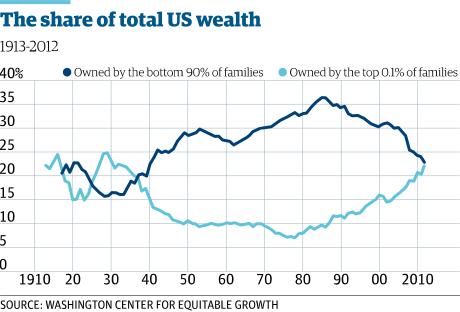
The delta between 1903 and today in this regard might be small, but the line between them isn't flat, and that makes it even more tragic and frustrating to have this questioned as if it's an impossible problem.